AI and computing power have become common topics at various technology exhibitions. This year, the exhibition at the Wuzhen Summit's Internet Light Expo showcased the differentiation in domestic computing power supply, with super-node systems becoming a new trend in the industry, as well as players focusing on edge computing power solutions.
Several industry experts interviewed mentioned that computing power has risen to become a strategic infrastructure, on par with water conservancy and power grids. With the changing demands of intelligence, customers are more concerned with whether the output of computing power is effective and economical, and computing power infrastructure is also shifting from scale expansion to competition in system efficiency.
"Computing power demand is experiencing explosive growth"
At the Internet Light Expo, reporters from Yicai saw that intelligent agents had become an integral part of daily life and office scenarios, and were also being integrated into fields such as healthcare and industry. For example, Ant Afu helps with health management, Abao arranges travel plans, Lingguang focuses on handling routine tasks, and there were also exhibits showcasing enterprise intelligent agent super factory solutions, among others.
In addition to this, large models in both general and vertical fields also made their appearances. Humanoid robots equipped with the Ant Lingbo model worked in pharmacy scenarios, selecting and delivering prescribed medications for visitors; with the assistance of sewing large models, unskilled workers were able to operate AI sewing machines; there was also a plant DNA large model exhibited by a company, which could AI extract potential molecules to improve the utilization rate of components.
The development and application of these large models and agents are inseparable from the support of computing power.
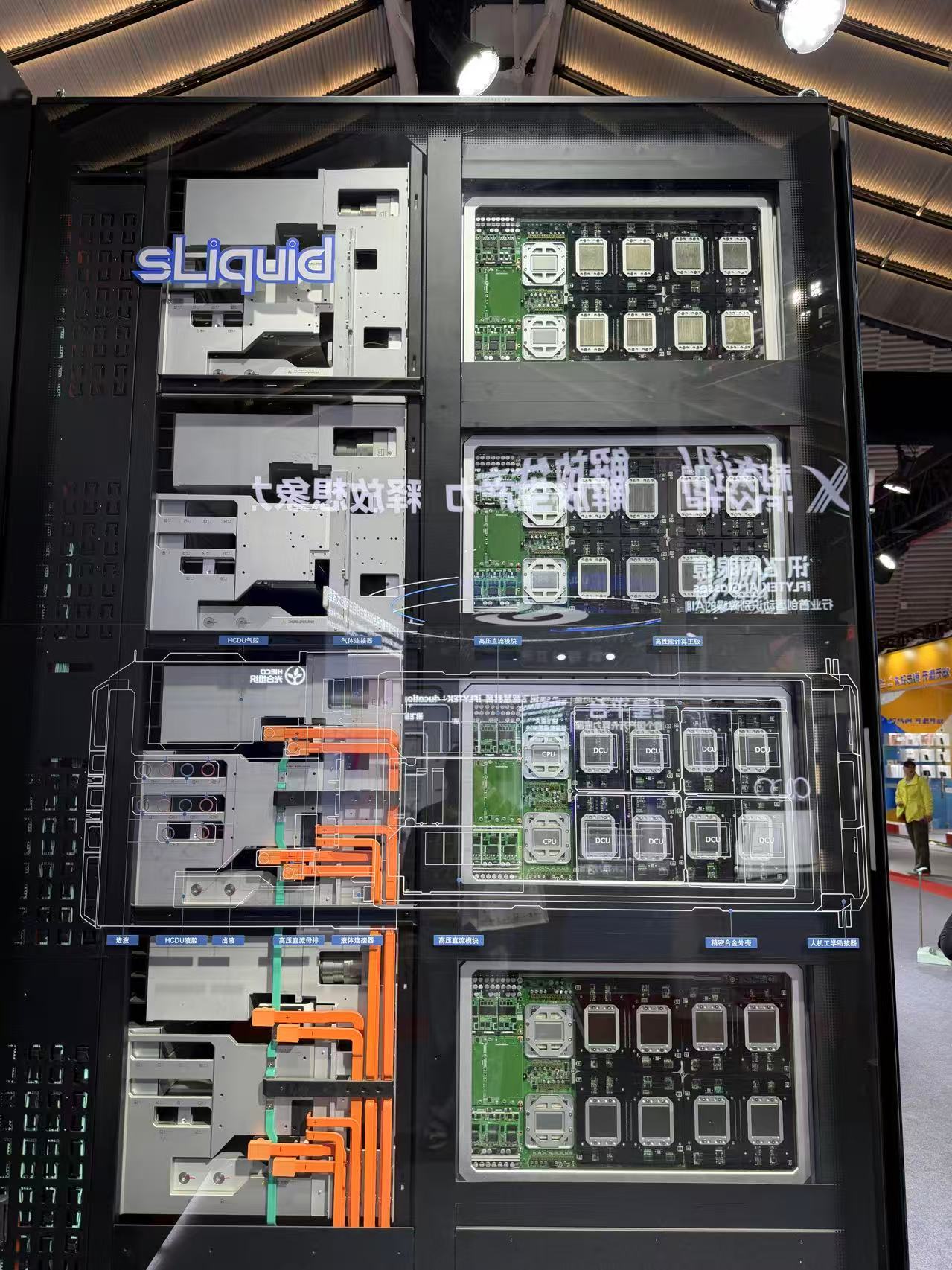
The computing power products exhibited by multiple companies on the main road of Hall A of the exhibition are also a microcosm of the surge in demand. Among them, companies such as Alibaba, Dawning Technology, and ZTE Communications have presented super-node systems, which combine thousands of computing cards through high-speed interconnection and unified memory addressing to physically form “supercomputers.” There were also companies like Yuntian Changxiang that focused on edge computing power, using distributed nodes to deliver computing power closer to users and applications.
Taking Inspur 8000 as an example, this is a domestically produced 100,000-core AI supercluster. Bu Jingde, the company's chief engineer for high-end computing, introduced to reporters that the Inspur 8000 belongs to a super-intelligent integrated system that can not only perform traditional scientific calculations but also meet the needs of large model training.
"For example, in the field of astronomical research, the computational resolution in the past was not high enough, making it difficult to compare simulation results with experimental science. This system can improve computational resolution, and the results generated can also match theoretical predictions," said Bu Jingde. He noted that training large models requires high standards for the stability of the entire system and the ability to continue calculations from where they were interrupted, and this system is capable of meeting these requirements."
Yuntian Changxiang mainly targets customers with a need for reasoning capabilities. In an interview, Xu Gongmei, one of the company's co-founders, mentioned that since the first quarter of this year, they have noticed a explosive surge in demand for computing power.
"One wave comes from Coding (programming), and another wave comes from AI short dramas. These two groups are currently the definite customers willing to pay," Xu Gongmei explained. Originally, the company's customers were concentrated in fields such as game rendering, cloud gaming, and video live streaming. In recent years, providing computing power for model generation has gradually formed a second growth curve, and this new business now accounts for a significant proportion of the company's revenue.
Some industry insiders also mentioned that there is a shortage of high-end computing power, and many large companies have placed orders in advance to secure these resources. In addition, due to the surge in demand for inference capabilities, customers' priorities have also changed.
Bu Jingde observed that in the past, customers purchasing computing power might focus on peak values, but now they are more concerned with the output of effective computing power, that is, the amount of Token that can be produced per unit of time. “What they are concerned about is whether the cost of computing power can be balanced, which involves system engineering optimization and performance improvements,” he added.
Super nodes enhance system efficiency, while edge computing power is leveraged through base stations to reach more remote areas.
Changes in customer purchasing preferences also mean that the evaluation criteria for computing power will expand from single-machine performance to the infrastructure level.
The "2026 China Artificial Intelligence Computing Power Development Assessment Report" released in September this year mentioned that simply expanding the scale of computing power is no longer sufficient to meet the continuously growing demands for intelligence. AI Infrastructure is shifting from scale expansion to competition in system efficiency.
Li Jun, the chairman of Dawning Technology Group, also stated in his speech that in the future, the competition in computing power will not merely be about the peak performance of individual chips, but rather about the system's ability to efficiently organize a large amount of computing, storage, networking, power, and other resources.
In response to this, multiple companies have proposed differentiated solutions for their super-node systems.
For example, Dawning Technology Group Co., Ltd. has chosen a high-density architecture. Its scaleX640 design enables 640 cards per single cabinet, which increases the computing power density by 20 times compared to similar products. It is also possible to form a thousand-card-level computing unit by combining two cabinets. Moreover, it adopts immersion phase change liquid cooling technology, which can reduce energy consumption.
ZTE Corporation staff also mentioned that the OEX super-node they demonstrated achieves high-bandwidth and high-density integration of 128 cards within a single cabinet. It adopts an orthogonal backplane-free interconnection architecture to address issues such as severe signal attenuation and poor reliability in high-density scenarios that are common with traditional cable solutions. Additionally, this product breaks through the “communication barriers” associated with large model training.
As a company that provides edge computing power, Yuntian Changxiang has made considerable efforts in intelligent and efficient invocation and real-time delivery, and has proposed a strategy called "Real-time Intelligent Computing Networking."
Xu Gongmei stated that the company mainly has a deep integration with telecommunications operators, deploying its products at base stations or computing nodes through cooperation. Currently, there are over 200 nodes in China, covering more than 300 cities. “Nowadays, the number of 5G base stations nationwide has exceeded 5 million, and we can utilize these base stations located across the country to deliver computing power. There’s no need for us to reinvent the wheel,” he added.
Behind this layout is also the support of the "integration of computing and networking" policy orientation. Previous relevant policy documents pointed out that it is necessary to be guided by scenario requirements and explore the deployment of inference computing power in edge devices of 5G/5G-A networks, IP networks, and new types of industrial networks.
In addition to this, the infrastructure for computing power is also facing transformation. Some industry insiders interviewed mentioned that as hyper-node systems become the new trend, the traditional data center capabilities in terms of load-bearing capacity, energy consumption, and power supply no longer match those of new cabinets, so they will need to undergo a new round of renovation.
Article Author