Key Points
- XRPL Developers have built an experimental native perpetual futures infrastructure
- RLUSD may support leveraged trading and margin accounts
- Proposed upgrade to introduce 10 new types of transactions
The developers of XRP Ledger Foundation have constructed an experimental implementation of native perpetual futures trading, which could enable leveraged crypto derivatives to run directly on XRPL and use collateral assets such as the stablecoin RLUSD from Ripple.
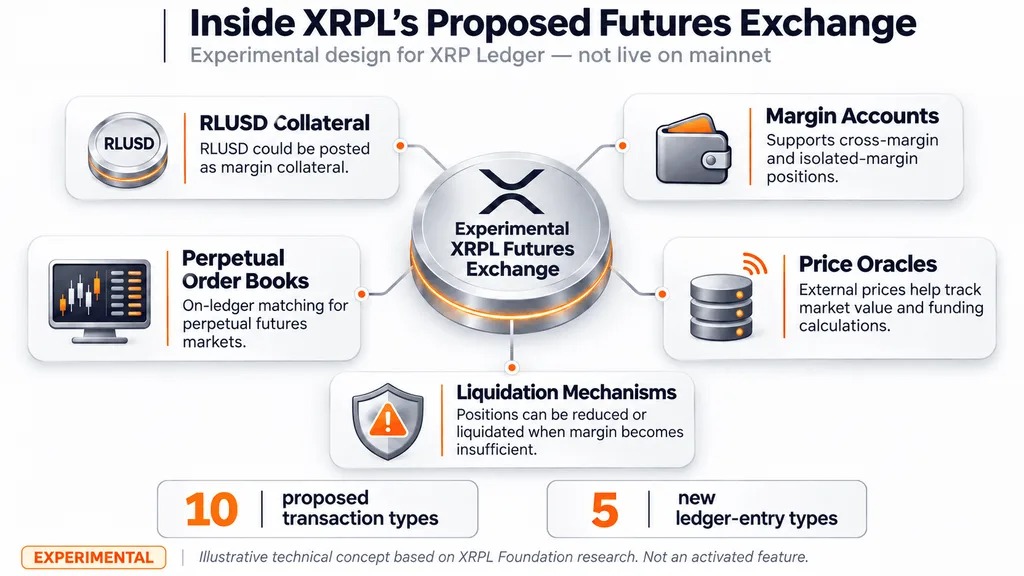
According to a technical study released by the foundation on November 4th, the proposed system introduces 10 types of transactions and 5 types of ledger entries, covering margin accounts, order matching, funding fee payments, and forced liquidations.
This implementation contains approximately 15,070 lines of handwritten code, distributed across 81 files. However, it is still an experimental development branch and not an approved network upgrade at this time.
XRP Ledger Developers building native futures infrastructure
The proposed PerpetualFutures amendment will allow operators to directly establish derivative exchanges on XRP Ledger.
Unlike traditional futures, perpetual contracts do not have an expiration date. Traders can maintain leveraged long or short positions, and regular payment of funding fees helps to keep the contract price in line with the underlying market.
This architecture supports two trading modes: full-position margin and per-position margin, with collateral being deposited into a dedicated account.
It also introduces price oracle calculations and settlement processes for managing positions when available margin is insufficient.
This proposal is different from XRPL's previous concept of a derivatives sidechain. The latter explored providing leveraged trading and options through independent infrastructure.
RLUSD may directly bring derivative transactions to XRPL.
The proposal also attempts to bridge a significant gap between the trading business of Ripple institutions and XRP Ledger itself.
Ripple Prime has provided institutions with access to derivatives trading through Hyperliquid, including around-the-clock swap transactions covering over 100 markets.
Eligible customers can use RLUSD as collateral, but these underlying perpetual markets operate outside of XRPL.
According to the feasibility study by the foundation, as of November 4th, the open interest of XRP contracts on Hyperliquid amounted to approximately 219 million US dollars.
A native exchange might ultimately strive to capture a portion of that trading activity.
However, this development will not automatically lead to adoption by institutions.
Previous concerns regarding the liquidity of the Ripple Prime perpetual market indicate that market makers and sufficient trading depth are still of paramount importance.
The proposed infrastructure may also complement the existing RLUSD collateral arrangements for institutions, however, at present, no participating institution has committed to using the native XRPL perpetual exchange.
Why hasn't this futures upgrade been ready to go live on the mainnet yet?
This technical study estimates that development will require 320 hours, with an additional 560 hours for review. Additionally, two external security audits will need to be conducted.
Additional review, audit, and integration costs are estimated to range from $331,000 to $387,000, excluding the initial development hours.
There are still no conclusions regarding key issues such as liquidity, the reliability of price predictors, control by collateral issuers, and how to handle losses during the liquidation process.
This proposal is also independent of the native lending upgrade of XRPL. The latter obtained 60% support from validators on November 6th, but it is still below the activation requirement.
Even though the code has been completed, formal review and governance approval are still required. The latest security amendment XRPL indicates that the activation of features depends on the continuous consensus among verifiers.
Marcus Hale
Marcus Hale is an author who covers Bitcoin, Ethereum, digital assets, regulation, the adoption of ETF, and the crypto and financial markets by institutions. His work focuses on influencing market dynamics, investor trends, as well as the broader forces that shape the crypto economy.