Core Points
- Dow Jones tumbles 849 points amid market uncertainty
- Morgan Stanley expects the S&P 500 to rebound to 8,700 points
- NVIDIA's financial reports and Federal Reserve policies continue to influence market sentiment
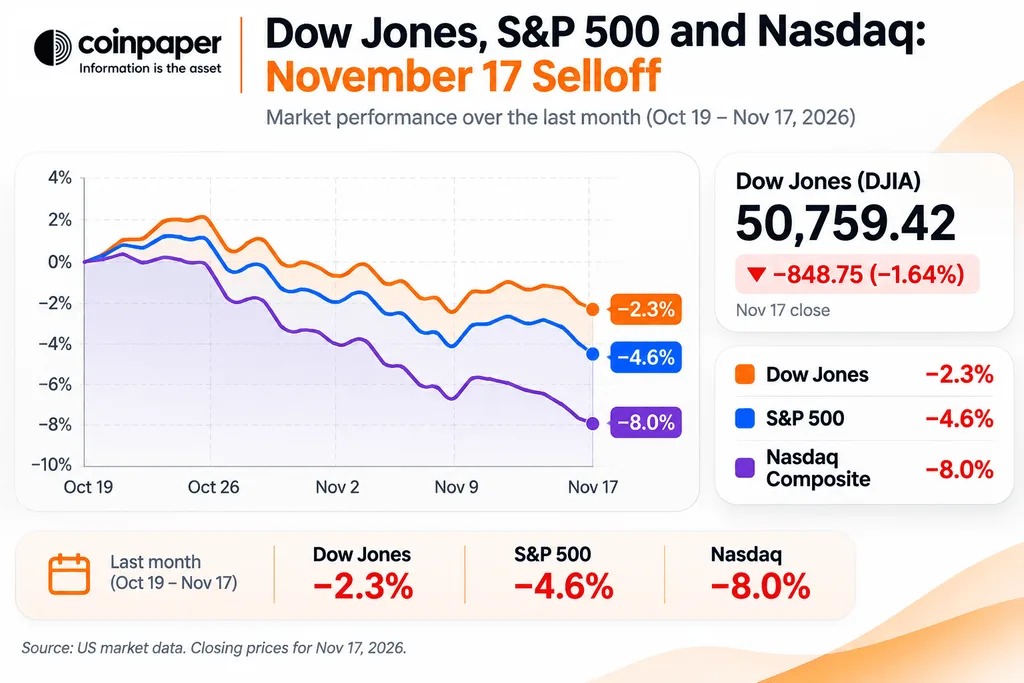
After a sharp drop of nearly 850 points on November 17th, the Dow Jones Industrial Average is once again facing a test of investor confidence. Nevertheless, Wall Street strategists are increasingly believing that the broader stock market is expected to rebound in the coming year.
On Tuesday, the Dow Jones closed at 50,759.42 points, down 1.64%; the S&P 500 index fell 1.03%; and the Nasdaq Composite Index declined 0.74%. This pullback continued a broader stock market correction, driven by investors' concerns regarding the valuation of artificial intelligence, corporate spending, and interest rates.
Why is the Dow Jones still falling despite bullish forecasts?
The Dow Jones has recently weakened, reflecting growing concerns in the market regarding corporate profitability and the outlook for monetary policy.
This difference also helps to explain why the Dow Jones Industrial Average may still fall even though tech stocks rebound. Previously, there has been a similar divergence in the performance between NASDAQ and the Dow Jones Industrial Average.
Higher borrowing costs remain another obstacle. On Wednesday, the yield on the benchmark 10-year U.S. Treasury note hovered around 5.1%. Federal Reserve officials warned that persistent inflation may require further policy tightening.
According to the Federal Reserve's official calendar, the minutes of the October policy meeting are scheduled to be released on November 18th.
Investors will be watching whether policymakers still remain concerned about inflation, and how these concerns may affect the interest rate decisions in December.
Morgan Stanley expects the S&P 500 to reach 8,700 points
Despite recent market sell-offs, Morgan Stanley has still raised its global equity allocation to the highest overweight level, citing improved valuations and expectations for stronger corporate earnings.
The target level for the S&P 500 index at the end of 2027 suggested in this report is 8,700 points, while it closed at 7,340.53 points on Tuesday. If this level is reached, there would be a potential increase of about 18.5% from the current closing price.
This forecast is based on the expectation that corporate profits will continue to grow, with supporting factors including the wider adoption of artificial intelligence and a more stable financial environment.
Goldman Sachs also made a forecast that the S&P 500 would reach 8,700 points, but it expects slower profit growth in 2027.
However, this outlook is directed at the S&P 500, not the Dow Jones index itself. A broader recovery in the stock market does not necessarily mean that both indices will experience the same degree of increase.
Can NVIDIA's financial reports help Wall Street rebound?
This chip manufacturer announced record quarterly revenue, reaching $115.8 billion, and expects sales in the fourth fiscal quarter to be around $130 billion. The strong performance forecast boosted the stock price of NVDA during the preliminary trading after the market closed.
However, compared to technology benchmark indices that are weighted by market capitalization, NVIDIA's impact on the Dow Jones, which is weighted by price, is much smaller.
This difference is important because if the upward trend is mainly concentrated in artificial intelligence stocks, it may support the Nasdaq and the S&P 500, but it may not necessarily bring the same degree of increase to industrial, financial, and consumer companies.
Recent concerns about profitability in the retail sector also indicate that strong demand for technology does not necessarily mean that the entire economy remains confident.
About the Author
Maya Bennett is a financial journalist whose coverage includes cryptocurrencies, stocks, and broader market trends. Her work focuses on Bitcoin, major digital assets, the stock market, monetary policy, as well as economic developments that influence investor sentiment. She is adept at transforming rapidly changing market news into clear and concise reports.