
I'm absolutely fascinated by $ORE and $JLP.
Why?
$ORE is becoming Solana's native hard currency.
Fair issuance.
Limited supply.
No venture capital.
$ORE brings a new perspective to Store of Value (SoV) mining. It eliminates the value loss Bitcoin suffers from due to electricity consumption and redirects that value back to the buyback mechanism.
Similar to $JLP. You know how much I love $JLP.
Both are pure activity capture tokens.
$JLP absorbs trading volume from Jupiter Perps.
$ORE absorbs native "mining" trading volume from Solana.
As on-chain activity grows, both tokens will continue to create value for holders.
They are Solana's primary yield engines.
414
0
0
49
Edgy - The DeFi Edge 🗡️
06-25 09:38
フォロー
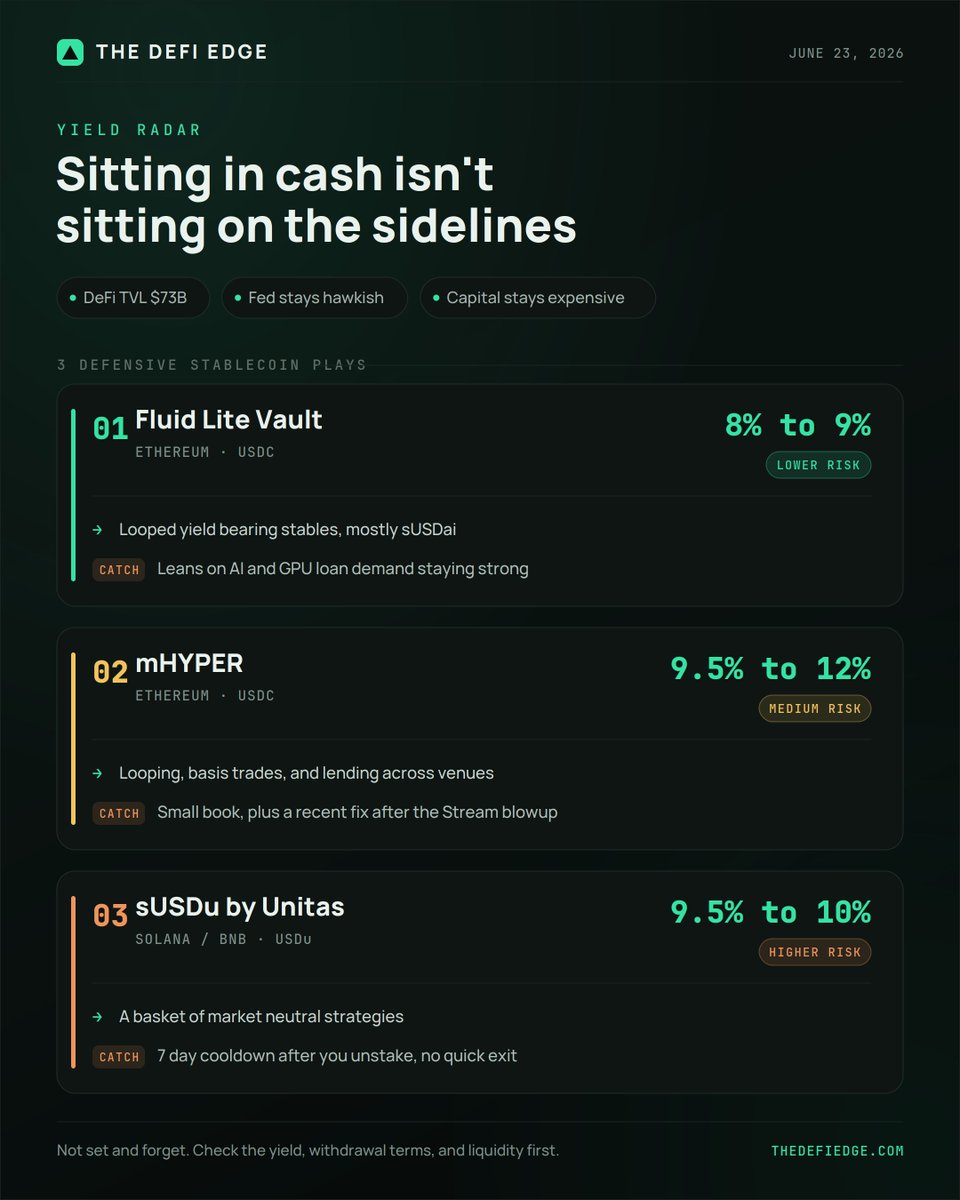
Stablecoin yields remain incredibly high.
I spent some time researching several popular investment opportunities and found that their return strategies vary.
Some invest in government bonds, some engage in basis trading, and others rely on market-neutral trading strategies.
Here are three stablecoin products with annualized yields of approximately 8-12%, along with their respective advantages and disadvantages:
#1 - Fluid Lite Vault (Ethereum) Annualized yield approximately 8% to 9%
Deposit USDC to earn from a revolving yield stablecoin. This is the lowest risk of the three products and the one I'm least worried about.
About 70% of the returns come from sUSDai, which is the truly noteworthy part. sUSDai's returns come from US Treasury bonds and interest generated from loans used by AI companies to purchase GPUs. Yes, you read that right. The success of the entire return depends on the stability of demand for AI.
In addition, there is a 0.05% withdrawal fee. During the KelpDAO liquidity crisis, instant withdrawals were disabled regardless of fees.
#2 - mHYPER (Ethereum) Annualized yield is approximately 9.5% to 12%
Operated by Hyperithm, a licensed firm with branches in Tokyo and Seoul. Yields come from circulating stablecoins, basis trading, and lending.
mHYPER has a relatively small asset base (approximately $120 million), making it less experienced compared to large asset management firms like Gauntlet. It was also affected by the Stream Finance incident. The team has withdrawn bad positions and quarantined vaults, but frankly, given the short time since the fix, I'm still closely monitoring its performance.
Using the normal redemption method (1 to 3 days) avoids the 0.5% instant withdrawal fee. Also note that a 20% performance fee is charged on yields.
#3 - Unitas' sUSDu (Solana or BNB) offers an annualized yield of approximately 9.5% to 10%.
This is the most transparent of the three. It boasts reserve verification from Primus, DeFiLlama, and Dune, is audited weekly, and has over 100% backing. If transparency is your priority, this product will give you peace of mind.
Yields come from a range of market-neutral strategies, funding rates, lending, transaction fees, and JLP capture. Essentially, it's a synthetic dollar.
A point to note is liquidity. There's a 7-day cooling-off period after unstaking. And your funds will stop yielding indefinitely.
So, only put money here that you can leave untouched for a week or two.
However, this isn't a one-size-fits-all solution. Yields will fluctuate, withdrawal terms can become harsh in the worst-case scenario, and liquidity can disappear quickly if things go wrong (like with KelpDAO).
All that I just explained, the total yield is 8-12%.
What are you browsing while you're waiting?
437
0
0
48
Edgy - The DeFi Edge 🗡️
06-24 20:52
フォロー
Stablecoin yields remain incredibly high.
I spent some time researching several popular investment opportunities and found that their return strategies vary.
Some invest in government bonds, some engage in basis trading, and others rely on market-neutral trading strategies.
Here are three stablecoin products with annualized yields of approximately 8-12%, along with their respective advantages and disadvantages:
#1 - Fluid Lite Vault (Ethereum) Annualized yield approximately 8% to 9%
Deposit USDC to earn from a revolving yield stablecoin. This is the lowest risk of the three products and the one I'm least worried about.
About 70% of the returns come from sUSDai, which is the truly noteworthy part. sUSDai's returns come from US Treasury bonds and interest generated from loans used by AI companies to purchase GPUs. Yes, you read that right. The success of the entire return depends on the stability of demand for AI.
In addition, there is a 0.05% withdrawal fee. During the KelpDAO liquidity crisis, instant withdrawals were disabled regardless of fees.
#2 - mHYPER (Ethereum) Annualized yield is approximately 9.5% to 12%
Operated by Hyperithm, a licensed firm with branches in Tokyo and Seoul. Yields come from circulating stablecoins, basis trading, and lending.
mHYPER has a relatively small asset base (approximately $120 million), making it less experienced compared to large asset management firms like Gauntlet. It was also affected by the Stream Finance incident. The team has withdrawn bad positions and quarantined vaults, but frankly, given the short time since the fix, I'm still closely monitoring its performance.
Using the normal redemption method (1 to 3 days) avoids the 0.5% instant withdrawal fee. Also note that a 20% performance fee is charged on yields.
#3 - Unitas' sUSDu (Solana or BNB) offers an annualized yield of approximately 9.5% to 10%.
This is the most transparent of the three. It boasts reserve verification from Primus, DeFiLlama, and Dune, is audited weekly, and has over 100% backing. If transparency is your priority, this product will give you peace of mind.
Yields come from a range of market-neutral strategies, funding rates, lending, transaction fees, and JLP capture. Essentially, it's a synthetic dollar.
A point to note is liquidity. There's a 7-day cooling-off period after unstaking. And your funds will stop yielding indefinitely.
So, only put money here that you can leave untouched for a week or two.
However, this isn't a one-size-fits-all solution. Yields will fluctuate, withdrawal terms can become harsh in the worst-case scenario, and liquidity can disappear quickly if things go wrong (like with KelpDAO).
All that I just explained, the total yield is 8-12%.
What are you browsing while you're waiting?
497
0
0
31
Stephen | DeFi Dojo
06-16 01:11
フォロー
Day 227 – Day 106 of the War
Trump: Iran Nuclear Deal Scheduled for Signing Tomorrow
Iranian Foreign Minister (Previously): Specific Signing Time Will Not Be Tomorrow – Signals from All Sides Divide
Trump: No Money Deal, “We Look Forward to Cooperation with Iran”
Iranian Foreign Minister: Iran Will Charge for Services in the Strait of Hormuz
The Possibility of Signing the Islamabad Memorandum in the Coming Days “Cannot Be Ruled Out”
UAE: Denies Unfreezing Frozen Iranian Funds
MSCI: SpaceX Included in Standard Stock Index and Large-Cap Index
Investment Firms Join Trump’s $100 Billion Venezuelan Oil Race
---
Fear and Greed: 20 – Extreme Fear
Bitcoin: $64,240 | Ethereum: $1,676 | HYPE: $59.9
---
@HyperliquidX — 3x Long
BTC 3x: +$0.83 (+6.4%)
ETH 3x: +$2.63 (+6.7%)
AAVE 3 3x Leverage: +6.39 USD (+12.2%)
MORPHO 3x Leverage: +10.91 USD (+36.8%)
ETHFI 3x Leverage: +6.09 USD (+8.7%)
ENA 3x Leverage: -2.49 USD (-8.6%)
---
@lighter_fi — PENDLE 5x Long Position
Profit/Loss: -363.15 USD (-121.74%) | Capital Gain: +5.47 USD
---
@boros_fi — Interest Rate Swaps
HYPEUSDC: Paid 9.24% | Gained 10.95% | Profit/Loss: -16.74 USD
SOLUSDC: Paid -3.58% | Gained 2.63% | Profit/Loss: +5.82 USD
BRENTOILUSDC: Gained -35.99% | Paid 63.65% | Profit/Loss: -$12.21
---
@pendle_fi — Fixed Income
AVLT: +$145.55 (+28.19%) | Annualized Return 28.09%
USDG: +$31.95 (+11.83%) | Annualized Return 4.47%
sUSDD: +$23.55 (+14.62%) | Annualized Return 6.97%
fxSAVE: +$18.75 (+68.52%) | Annualized Return 8.39%
savUSD: +$10.83 (+3.44%)
jrmHYPER: +$5.26 (+3.59%)
USD Midas mROX: -$1.19 (-2.07%)
jrUSDat: -$4.71 (-48.99%)
superUSDC: -$10.03 (-8.72%)
sUSDS: -$17.30 (-5.55%)
USD3: -$26.56 (-17.73%)
eTHIRD: -$44.85 (-23.19%)
Saturday was @pendle_fi's profit day—$95 profit earned today.
---
@defituna — SOL/USDC 3x Leverage
Within Range | $1 = $170 | Entry Price: $69.341 | Execution Price: $68.179
Profit: +$14.70 | Profit/Loss: +$0.33
---
@byreal_io — Tokenized RWA Liquidity Provider
JLP-USDC: $891.81 | -$98.07 (-9.78%)
CRCLx-USDC: $434.36 | Annualized Yield 9.77% | -$73.85 (-13.92%)
METAx-USDC: $349.07 | Annualized Yield 4.22% | -$9.31 (-2.56%)
MSTRx-USDC: $211.59 | -$88.99 (-29.11%)
AMZNx-USDC: $195.94 | Annualized Return 7.00% | -$1.49 (-0.73%)
SPCXx-USDC: $26.47 | Annualized Return 84.69% | -$0.06 (-0.23%)
---
@prjx_hl — HYPE LP
HYPE/USDT0: $479.40 | Annualized Return 209.57% | Unclaimed Profits: $18.84
Total Fees: $128.35
HYPE/USDC:
$2,157.97 @ Annualized Return 103.50%
$385.76 @ Annualized Return 40.30%
$29.24 @ Annualized Return 98.71% ← Opened positions today, all LPs Earnings deposited here
Total fees: $170.45
---
@628Labs at @ipor_io — cbETH Dynamic Loop
$1
410
0
0
48
加密韋馱|Skanda 🔶
05-21 22:00
フォロー
Many people seem to misunderstand Jupiter/GMX, a non-order book type of PERP DEX.
They believe that centralized contracts like Hyperliquid without KYC are simply a generational replacement for "AMM exchanges."
However, this is completely wrong.
1. First, Jupiter/GMX's trading logic is not an "AMM curve" (that's the older @perpprotocol).
Instead, the oracle pulls prices from the price source, and the LP pool acts as the counterparty for the trades.
Theoretically, this type of exchange can align with the price source without slippage. For example, on the Chicago Mercantile Exchange (CME) gold futures, oracle-based exchanges like PerpDEX can directly align their quotes.
However, both order books like Hyperliquid and CFD models like @variational_io require "arbitrage" to move prices, essentially acting as intermediaries profiting from price differences.
But GMX, to prevent price discrepancies caused by quote transmission and block time, adds a "price shock" mechanism to prevent arbitrage.
2. The real strength of GMX/Jupiter lies in their ability to create assets.
Many people don't realize that in the contract trading field, the so-called "real-world assets" don't actually exist.
Your order settlement price has nothing to do with the underlying asset's real-world trading liquidity; it's provided by the contract pricing mechanism (order book/oracle, etc.).
So if you like to criticize "no underlying value support" as gambling, you can now criticize order book exchanges.
But GMX/Jupiter is different. Its liquidity comes from the LP pool. LPs, as the counterparty to all trades, recover all customer losses and transaction fees and redistribute them proportionally. This refers to the pools at Macau casinos.
These are genuine interest-bearing assets.
Furthermore, these pools can be used as structured financial products and collateral without counterparty risk for DeFi nested transactions and arbitrage trading.
Jupiter's JLP was once the largest source of arbitrage trading and profits on Solana. When @DriftProtocol ran into trouble, many people didn't understand its significance – it was one of the largest providers of JLP arbitrage-neutral strategies at the time.
This capability is something order book exchanges lack. Centralized exchange vaults, including HLP, are essentially active MM strategies, meaning you're entrusting your funds to a centralized black box. Using HLP as collateral essentially transfers counterparty risk.
3. The irreplaceable business logic based on the duality of "betting against the pool"
Uniswap has proven to us the irreplaceable efficiency advantage of the LP pool mechanism for long-tail asset issuance – to date, no order book can replace the same mechanism as Uniswap/Pump/FourMeme.
This isn't an efficiency issue; it's a market-making cost issue, and I'm not just talking about cold start – how do you recover all the counterparty profits and losses and trading frictions in an order book exchange?
Those who didn't understand can go back and review my previous tweets about polymarkets and propAMM.
The real problem with GMX and Jupiter might be that they only considered the issue from the perspective of trading users, without considering the needs of the upstream market. This is fundamentally different from Hyperliquid.
Even so, you can look at the Defillama leaderboard; no matter how much the top-ranked order book exchanges manipulate the rankings, GMX/Jupiter's volume and revenue are almost unaffected.
If they were more aggressive, their performance would be even better, but this is enough to demonstrate that they are irreplaceable.
494
0
0
38
吴说区块链
04-27 11:14
フォロー
Wu learned that Jupiter Lend, a DeFi platform within the Solana ecosystem, announced on Twitter that it has increased the borrowing limit for JLP/JupUSD from $25 million to $40 million, adding $15 million in capacity. Users can borrow up to 85% of LTV or recycle JLP.
448
0
0
20
Foresight News丨APP 重磅更新
04-02 14:18
フォロー
🚨Drift's $285 Million Stolen Assets Have Been Exchanged for 129,000 ETH
According to @EmberCN, the $285 million stolen from Drift has been exchanged for 129,000 ETH (approximately $278 million).
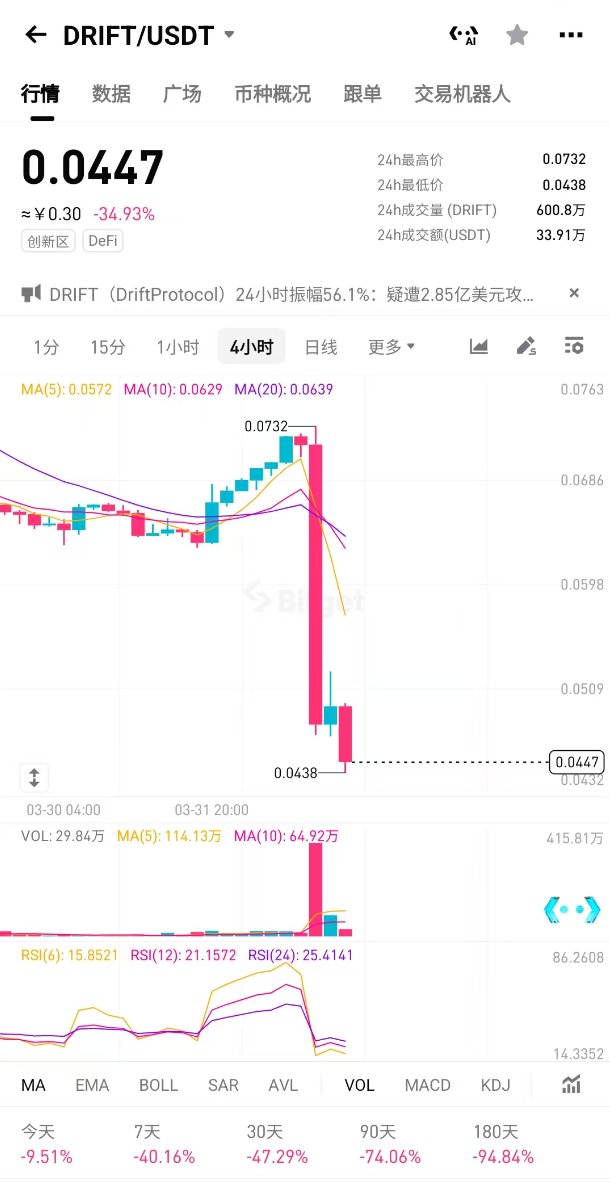
Possibly affected by the Drift Protocol attack, $DRIFT has fallen over 36% in the past 24 hours, currently trading at 0.04 USDT. Its current market capitalization is $25.41 million, and its FDV is $43.72 million.
Previously, The Block reported that the Solana ecosystem decentralized exchange @DriftProtocol was hacked, resulting in losses of at least $200 million (some analyses suggest losses closer to $270 million).
The attack involved multiple Drift vaults, including JLP Delta Neutral, SOL Super Staking, and BTC Super Staking.
The affected assets primarily include approximately 41.7 million JLP (approximately $155 million), as well as SOL, USDC, cbBTC, and wBTC.
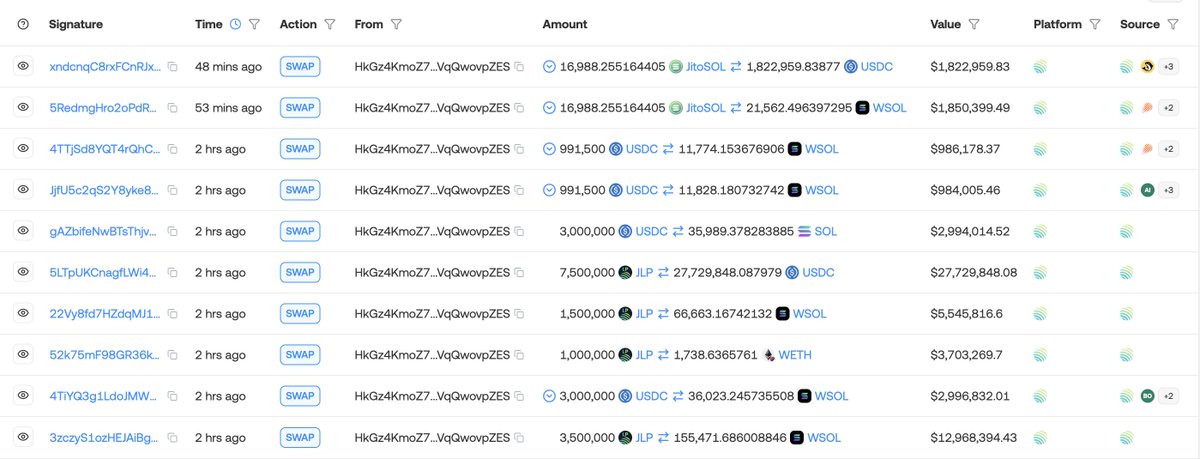
On-chain data shows that the attackers have converted the stolen assets into USDC through Jupiter and then used them to purchase ETH on Ethereum. As of 1:45 AM Beijing time today, the attackers held approximately 19,913 ETH (approximately $42 million).
457
0
0
29
benmo.eth
04-02 11:34
フォロー
After Aster supported JLP and offered transaction credits, several teams working on JLP-neutral strategies moved their funds from Drift to Aster, inadvertently escaping the collapse of Drift today. One of them said, "I was shaken by that brush with death." Currently, the cost-effectiveness of on-chain earning is extremely poor, and it's not worth staying on for long.
386
0
0
28
Wu Blockchain
04-02 02:35
フォロー
Breaking News: According to MLM monitoring, an address associated with Drift Protocol (HkGz4Kmo...pZES) experienced an unusual flow of approximately $270.6 million, representing about 50% of its Total Value Locked (TVL). These assets primarily include approximately $155.6 million in JLP, $60.4 million in USDC, and $11.3 million in cbBTC. Helius CEO Mert stated that while the situation is not yet fully confirmed, on-chain signals suggest a potential vulnerability. Drift has not yet issued an official statement.
Drift Protocol subsequently stated that they are monitoring and investigating the unusual activity on the protocol and advised users to refrain from depositing funds and exercise caution until further notice.
470
0
0
30
Stephen | DeFi Dojo
02-05 17:56
フォロー
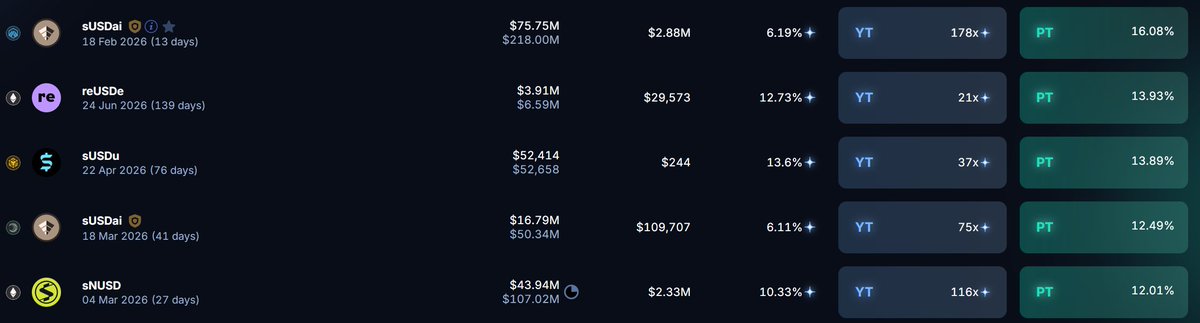
Top 5 Stablecoins with the Highest Yields on Pendle Fi Platform
1) sUSDai: 16% Yield, 13-day Term
► Introduction: @USDai_Official's GPU-collateralized stablecoin, currently over 99% backed by Treasury bonds.
► Opportunity: It would be better if its maturity wasn't so short. If I wanted exposure, I would choose the 41-day term (12.4% yield).
2) reUSDe: 14% Yield, 129-day Term
► Introduction: reUSDe is @re's "performance" token, and can be seen as a secondary component of Re in some ways. The yield comes from reinsurance, but Re also has an institutional component (Re Capital). As I understand it, even before reUSDe, Re Capital would have absorbed approximately $70 million in initial losses.
► Opportunity: The 140-day yield looks quite good, especially if there is indeed a lower-tier "share" to absorb potential initial losses.
3) sUSDu: 13.6%, 76 days
► Information: sUSDu from @UnitasLabs uses a delta-neutral strategy with JLP to collect funds and JLP yields.
► Opportunity: Extremely low liquidity, so it may not be worthwhile for most people. That said, JLP has consistently underperformed, so this could be an opportunity to short yields.
4) sUSDai, mentioned again, but with a 41-day term.
5) sNUSD: 12%, 27 days
► Information: sNUSD is @Neutrl's staked asset, backed by a basket of stablecoin yields, but focused on over-the-counter trading, meaning the asset is purchased at the spot price and hedged during the vesting period. Solvency is currently fully transparent, and transparency regarding stablecoin strategies should improve soon.
► Opportunity: I personally like this, but as a Neutrl ambassador, I may be biased. The biggest drawback is that it only lasts 27 days, but if you frequently use short-term time points to reduce the risk of duration issues, it's a good option.