
















After Broadcom reported record quarterly results, Wall Street's views on the chip company have diverged. Bank of America lowered its target price but still maintained a buy rating; on the other hand, several institutions raised their forecasts after the financial report was released, with the focus shifting to whether high growth can continue to support the current valuation.
Bank of America lowered to $460
Tracking data shows that Bank of America has lowered its target price for Broadcom from $530 to $460, a reduction of $70. Analyst Vivek Arya has also maintained a buy rating on AVGO, indicating that their judgment has not shifted to bearish, but rather they have become more cautious about the valuation range.
In contrast, Goldman Sachs raised its target price from $525 to $540, Bernstein increased from $550 to $575, while Baird maintained a target price of $630. After the financial report was released, the disagreements among selling institutions regarding Broadcom became significantly wider.
AI Income growth rate remains on the rise
The most notable data from Broadcom this quarter comes from its AI semiconductor business. This business segment saw a year-over-year revenue increase of 221%, reaching $16.7 billion. The company expects this figure to further rise to around $21.7 billion in the fourth fiscal quarter, indicating that demand for AI products continues to expand rapidly.
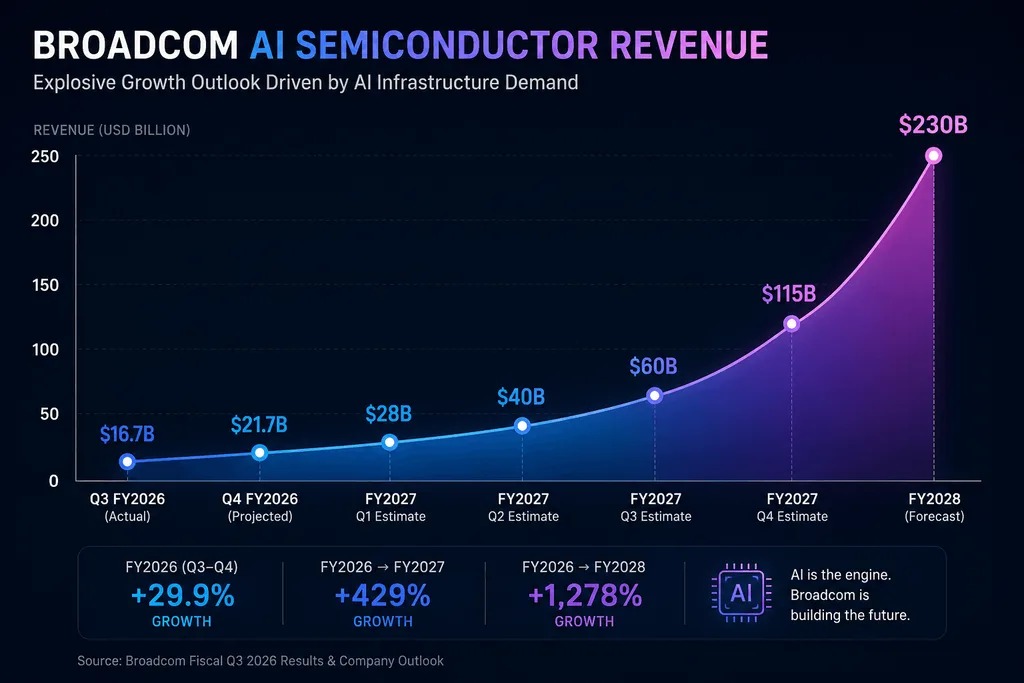
Chen Fuyang, the company's CEO, stated that Broadcom expects its semiconductor revenue for the fiscal year 2027 AI to be approximately $115 billion, and it is expected to increase to around $230 billion in the fiscal year 2028. The main drivers behind this forecast are the growing demand for custom accelerators and networking equipment.
The debate has shifted to whether the valuation is too high.
The article points out that the focus of current market debates is no longer whether Broadcom's AI business is growing, but whether this growth has already been factored into the stock price. Even if the company delivers strong financial results, investors are more concerned about whether the future rate of profit expansion will meet higher expectations.
At the competitive level, in addition to facing NVIDIA, Broadcom also engages in more direct competition with Marvell in the areas of custom chips and networking services. As Marvell's cooperation with Google deepens, the competitive pressure on AI's infrastructure segment is also increasing.