



















Ryanair's stock price has been weakening recently, and market attention has shifted from short-term fluctuations to the company's latest adjustments to winter capacity. The company stated that in order to control the pressure caused by high fuel costs, it will reduce winter flight schedules, with an expected reduction of about 2 million passengers as a result.
Capacity cuts suppress market sentiment
The background for this adjustment is the rise in fuel costs. The report mentions that the related pressure is related to the situation in the Middle East. For airlines, fuel expenditure is one of the core costs, and a reduction in capacity usually means that companies become more cautious about future demand and profit performance for some time to come.
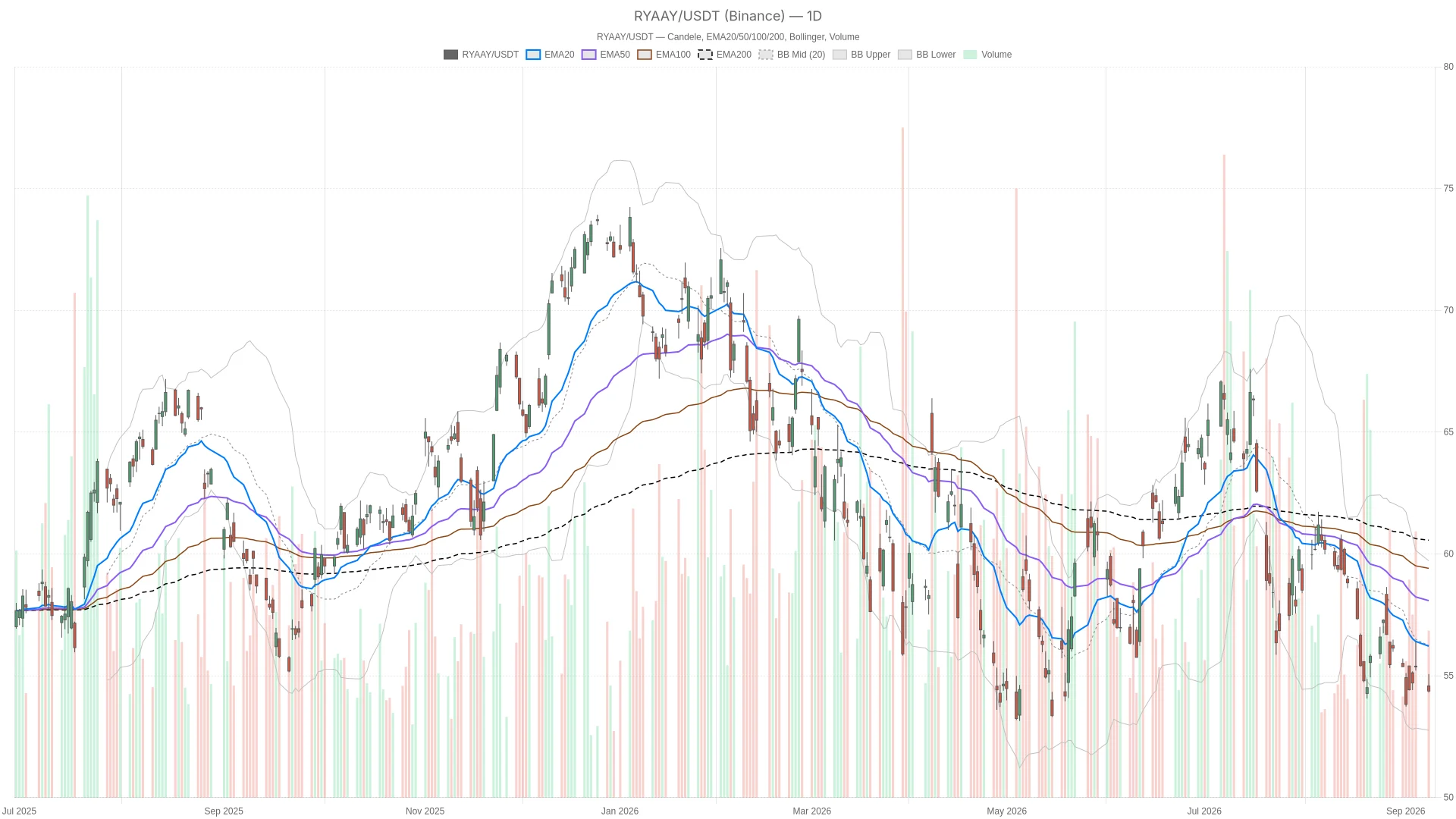
As of September 8, Ryanair's US stock depositary receipts RYAAY were trading at $54.37. The article states that the stock price has fallen below the 20-day, 50-day, and 200-day moving averages, indicating that the stock price is still in a downward trend.
The market is focusing on short-term support levels.

From the range given in the text, $54.10 is considered a short-term support level, while around $54.85 is the upper resistance level. The stock price closed between these two levels, indicating that the market is still assessing the impact of capacity cuts on subsequent performance.
The report also mentioned that the stock price is currently closer to the lower edge of the Bollinger Bands, reflecting that volatility during the decline is still relatively high. This type of trend usually occurs after fundamental company news triggers a re-pricing.
The Middle East situation is increasing cost pressures.
This capacity adjustment is not merely a simple optimization of flight schedules. The more direct reason is the upward pressure on fuel prices, which squeezes profit margins, and this change is related to the tense situation in the Middle East. For the aviation sector, geopolitical risks often quickly affect investors' expectations through energy prices.
The article also points out that although the short-term trend indicates that selling pressure may slow down temporarily, the signals at the daily and hourly levels are still weak. What the market is more concerned about next is whether cost control will be able to offset the pressure brought about by the decline in passenger volume after the company reduces its winter capacity.