

















Foreign media reports that the VeChain token VET showed a clear strengthening in September. After breaking through the downward trend line that had persisted for some time, its price has approached a key resistance area. The article suggests that this round of increase is related to the upcoming InterStellar upgrade of VeChain. However, whether the market can further expand still depends on whether the price can stabilize in a higher range.
InterStellar becomes a short-term catalyst
VeChain is advancing to the next phase of the roadmap for Renaissance, with VIP-255 being the most notable aspect of this progress. According to the project team, this upgrade will introduce a set of improvements based on Ethereum versions Cancun, Prague, and Osaka, with the goal of narrowing the compatibility gap between VeChainThor and the Ethereum ecosystem.
The article mentions that VIP-255 encompasses temporary storage, MCOPY, contract behavior updates, historical block information retrieval, as well as additional measures for transaction and block size protection. VeChain aims to enable developers to more easily migrate newer EVM applications and tools to VeChainThor while maintaining the existing network architecture.
The price has entered the first key resistance zone.
The article argues that after several months of sideways movement, VET has already broken through the downward trend structure, and the upward momentum accelerated in September, with prices rising from the low accumulation area towards resistance around $0.00816.
As of press time, VET is trading at $0.007780, with a daily increase of about 18%. The article states that the current price has entered the main supply range of $0.0075 to $0.0080, which means that subsequent attempts at breaking through will be more significant in terms of direction.
- Key resistance range: $0.00816 to $0.0085
- Upper observation position: $0.0095
- Next psychological barrier: $0.01
Whether a new price range can be formed remains to be confirmed.
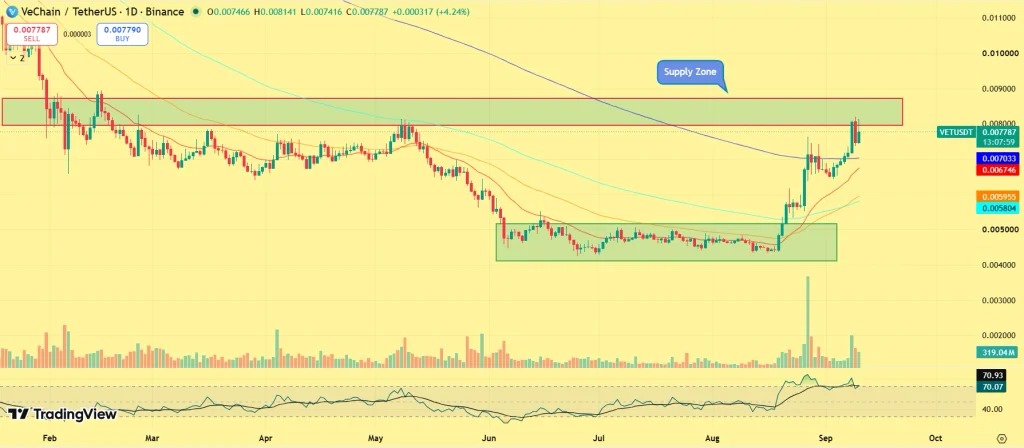
The article argues that in the past few months, the multiple rebounds of VET have been suppressed below the downward resistance. However, the difference this time is that the price has broken the previous pattern and entered a range that requires the market to reprice it.
However, the short-term trend has not yet been fully confirmed. If VET encounters resistance multiple times above the supply zone and falls back below $0.0070 to $0.0072, this breakout may once again turn into a failed rebound. The article considers the range of $0.00816 to $0.0095 to be the most important area to watch at present, believing that the performance in this range will determine whether this rebound can evolve into a larger-scale trend change.