
















As the popularity of coin issuance continues to rise with Solana, a new platform named Paid has entered the launchpad arena, focusing on directly distributing token creator fees to X accounts. Since its launch on September 15th, the project has already recorded thousands of coin issuances and dozens of payments via X in a short period of time. However, its execution process, level of automation, and compliance arrangements have also drawn attention.
Over 1.75 million new tokens were added in a week.
Solscan Data shows that in the past 7 days, Solana has seen over 1.75 million new tokens created, setting a new record for this network in a single week. As the memecoin launch platform continues to expand, the threshold for users to create tokens on Solana has further decreased.
Paid is chosen to be launched at this stage, with the core selling point being the binding of the pump.fun tokens to a specified X account. The platform states that users can either enter the token information and select an X account on the Paid website, or they can directly issue tokens on the pump.fun, and include @handle in the token description, while directing the creator fees to the Paid treasury.
Fees are collected first, and then exchanged into the X account.
According to the project description, the creator fees generated from the relevant tokens will first be deposited into the Solana treasury of Paid. Subsequently, the platform converts the received SOL into US dollars and then makes payments to the corresponding X accounts through X Money.
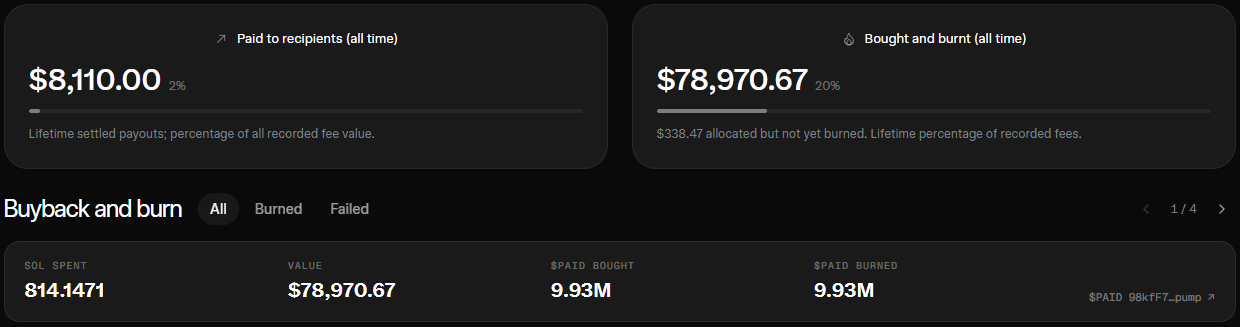
The payment page for Paid will display a settlement receipt. The platform states that 80% of the fees collected is used for distributing profits to the bound accounts, while the remaining 20% is used to repurchase and destroy the native token $PAID. The project indicates that once the funds accumulate to a certain scale, they will use Jupiter to buy $PAID on the public market and complete its destruction.
- The cumulative cost approaches $400,000.
- 4,148 token creations have been initiated.
- 115 X-terminal payments have been completed.
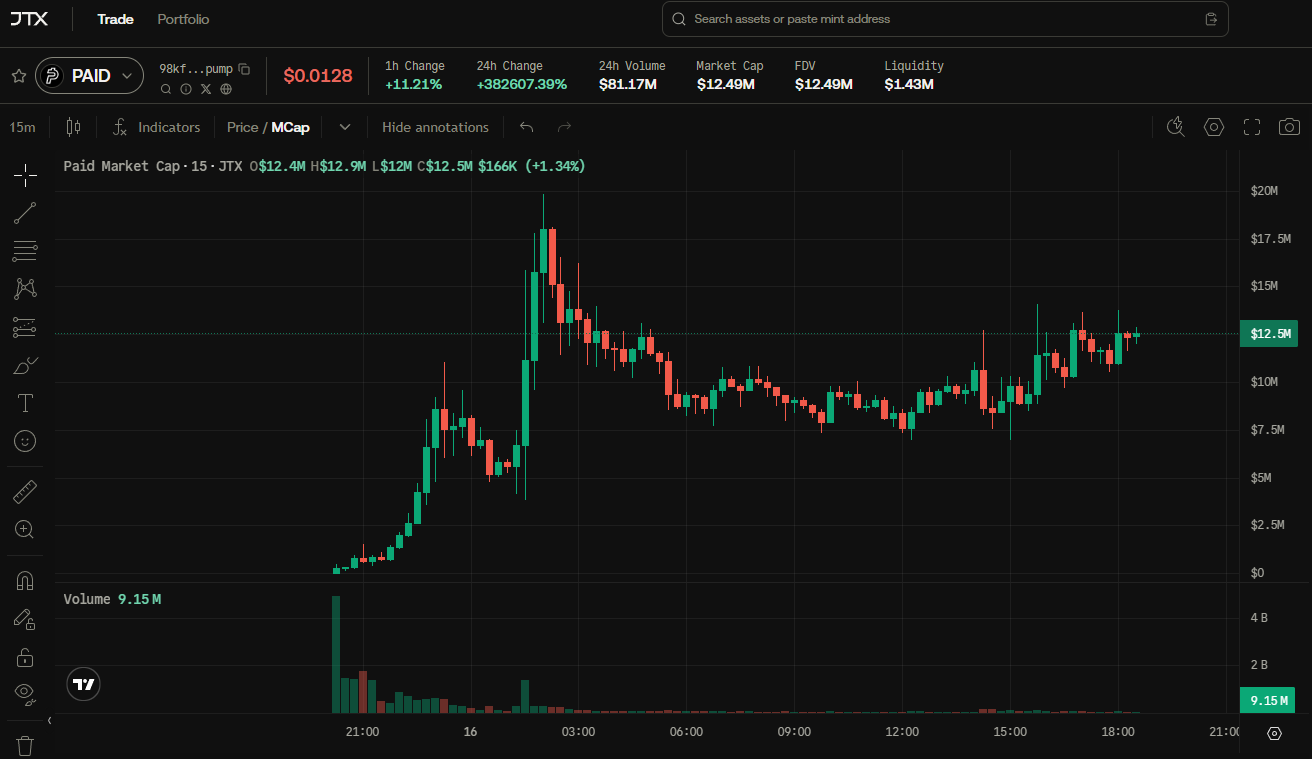
In addition, the platform stated that approximately $81,100 worth of $PAID has been repurchased and destroyed, with an additional $8,110 paid to the recipient. The market value of $PAID once reached a high of $20 million, and it is currently around $12 million.
The withdrawal process and automation capabilities are under question.
The process disclosed by Paid shows that when 80% of the funds in the pending allocation pool reach $100, the platform will send the funds to Kraken. Subsequently, Kraken will convert SOL into US dollars, and then transfer it through ACH to the X Money balance of Paid.
The project stated that this process utilized spot transactions of Kraken and API. The main part that is currently difficult to accelerate is the settlement of ACH, which usually takes 1 to 3 working days. Paid also mentioned that some payments are shown as pending because the coin issuance speed exceeds the ACH funding arrival speed, and the amounts to be settled will be automatically issued once the funds are in place.
However, the community's doubts mainly focus on two points: first, whether there is a publicly accessible interface for X Money; second, whether this mode can support bulk simultaneous payments. Some community posts claim that Paid may still require manual payment through a certain X account at present. The project stated that its payment process uses registered security keys.
Compliance and scalability remain to be seen.
Paid also emphasized that there is no subordinate, certification, or official cooperation relationship between them and X or X Money. This has further drawn attention from the outside world to what permissions this platform actually possesses, as well as whether the existing access methods are sufficient to support its operations in the long term.
Another controversy arises from U.S. funds transfer regulations. Community discussions point out that Paid involves fee collection rates, asset exchanges, recording payables, and making payments to third parties in its processes. Whether such arrangements comply with relevant regulatory requirements depends on the specific structure of the entities involved, their licenses, exemption conditions, and the terms of cooperation.
From the current data, Paid has recorded 4,148 token distributions, but only 115 payments have been completed on the X platform. There is still a significant gap between the two. At this stage, it is not possible to determine whether this is due to a normal settlement delay, limited actual payment demand, or constraints in the platform's processing capacity.
In the Solana launch platform market, pump.fun still holds a dominant position, with daily revenues often exceeding one million US dollars. Whether Paid can establish itself in the market by leveraging the selling point of "native revenue sharing for X accounts" will depend on whether the payment process is smooth, as well as whether the platform can prove that its model can be steadily expanded.