
















Jensen Huang stated at a AI event that NVIDIA expects the number of chips sold next year to double that of this year. This statement once again emphasizes the company's optimism regarding the demand for data center and computing power infrastructure that supports AI models and applications.
There were concerns in the market earlier that investment in the AI industry might cool down, which could in turn drag down demand for chips. Jensen Huang's judgment this time directly contradicts such concerns and has also driven NVIDIA's stock price higher.
Still experiencing rapid growth in recent performance
NVIDIA announced last month that its revenue for the second quarter of the fiscal year reached $96.2 billion, a year-on-year increase of 106%. Among this, revenue from data center business amounted to $89 billion, with a year-on-year increase of 117%. The company also expects its revenue for the third quarter to be around $108 billion.
These data have already driven up stock prices after the financial report was released. Now, Jensen Huang is drawing further attention to the market towards the shipment capacity and demand sustainability around 2027.
It should be noted that a doubling of chip sales does not necessarily mean a corresponding doubling of revenue. Changes in product structure, pricing, as well as the switch from the Blackwell platform to the Vera Rubin platform, will all affect how the increase in shipments is ultimately reflected in sales figures.
AI Concerns over Slowing Investment Encounter Contrary Signals
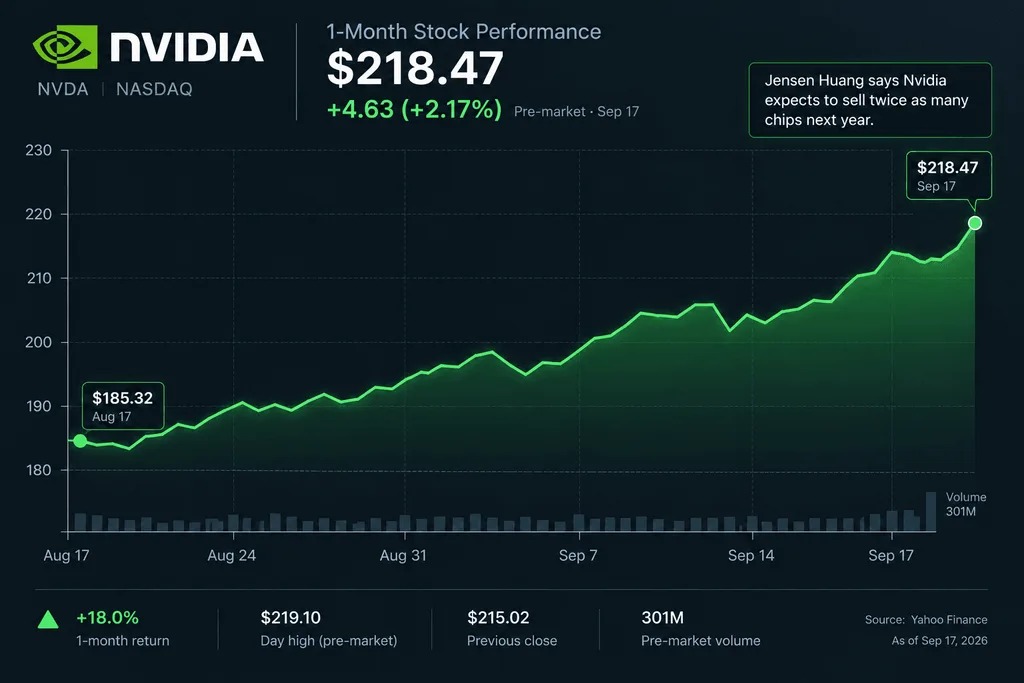
Earlier this week, some industry insiders from the AI sector called for a slowdown in the development pace of AI, sparking concerns in the market about future infrastructure spending. As a result, NVIDIA's shares fell by 3.4% in the semiconductor sector on Monday, and chip stocks as a whole were also under pressure.
Jensen Huang's statement this time sends the opposite signal once again: at least based on the orders and deployment pace observed by NVIDIA, there has been no significant decline in demand.
NVIDIA has previously stated that the Blackwell as well as the next-generation Vera Rubin platforms have a substantial demand reserve. The company has also recently expanded its cooperation with AWS. According to disclosures, AWS plans to deploy an additional 2 million NVIDIA GPU units in its infrastructure between 2027 and 2028.
Market focus shifts to supply capacity
As demand expectations continue to rise, investors' focus on NVIDIA is shifting from "whether there is still demand" to "whether products can be delivered on time."
Factors affecting the rate of expansion include memory supply, advanced manufacturing process capacity, packaging capabilities, power supply, and the progress of data center construction. All these aspects can potentially limit the speed at which NVIDIA and its customers can deploy new hardware.
However, Jensen Huang still maintains an optimistic outlook recently. Last week, he stated again that NVIDIA's revenue for the coming year is expected to grow by about 70%. His basis for this is that the company has a high level of visibility into the global AI infrastructure demand through cloud service providers, AI laboratories, and data center partners.