
















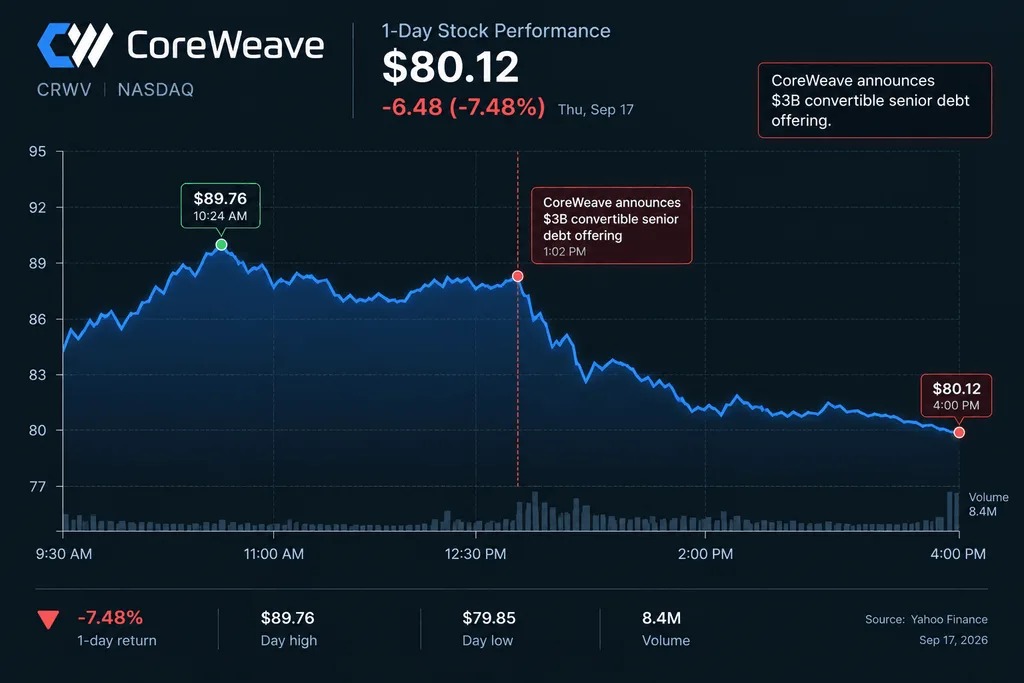
NVIDIA-backed AI infrastructure company CoreWeave disclosed plans to raise $3 billion through a private placement of convertible preferred notes maturing in 2033. Initial buyers also have the option to subscribe for an additional $500 million under certain conditions. Following the announcement, the market shifted its focus to the new debt and potential dilution, causing the company's stock price to fall by about 7% on Thursday.
The maximum issuance scale can reach up to $3.5 billion.
The announcement indicates that the base scale of this financing is $3 billion, and if the initial buyer exercises the additional purchase option, the total scale could rise to $3.5 billion. The company stated that part of the funds raised will be used for capped-call transactions to reduce the dilutionary pressure associated with future share conversions, while the remaining funds will be used for general corporate purposes.
In addition to convertible bonds, CoreWeave has also simultaneously launched new equity financing arrangements. With the combination of these two tools, concerns regarding its financing costs, capital structure, and dilution of shareholders' equity have increased, which has also become one of the direct reasons for the decline in stock prices.
Computing power requirements continue to drive up capital expenditures.
The company also disclosed that at the beginning of the third quarter, the committed amount for new customers exceeded $25 billion. By August 11, its contracted power capacity was approximately 4.2 gigawatts, which is higher than the 3.7 gigawatts at the end of the second quarter, indicating that the expansion of data centers continues to accelerate.
CoreWeave It is also mentioned that recently, the annualized pricing for AI computing power contracts has reached approximately $40 million per megawatt, and in July, the overall product portfolio pricing increased by about 70% compared to before. This indicates that the demand for NVIDIA GPU computing power remains strong, and customers are still willing to pay higher prices for scarce computing resources.
Debt increase goes hand in hand with expansion.
However, undertaking such requirements requires continuous investment in GPU, data centers, power supply, network, and cooling facilities, which incurs substantial capital expenses. CoreWeave is currently burdened with multiple layers of debt, including preferred bonds with interest rates ranging from 8.5% to 9.75%, as well as existing convertible bonds. The issuance of new bonds maturing in 2033 means that its financing structure will be further complicated.
Management stated that the new equity financing arrangement will enhance financing flexibility and help the company gradually improve its credit profile, moving closer to an investment-grade credit rating. For the market, the core challenge faced by CoreWeave at present is how to strike a balance between continued expansion and debt control, as well as mitigating the pressure during the period of high demand for computing power in AI.