




Google DeepMind Establishes Research Institution to Promote AGI Discussions
TechCrunch
14h ago
Ai Focus
Google DeepMind Launches New Institution, Releases First Batch of Articles Focusing on AGI Security, Model Transparency, and Cutting-Edge Evaluation Mechanisms.
Helpful
No.Help

Researchers from Google and Google DeepMind announced the establishment of DeepMind Institute, aiming to advance discussions surrounding general artificial intelligence (AGI) from principled statements to more concrete aspects of security, evaluation, and policy design. The organization is governed by DeepMind, co-founder Shane Legg, Google executive James Manyika, and Google DeepMind leader Demis Hassabis serving as directors.

First release of four articles

The new organization states that its goal is to allow for open discussions about the different perspectives on AGI among Google, Google DeepMind, and the broader research community, rather than maintaining a single standpoint. The first four articles published cover topics such as how to address the potential economic impacts of AGI, preserving the readable reasoning process of models, principles for promoting human welfare, and an evaluation framework for cutting-edge AI models.

This means that the relevant discussions are shifting from general security concerns to more actionable institutional designs. The focus of the article is not only on risk assessment but also begins to address what disclosure obligations developers should undertake, as well as how external institutions can intervene in the review process.

Focusing on Model Inference Visibility

One of the articles was written by security researchers Rohin Shah and Anca Dragan. The core argument is that it is becoming increasingly difficult for outsiders to observe the model inference process, but this is not an irreversible trend. The two believe that as new architectures make the strongest models more difficult to monitor, developers and regulators need to actively address the trade-off between performance and supervisability.

The directions proposed in the article include restricting the depth of continuous calculations by models without leaving any readable traces of reasoning, or requiring developers to prove that even with a decrease in system transparency, external monitoring can still be carried out to the same extent.

Hassabis Proposes a cutting-edge model evaluation institution

In another article, Hassabis proposed the establishment of a leading AI standard organization led by the United States, dedicated to evaluating the most advanced AI models. According to this concept, developers would initially have up to 30 days before the model is released to voluntarily submit it for review; if this evaluation mechanism proves effective, it may become a prerequisite for deploying leading models in the United States in the future.

In the initial stage, this institution will jointly design evaluation methods with AI company, and then gradually transition to independent testing without disclosing the content in advance, in order to prevent the laboratory from optimizing the model based on known topics. Hassabis also mentioned that if the risk situation further escalates, additional measures can be taken, and it is not ruled out that coordination among cutting-edge AI developers may be slowed down.

Industry discussions have shifted to specific solutions.

At the time of the release of these articles, discussions in the AI industry regarding security are undergoing changes. In the past, principle-based warnings were common; nowadays, more focus is being placed on information disclosure, external audits, and the control of development pace when necessary.

This shift further intensified this week due to the public support from several industry insiders for some of the proposals put forward by Anthropic's Chief Executive Officer, Dario Amodei, regarding "controlling the pace of AI development." The launch of DeepMind Institute also made Google's stance in this discussion more concrete.

Tip
$0
Like
1
Save
1
Views 43
HKWDB reminds readers to view blockchain rationally, stay aware of risks, and beware of virtual token issuance and speculation. All content on this site represents market information or related viewpoints only and does not constitute any form of investment advice. If you find sensitive content, please click“Report”,and we will handle it promptly。
Submit
Comment 0
Hot
Latest
No comments yet. Be the first!
Related
Coinbase Reaches Over 3,000 U.S. Banks Through Cooperation
Coinbase and Stablecore collaborate to advance the integration of encryption services on the banking side, covering over 3,000 American banks and credit cooperatives that can be reached through technical systems.
crypto.news
·2026-09-18 12:15:15
33
Coinbase and Stablecore connect with community banks: Covering 3,000 is a potential, not all have already been launched
On September 16th, Coinbase announced a partnership with Stablecore to integrate digital asset custody, trading, and stablecoin payments into the existing systems of community banks, regional banks, and credit cooperatives in the United States. This collaboration has already been implemented in financial institutions including those in Texas under Amarillo National Bank. The technology provided by Stablecore can reach over 3,000 banks and credit cooperatives, but being "reachable" does not mean that all of these institutions have already adopted it, nor does it imply that thousands of banks will simultaneously offer crypto services on that day.
币界网
·2026-09-18 09:55:41
198
1.9 trillion euro fund platform partners with Solana: Project Harmonia launches first, not yet fully online
Another bridge has been built between traditional fund distribution and public blockchains. On September 16th, the Solana Foundation announced the launch of Project Harmonia, which connects tokenized funds on the Solana blockchain through the global fund distribution network Allfunds. As of June 30, 2026, this project managed a scale of approximately 1.9 trillion euros, connecting over 3,300 asset management firms and financial institutions. Such a scale has drawn attention to the project, but at this stage, the focus is first on collecting proposals; it's not that 1.9 trillion euros in assets have already been moved onto the blockchain.
币界网
·2026-09-18 09:54:30
194
Anthropic Opens "Lax Version" of Claude to Life Sciences Team: Behind the Application System is an Experiment with Permissions
On September 17th, Anthropic launched the Life Sciences Verification Program LSVP, which allows qualified professional teams to use the Claude model with fewer restrictions for tasks such as drug discovery, biological research, clinical development, and manufacturing. This program has already been integrated with dozens of institutions in its early stages and is now open for applications to a wider range of life science organizations in its beta version. It is not a one-time unlocking for all users, but rather a tiered access system based on identity, project, and continuous monitoring.
CoinMeta
·2026-09-18 09:51:19
42
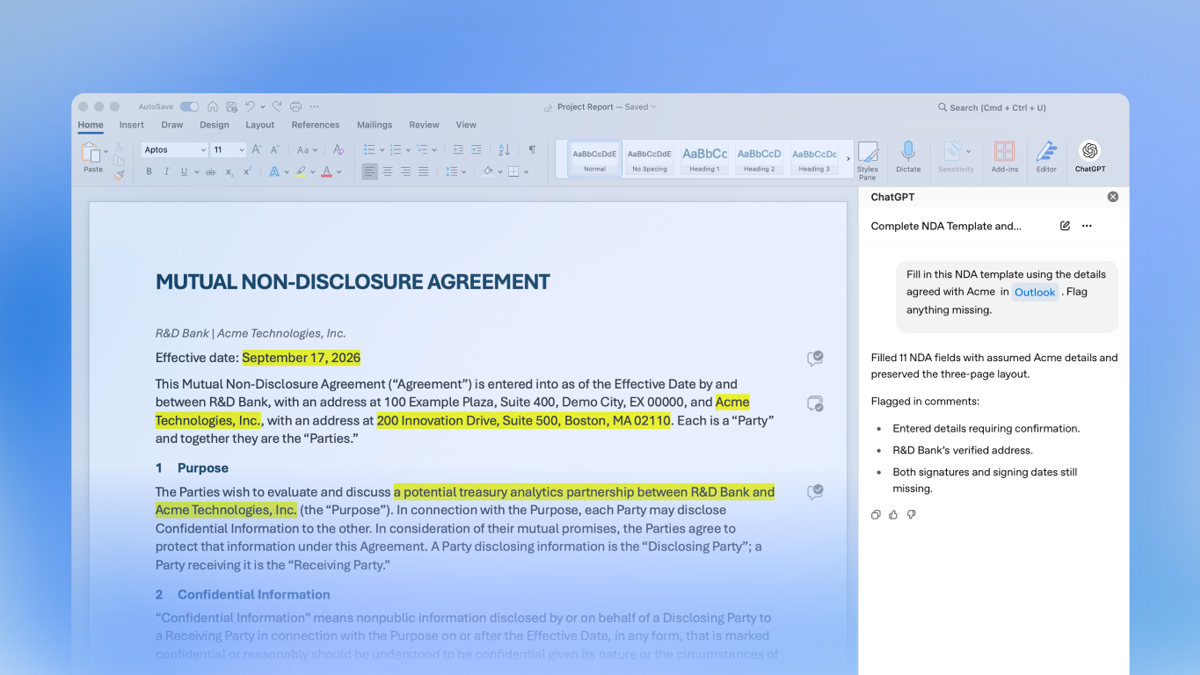
ChatGPT officially enters Word: Free users can also install it, but it's not yet a "automatic essay writer"
Microsoft has finally incorporated ChatGPT into the sidebar. On September 17th, they updated their product description to state that ChatGPT, for, and Word are now available to all ChatGPT packages, including the free version. Users can directly use these tools within the documentation to draft notes, summarize long texts, rewrite selected text, and adjust titles and formats as well. With this addition, Excel, PowerPoint, and Office join together, forming a set of three core tools that can all be accessed through the same Microsoft Store plugin.
CoinMeta
·2026-09-18 09:50:09
33
View More