

















From the user's perspective, stablecoins and bank deposits can be surprisingly similar. Both can represent $1, can be used for payments, and can also exist solely within applications, rather than in the form of physical cash.
However, from a legal and financial perspective, they are two very different forms of currency.
Bank deposits represent claims against commercial banks. When $1,000 is deposited in a checking account, the bank owes that amount to the customer. Stablecoins, on the other hand, are typically digital tokens issued by independent private entities and backed by reserve assets to ensure their value remains as close as possible to that of currencies such as the US dollar. The International Monetary Fund ( IMF ) describes this distinction as the difference between “account-based money” and “token-based money.”
This difference will affect everything from deposit insurance to the way funds flow.
Bank deposits rely on banks, while stablecoins rely on reserves.
Commercial banks typically do not keep every dollar deposited in their vaults intact. Deposits constitute a part of the funding source for the banking system, while the assets held by banks include loans, securities, and reserves.
Stablecoin issuers adopt different models.
For example, Circle indicates that USDC is backed by reserve assets denominated in US dollars and can be exchanged for US dollars at a 1:1 ratio. Its reserves include cash as well as highly liquid instruments such as short-term US Treasury bonds and overnight US Treasury repurchases.
This reserve structure is also a way for many stablecoin businesses to generate profits. The issuers do not pay most of the earnings to the token holders; instead, they can earn income from the securities that underpin their tokens: this is also a model that we have discussed in our articles on the breakdown of stablecoin reserves.
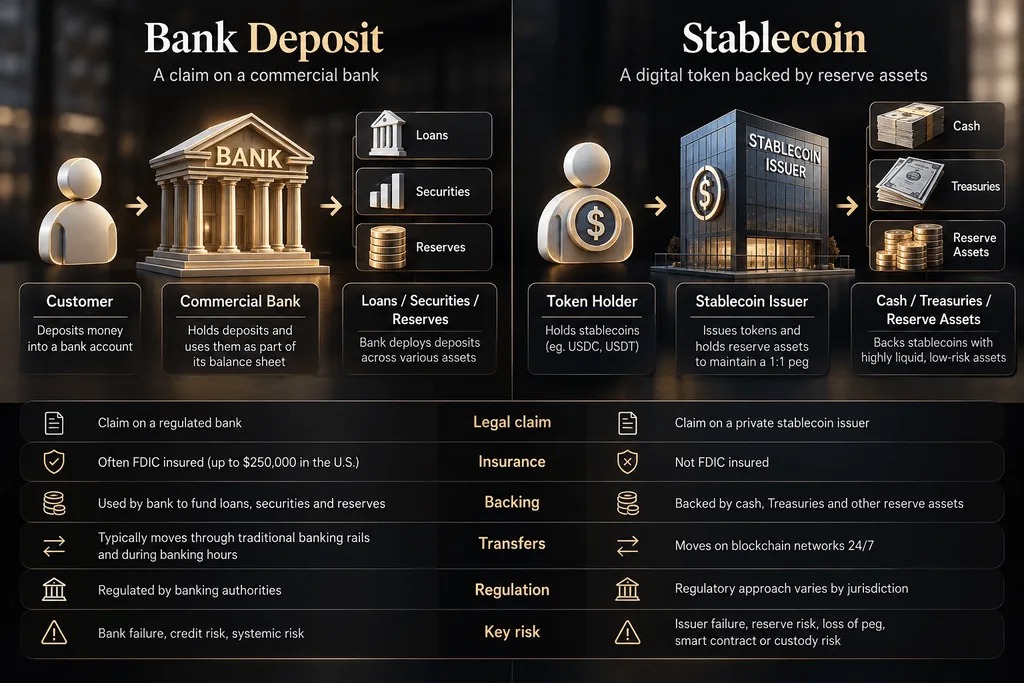
Deposit insurance is a significant difference.
In the United States, deposits that meet certain criteria and are held in banks insured by the Federal Deposit Insurance Corporation (FDIC) are typically protected, with a limit of up to $250,000 per depositor per insured bank and per type of ownership. It is clearly stated that crypto assets themselves are not covered by deposit insurance.
Therefore, holding stablecoins does not provide the same level of protection as directly depositing funds in a insured bank account.
Stablecoins also carry various risks, including the failure of the issuer, issues with reserve assets, temporary decoupling from the US dollar peg, blockchain malfunctions, and mistakes in managing private keys or wallet addresses.
This is also one of the reasons why bank stablecoins and tokenized deposits should not be considered interchangeable. Tokenized deposits may use blockchain technology, but they are still bank liabilities and do not thereby become tokens supported by independent reserves.
Adrian Cole
Adrian Cole has been engaged in financial market reporting for over 6 years, with a focus on crypto assets, stocks, and macroeconomic trends. He tracks Bitcoin, major altcoins, the U.S. stock market, interest rates, commodities, as well as various types of data that drive market changes. Over the years, he has written hundreds of market updates and analysis articles, with an emphasis on price trends, investor sentiment, and the connections between traditional finance and digital assets.