














IT News on September 29th: According to CCTV News, on September 28th, at Weihai Port in Shandong, China's independently developed 150 horsepower/250 horsepower 4500-meter deep-sea operation robots officially set sail, joining forces with Harbin Institute of Technology (Weihai) to carry out joint scientific research in the South China Sea.
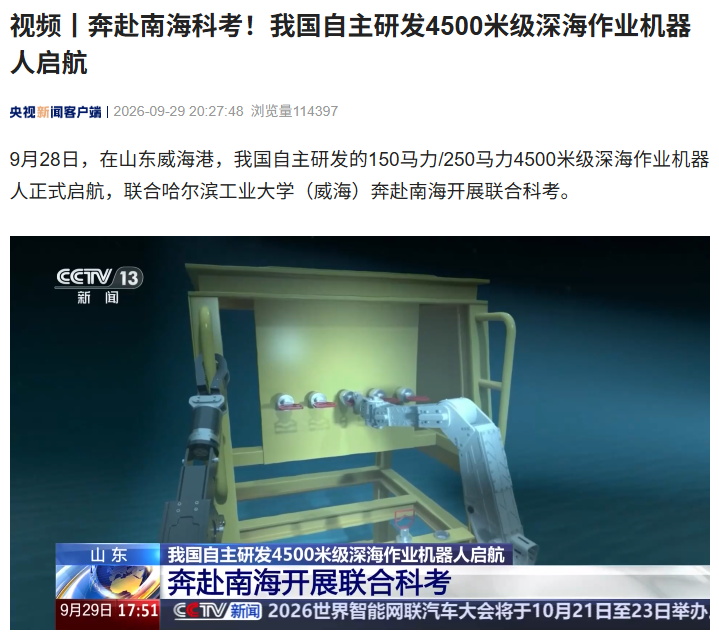
According to reports from IT, the robot is equipped with a self-developed seven-axis multi-functional hydraulic robotic arm, which has overcome more than thirty key technologies such as deep-sea pressure resistance and sealing, high-power propulsion in deep water, long-distance underwater communication, and multi-modal autonomous navigation. It is capable of undertaking complex tasks such as deep-sea oil and gas development, submarine pipeline inspection, mineral resource exploration, underwater scientific research sampling, and emergency salvage.
The purpose of this joint scientific expedition in the South China Sea is to practically verify the performance of the entire equipment system, further improve the deep-sea equipment verification system, and bridge the final gap between "laboratory - engineering - industrialization," providing support from domestically produced equipment for ensuring national deep-sea resource security and advancing the development of a maritime powerhouse.
Tao Zewen, the person in charge of project research and development, introduced that the core software and hardware of this 4,500-meter deep-sea robot are all domestically produced and under our own control. In the future, we will continue to reduce the cost of applying domestic deep-sea equipment.
Extended reading: The robot model launched this time is VY150, which was jointly developed by Shandong Future Robotics Co., Ltd. and the Robotics Research Institute of Harbin Institute of Technology. It is a mass-produced industrial-grade ROV (unmanned remotely operated vehicle) in China and also one of the first domestically mass-produced heavy-duty industrial-grade deep-sea robots capable of operating at depths of up to 4,500 meters. Over ten thousand components of the robot are domestically produced, with a maximum operating depth of 4,500 meters, and it can be extended to operate at depths of up to 6,000 meters as well.
ROV There are also unmanned telepresence vehicles (ROVs) that are connected to a mother ship via a cable. This cable not only transmits electrical power but also communicates information, allowing operators on the ship to remotely control them while they work in the deep sea. Alongside these are manned submersibles (HOV, such as the "Jiaolong" and "Fendouzhe") and autonomous unmanned submersibles (AUV), with the latter two types relying on batteries for power.