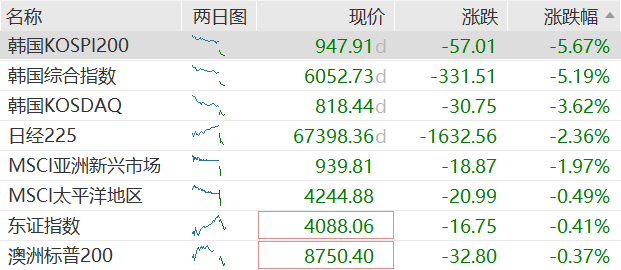
Asian and Pacific stock markets tumbled significantly on Tuesday, with the decline in trading enthusiasm for AI and the competitive pressure from memory chips hitting them hard. Technology stocks in South Korea and Japan were hit the hardest, and the MSCI Asian and Pacific index reached a new low in over two months.
Chinese memory chip manufacturer ChangXin Technology has made progress in new memory architectures; at the same time, the yield on U.S. Treasury bonds remains high, causing the market to grow more concerned about the capital expenditure prospects of AI.
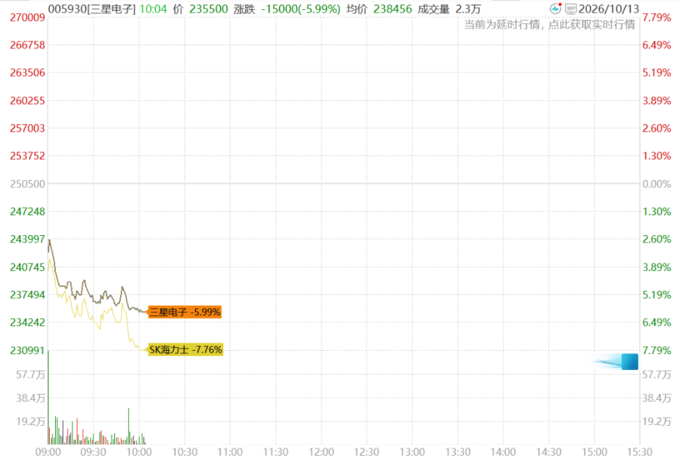
Due to weak market sentiment, on Tuesday the South Korean Composite Index tumbled by as much as 5.1%, triggering the exchange's Sidecar circuit breaker mechanism and halting programmed selling for five minutes; both Samsung Electronics and SK Hynix fell by more than 6%, heading for a fifth consecutive day of decline.
On the Japanese side, SoftBank Group fell by more than 8%, and stocks in the AI industry chain such as Tokyo Electron and Advantest also fell by over 5%. The MSCI Asia-Pacific Index dropped by 0.9% to 270.78 points, approaching its lowest point since mid-August.
U.S. stock index futures fell during early trading in Asia. The Nasdaq 100 index futures, which are dominated by technology stocks, declined by 0.5%, following a decline on Monday; the U.S. chip manufacturers index fell by 2.7%.
Storing competition intensifies pressure on South Korean chip manufacturers
Changes in the industry competitive landscape have further pressured the valuation expectations of South Korean chip stocks.
The main drag comes from the memory chip sector. Cao Kanyu, President of ChangXin Memory, announced at an industry event over the weekend that the company has made key progress in the next-generation 4F2 memory cell architecture and plans to launch server memory products based on this architecture by the end of 2026.
This design uses proprietary vertical gate-all-around transistors to suppress leakage, allowing more storage units to be packed onto a single chip, which directly points to the high-profit DRAM used by AI servers.
Dragged down by this news and the decline in US chip stocks overnight, Samsung Electronics fell by 6%, while SK Hynix tumbled nearly 8%, heading for a fifth consecutive day of losses.
The South Korean Composite Index closed at 6,061.82 points, down 5.1%; the South Korean Small-Cap Index fell by 2.49%. The Korea Exchange activated the Sidecar mechanism at 9:47 a.m. local time. Prior to that, the KOSPI 200 futures index had been falling for over a minute by more than 5%, triggering this mechanism and suspending programmed selling orders for five minutes.
Eugene, the Chief Investment Officer of Asset Management, stated that the valuation and stock prices of South Korean chip manufacturers seem to be affected by the uncertainty surrounding whether the economic upcycle will continue until 2028 and beyond.
In Japan, the Nikkei 225 index fell by more than 2%, while the Tosei Index managed to resist the decline, slipping down by just 0.2%. Bank of Japan Governor Haruhiko Kuroda was originally scheduled to appear before parliament at 1:00 p.m. local time, and the market remains focused on the direction of monetary policy.
SoftBank Group opened lower with a gap, and then continued to decline, with a loss of nearly 9%.
Tokyo Electron, Advantest, and other stocks in the AI industry chain fell by more than 5%.
Interest rates and profit seasons constitute the next key variables
Market attention is turning towards the upcoming season of macro data and financial reports. Hideyuki Ishiguro, the chief strategist at Nomura Asset Management, stated that some investors may be concerned that higher bond yields could affect AI-related financing and lead to a slowdown in capital expenditure.
This Thursday, TSMC's quarterly financial report will be released, which is regarded as one of the most important barometers for the demand prospects of AI. At the same time, the U.S. Consumer Price Index ( CPI ) data will be announced this week, following the rise in U.S. Treasury yields to decades-high levels.
Glenmede, the head of investment strategy and research, Jason Pride stated that this week's CPI report is likely to be the most important data before the Federal Reserve's October meeting. With inflation not significantly exceeding expectations, the Federal Reserve is likely to be patient with its next interest rate hike.
The financial reporting season for major U.S. banks also officially commenced on Tuesday, with Goldman Sachs, JPMorgan Chase, Citigroup, and Wells Fargo all releasing their results.
According to Bloomberg Industry Research data, analysts expect third-quarter profits of S&P 500 components to grow by about 25% year-on-year. Anthony Saglimbene, the chief market strategist at Ameriprise, stated that bank stocks (reflecting consumer and corporate health), large technology stocks (AI monetization progress), and energy stocks (oil price-driven profit sustainability) will be the three main themes in this round of earnings season analysis.
Performance of Other Assets
The US Dollar Index tumbled slightly by 0.1%, giving back some of the gains from the previous day.
The yield on 10-year U.S. Treasury bonds fell by 3.7 basis points to 5.209%.
In terms of commodities, WTI crude oil fell by 0.9%, and Brent crude oil fell by 0.9% to around $105.80 per barrel.
Spot gold continued its overnight decline, falling 0.36% on Tuesday during the Asia-Pacific session to trade at $4,157 per ounce.