

Bitcoin developer Paul Sztorc sparked controversy this month with his sharp criticism of Lightning Network. He believes that Bitcoin supporters are "deceiving themselves" regarding the actual performance of Lightning.
“Most people don’t realize how bad Lightning Network is,” Sztorc said in a post on X on October 4th, “because there’s a huge conspiracy that has been going on for many years, and ***they lie*** by saying that the user experience of LN is very good.”
But this harsh criticism has also brought up again a question that Bitcoin developers have been debating for many years: Does Lightning actually make Bitcoin easier to use, or has the community become too deeply involved with this Layer protocol that they have overlooked its flaws?
Lightning has usability issues.
The original intention of Lightning was to enable faster and cheaper Bitcoin transactions without having to record each payment individually on the blockchain, but its underlying mechanism often causes friction for both users and merchants.
Sztorc says that people don't realize how bad Lightning Network is. Source: Paul Sztorc

In a world of “one-click completion,” users of traditional financial payment networks can complete transactions simply by swiping a card or clicking a mouse. However, the cumbersome payment processes of Lightning rely on liquidity appearing in the right place at the right time. Routing payments over the network can fail, especially for larger transactions that need to go through multiple nodes.
Even Alex Bosworth, the person in charge of liquidity for Lightning, stated this month: "The painful fact is that in an architecture that takes into account privacy and peer-to-peer features, its speed is extremely slow compared to tap, to, and pay."
In addition, running nodes and managing channels are also too technical for ordinary users; ordinary users simply want to make payments and then continue with their daily lives. This is also why the proportion of managed usage is estimated to be higher—it is easier and more effective, but the cost is having to use a trusted intermediary.
Daily payment success rate reaches 99.7%
Lightning, co-founder and CEO of Amboss, admitted that the liquidity requirements were initially "difficult to understand," but he stated that with the help of existing tools or automated services, these issues are "easily solvable."
He said about Magazine: "For daily payments of around $100, most users can achieve 99% reliability on the core network." He added that simulations with Amboss show that the success rate for $100 payments is 99.66%.
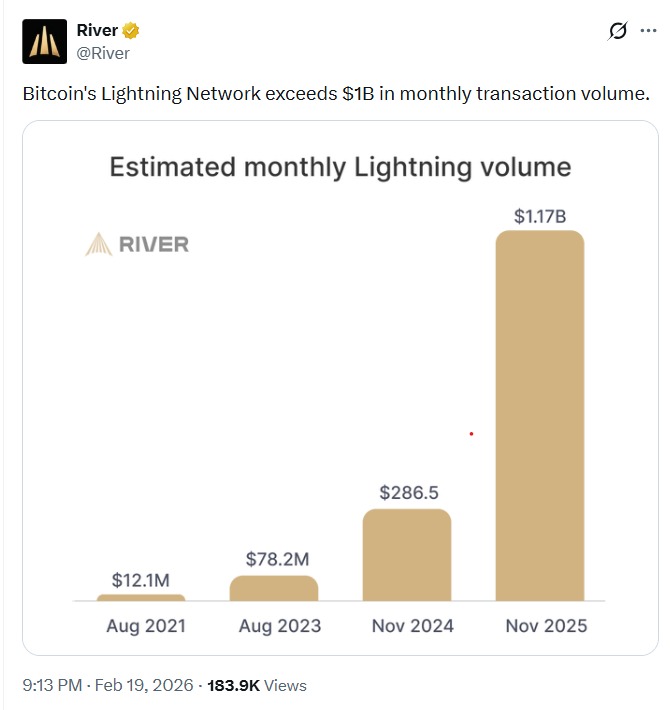
Data from River shows that Lightning had a trading volume of over 1 billion US dollars in November 2025. Source: River
In a Reddit discussion in April 2026, a user stated that he was “really impressed” by the technical progress made by this network, but still questioned its practicality in everyday consumption. “There is still a gap in reality,” he said:
Every coffee shop, grocery store, and gas station I visit uses the Visa or Mastercard terminals. NFC, tap, to, pay have become the standard. No one is selling products using the Lightning nodes, and no one will do so either.
Has the developer already solved the problem?
The head of marketing at Bitcoin payment infrastructure company Breez, Danny Stagg, stated that many of the criticisms regarding the Lightning user experience are now outdated.
"By 2026, such criticism is no longer fair," he said to Magazine, "but historically speaking, it does hold water. For many years, developers and users have been required to understand the complexity of Lightning, such as channels and inbound liquidity, in order to complete transactions and receive payments."
He stated that in the past two years, the internet has improved significantly, and new infrastructure has largely abstracted away these complexities. “The experience of using unmanaged services is now comparable to that of managed services,” he said.
Today, users no longer need to manage channels or run their own nodes; wallets or applications can provide Lightning payments, as developers and service providers can handle a large amount of the work at the underlying level.
The CEO Roy Sheinfeld stated that AI programming tools are helping developers to build Bitcoin-supported applications more easily, and the inquiries from potential partners have also increased rapidly.
"That's why we see more partners joining Bitcoin every quarter," said Stagg.
However, an increase in developers' interest does not necessarily mean that more people are using Lightning for daily payments.
The data reflects activity level, not necessarily success.
According to its 2026 Bitcoin Adoption Report, financial services company River estimates that Lightning processed 52,200 transactions in November 2025 alone, with a transaction volume of 1.17 billion US dollars.
Although this number seems considerable, it is still lower than the peak of 6.6 million transactions set by Lightning in August 2023, indicating that the number of transactions has not kept up with the growth of value flowing within the network.
Encrypted payment processor CoinGate reported that in its own customer base, there were 782,403 paid encrypted transactions in the first half of 2026, a year-on-year increase of 21.4%, of which Lightning accounted for 9.6% of the Bitcoin payments processed by the company.
Lightning accounts for 9.6% of Bitcoin payments. Source: CoinGate
What counts as success?
Shrader indicates that, due to the nature of payment statistics at the network level, "it is almost impossible to generate such data unless you are one of the parties in a transaction," therefore he does not accept the claim made by Sztorc that "over 80% of Lightning payments are of a managed type."
Stagg says that this statement 'describes yesterday's Lightning', where the hosting service provided a simpler experience, whereas at that time, the hosting service had not yet 'kept up'. (As early as 2023, River estimated that for every 8 hosted users, there was 1 self-hosted user.) However, without the latest hard data, the issue of the hosting ratio cannot be conclusively determined.
The same caution should also apply to claims that measure the adoption of Lightning using indicators such as payment volume, network capacity, or developer interest; each of these indicators measures different things, and none of them alone can prove whether Lightning is easy to use.
Enterprises are dealing with payments, and developers are also looking for ways to abstract technical complexity, but technological progress does not equate to mainstream usability.
Perhaps the real criticism is not so much that Lightning has failed, but rather whether its supporters confuse the evidence of what the internet “is capable of” with what people actually “do on the internet.”