Prismm is a startup company that helps banks keep family funds within the institution after the account holder passes away. Their approach is to designate beneficiaries and plan for estates from the very first day of opening an account, thereby simplifying the transfer of assets to the heirs. Prismm will introduce its mission on the stage of TechCrunch Disrupt's Startup Battlefield today.
Prismm was founded in 2020 by sisters Martha Underwood and Shella Sylla, both of whom have decades of experience in the banking and finance sectors. The two mentioned that the idea for Prismm stemmed from their own experiences: they witnessed firsthand how difficult it can be to manage household affairs during emergencies.
In 2017, after Hurricane Irma struck Miami, their father fell while helping neighbors clear trees from their roofs and was hospitalized. Their mother had always relied on their father to handle the family's finances and paperwork, so she had no idea where all the important documents and financial information were kept, nor did they know themselves. Later, their father recovered, but the experience of being unable to access crucial information at that time remained unforgettable for them.
This became the starting point for Prismm, but the idea really took shape three years later. At that time, Underwood was working at a bank during the COVID-19 pandemic. She observed that many families, after losing a loved one, would rush to the bank, frantically searching for accounts, trying to understand their bill situations, and striving to figure out how to support their surviving spouses.

In an interview with TechCrunch, Underwood said, "At that time, we realized that this was an infrastructure issue. As I delved deeper into the research, I found that although we had established various platforms for wealth growth and tracking, almost none of them were designed for the 'transition' phase. This process still relies heavily on manual labor to this day. So we thought, 'We can digitize this process.' We believed we could solve this problem because we saw that other families would face the same situation as well. It was at that moment that we truly committed ourselves to this endeavor."
Through Prismm, account holders can grant advance authorization to designated family members to access their accounts and files. In the event of the account holder's death, the designated individuals can log into the system to view assets and files in one place, and initiate the transfer of benefits to eligible recipients in a digital manner. Since identity information, consent documents, and supporting materials are all pre-archived, this process can be completed remotely even if family members are located in different states.
Underwood said, "Most of the products currently on the market are aimed at consumers. We've found that when you ask consumers to do something additional when they already have a long list of tasks to complete, it often becomes the last thing they get to done, especially for women. It's usually women who handle these affairs after someone passes away. We are also often the caregivers in such situations. So, if I'm supposed to take care of children, my husband, and other people while managing my parents' documents, it becomes unbearable. Therefore, this needs to be built into the infrastructure with as little friction as possible, so that people can access the information they need to make decisions. That's why we choose to integrate it directly into the bank's core systems."
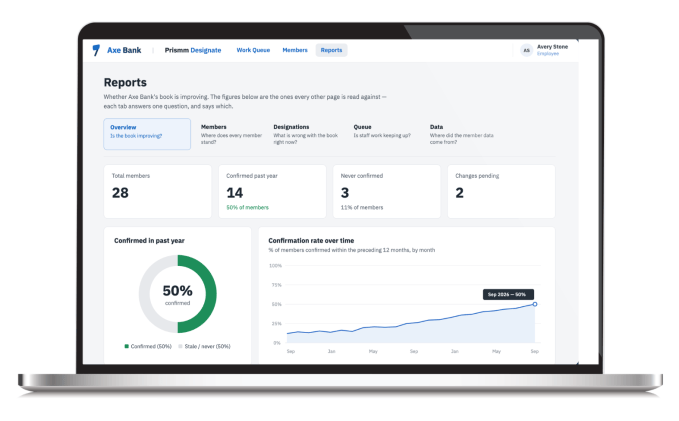
The company currently has two core products, with a third one under development.
The first product, Prismm Designate, enables banks to provide customers with a simple digital method to update their beneficiary information. The goal is to allow both customers and banks to keep beneficiary information up-to-date more quickly and easily.
The second product, Prismm Anchor, provides account holders with a secure space to track their accounts, documents, properties, and other assets across multiple institutions, and allows controlled access to be granted to designated individuals. This product is provided through financial institutions, so users do not need to download a separate consumer-oriented application to manage all these matters.
The third product, Prismm Continuity, is about to be launched. It will gradually guide employees and families through the transition process. The startup company stated that this will keep the most difficult parts of the process within the institution for handling, rather than shifting the burden onto the families.
Underwood and Sylla describe Prismm as an infrastructure that helps banks handle situations that arise after a customer passes away. They state that financial institutions lose billions of dollars in deposits each year due to what is known as "estate leakage." "Estate leakage" refers to heirs transferring the inherited funds to other institutions because banks do not have a system to manage the transition of accounts after a customer's death. They believe that rather than losing these accounts, banks would be better off using beneficiary information and a simpler inheritance process to keep the assets, as well as potential future customers, within their own institutions.
Underwood said, "We will become the infrastructure that financial institutions use to transfer funds to the next generation, because we not only understand how you operate on the backend, but we also understand that you need to take the initiative on the frontend to build relationships with the next generation of consumers."
This week, Prismm gathered in San Francisco with dozens of other startups and investors to participate in the Startup Battlefield competition of TechCrunch; the final winner will be announced on Thursday, October 15th.