


Amidst the strong bearish sentiment in the crypto market, Ethereum prices have tumbled significantly and are currently testing a key support level. As the second-largest token by market capitalization, ETH is approaching the $2350 range, and a wave of long liquidations has further exacerbated the ongoing pressure. This selling pressure has also sparked concerns about weakening investor demand. Recently, the outflow of funds from ETH ETF has presented new challenges for the bulls.
In a situation where the derivatives market also presents a complex picture, what the market is now focusing on is whether the price of ETH will be able to hold above $2,350, or whether it will fall further below $2,200.
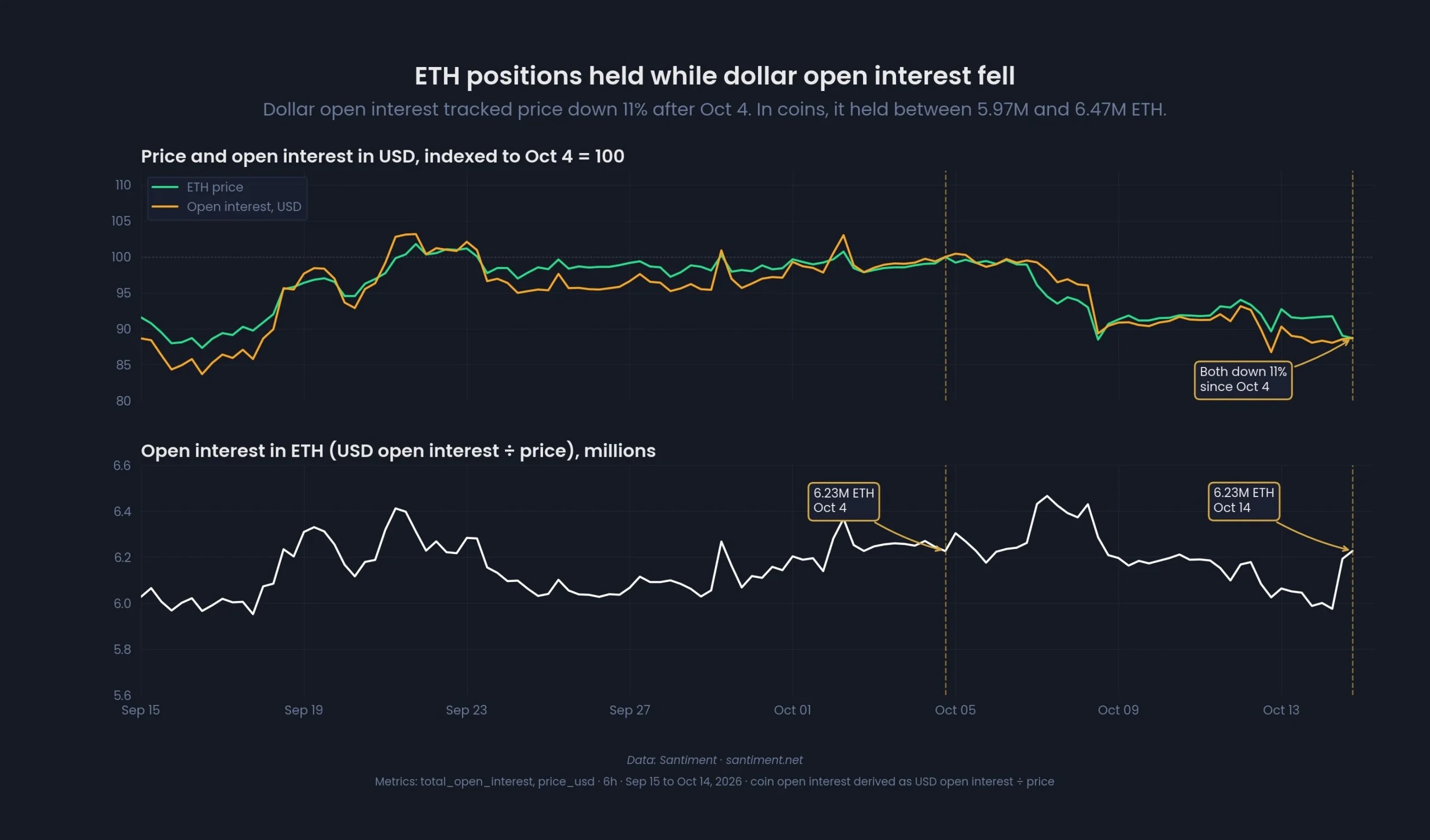
Ethereum open interest contracts decreased by 11%
According to the data from Santiment, although the price of Ethereum has been hit, traders have not significantly reduced their ETH holdings. From October 4th to October 14th, ETH fell by about 11%, and the open interest in contracts denominated in US dollars also decreased by roughly the same amount. This indicates that the enthusiasm in the derivatives market has also cooled down with the price decline.
The quantity of ETH related to open derivative contracts has remained at 6.23 million units over these two days, fluctuating between 5.97 million and 6.47 million units. However, this does not necessarily indicate that traders are betting on a rebound. Nevertheless, changes in positions around $2,350 may provide clues for the subsequent trend.
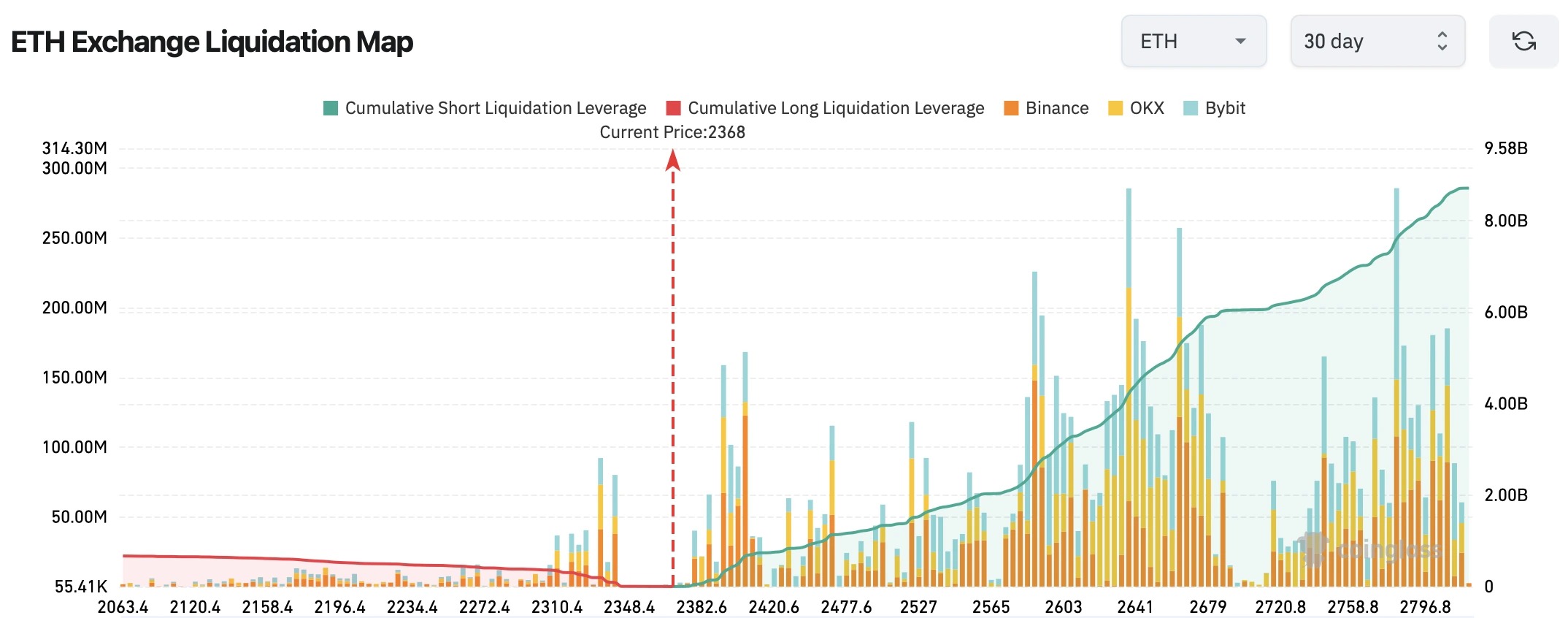
The liquidity of sellers is significantly weakened as shown in the settlement chart.
Ethereum liquidation charts show a clear imbalance between potential short liquidations and long liquidations. At the current price level, the liquidity of sellers below is significantly weaker than that of the potential liquidation pools above. As ETH declines, most of the potential downward liquidations have been cleared, resulting in a substantial reduction in long liquidation exposure.
Calculated at a reference price of $2,368, the chart estimates that there is approximately $676 million in cumulative long liquidation leverage on the downside of the market. At the same time, there is a potential short liquidation exposure of $8.71 billion on the upside, indicating that the liquidation risks indicated in the chart are mainly concentrated in the upward direction. If prices continue to rise, it may force bearish traders to cover their positions; however, if the support range of $2,350 is lost, $2,000 could become the next level worth watching, and short momentum will continue to prevail.
ETH Prices weaken, sellers target $2200
After pulling back from a local high near $2,800, Ethereum prices are showing signs of fatigue. Currently, its trading price is around $2,386, and the range of $2,350 to $2,400 has become an important support area. The latest candlestick chart has entered this range, and the market's focus has shifted to whether buyers can hold this area to avoid further declines.
RSI has already fallen and is gradually approaching the oversold area, indicating that momentum is weakening. In addition, CVD shows aggressive selling pressure, putting the price of ETH at a critical point; therefore, if it breaks below support, it could open up further downward space. If the price rebounds above $2400 and then stabilizes above $2430, it may help to alleviate the current selling pressure.
Can Ethereum hold the $2000 support range?
Ethereum prices are facing a critical test around $2,350, and the risk of declining to below $2,200 due to weakening momentum and the outflow of ETF funds remains a concern. If prices continue to fall below $2,350, bearish sentiment will further strengthen; however, if they rebound above $2,400 to $2,430 with support from new buying, it could improve bullish prospects and create room for a bearish squeeze. The estimated potential bearish liquidation exposure of $8.71 billion also increases the possibility of a rapid price rebound. The next move in ETH will depend on whether buyers can hold the support level or if sellers continue to push prices down.