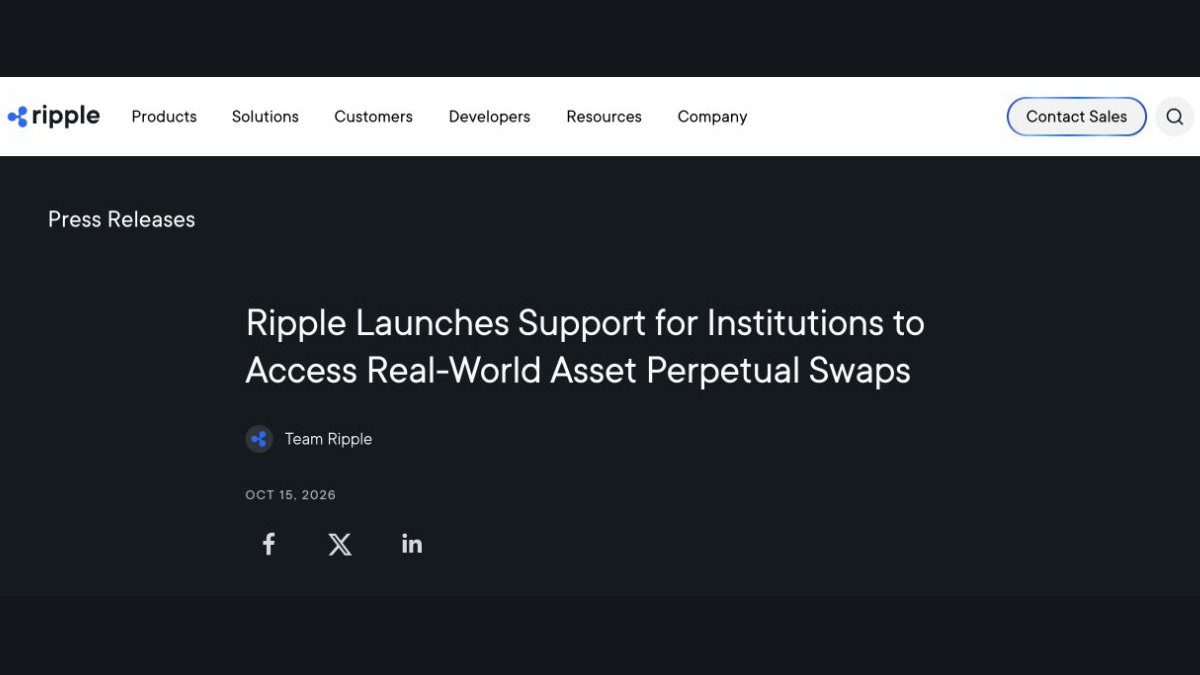


After the U.S. stock market closes, global traders' assessments of stocks, energy, and exchange rates do not cease. On October 15th, Ripple announced that its institutional brokerage business Ripple Prime now supports sustainable swaps related to real-world assets. Officials stated that institutional clients, including Virtu, are trading contracts referenced by over a hundred markets such as stocks, stock indices, ETF, metals, energy, and foreign exchange, with trading and settlement possible around the clock. It is important to clarify here: what clients obtain are derivative exposures, not actual stocks purchased on the New York Stock Exchange over the weekend, nor is any particular stock automatically tokenized.
This business is not the same as the DriveWealth brokerage infrastructure collaboration announced by Ripple a couple of days ago. The DriveWealth news discusses the integration of cross-border funds, stablecoins, and custody into the securities backend; today’s focus is on Ripple Prime allowing institutions to trade a specific type of RWA perpetual swap within their risk and margin systems. Both announcements involve traditional assets and blockchain systems, but they are in different business segments. Confusing them and describing them as “Ripple enabling 24/7 US stock trading overnight” would not only mislead readers but also obscure the real product boundaries that are worth paying attention to.
Referring to the price of traditional assets does not equate to owning that asset.
Ripple Official explanation: These swaps are based on the perpetual futures contracts launched by Trade.xyz on Hyperliquid, and are provided to customers by Ripple Prime as the counterparty. Perpetual contracts do not have a fixed expiration date, and their prices are managed for risk and adjusted for funding costs based on the underlying market; the actual terms, quotes, and settlement rules must be referred to in the specific product documents. They allow institutions to adjust their risk exposure to stock indices or metal prices when traditional exchanges are closed, but they do not grant rights to ordinary stockholders, nor do they entitle them to automatically receive dividends from listed companies. The extended trading hours are separate from the underlying market, which operates without interruption throughout the year.
Ripple emphasizes that institutions can manage such exposures through cross-margining with other asset classes supported by their brokerage platforms, and in applicable cases, RLUSD can also be used as collateral. The significance of cross-margining is to bring the risks of different positions under a unified framework, thereby reducing some duplicate collateral requirements; however, the trade-off is that the correlation between positions may change suddenly during extreme market conditions, allowing risks to spread from one market to another. Institutional clients value capital efficiency, but they must also be aware of collateral discounts, additional margin requirements, weekend price gaps, and the concentration of trading counterparts. It is not accurate to describe "higher capital efficiency" as "lower risk."
It is specifically announced that this service is currently provided within the licensing scope of CIV BVI under Ripple Prime. Future plans are to expand it to other regions. This geographical and licensing boundary is important: just because an institution can use it in one jurisdiction does not mean that global investors can directly buy and sell using local accounts; the availability of RLUSD as collateral also varies by jurisdiction. If reports only state "official launch" without specifying who can use it, where it can be used, or what can be traded, readers may easily mistake these institutional derivatives for a new stock exchange for retail investors.
24-hour trading leaves the valuation challenge for the weekend.
Traditional stocks have clear trading hours, while futures and foreign exchange have their own opening rules. When perpetual contracts referencing these assets continue to trade on weekends, platforms must address the following questions: How are marked prices determined when the underlying spot markets are not open? What happens to margin requirements in cases of insufficient liquidity, sudden major news, or gaps at the next opening of related markets? These are not marginal technical details; they are crucial to whether 24/7 trading can be stable. Continuous price trading does not guarantee continuous value updates, nor does the quotation displayed on screens ensure that trades can be executed with sufficient depth at any time.
Ripple quoted the person in charge of Virtu's digital asset business in the press release, stating that 24/7 cross-asset margin trading is beneficial for their participation in new liquidity pools. We can interpret this as direct evidence of customer demand, but we cannot infer from this that the market has matured. The official mentioned a rapid increase in the trading volume of perpetual contracts related to real assets since the beginning of this year, yet they did not provide the Ripple Prime platform's independent trading volume, total number of customers, or results of stress tests in this announcement. Whether the business has truly improved institutional hedging efficiency requires observing the actual depth of transactions, slippage, risk events, and customer persistence in use, rather than just looking at the fact that there are over a hundred tradable assets.
Such products are also easily confused with “tokenization of real-world assets.” Recording bonds or fund shares as on-chain tokens involves issuance, holder rights, and custody; in the case of perpetual swaps referenced to stock or gold prices, the core is a derivative contract between the two parties. Both may utilize on-chain settlement and collateral, but they cannot replace each other. Understanding the legal attributes of assets is more important than memorizing the abbreviation RWA. Especially when promotions list stocks, ETF, metals, and foreign exchange side by side, it is necessary to confirm whether what is referred to is spot, futures, or merely reference prices for contract settlement.
As of October 15th, it is confirmed that Ripple Prime has provided support for RWA perpetual swaps within a specific permitted scope, and institutional clients have already participated. There are over a hundred traditional markets referenced in these contracts. However, it is not confirmed whether global users can trade them or whether the underlying stocks enable 24/7 spot delivery. Subsequent developments worth watching include public information regarding regulatory regions, contract documents, weekend pricing, and handling of extreme market conditions. Accurately describing it as "an additional risk exposure tool" is more realistic than presenting it as a complete migration of the securities market to the blockchain.