On October 16th, IT announced that AI Company released a blog post yesterday (October 15th), announcing the launch of the Ternary Bonsai Series models, which come in three sizes: 2B, 4B, and 9B. The goal is to enable these AI intelligents to run locally on smartphones, PC, and wearable devices, performing tasks such as reasoning, image recognition, and tool invocation.
The Ternary Bonsai 2 series models are built on Alibaba's Qwen 3.5 foundation and adopt a "ternary" weighting notation, which means that model parameters are encoded using only three values: -1, 0, and +1. According to the official statements, the storage requirements for the 2B, 4B, and 9B models are approximately 0.43GB, 0.95GB, and 2GB respectively.
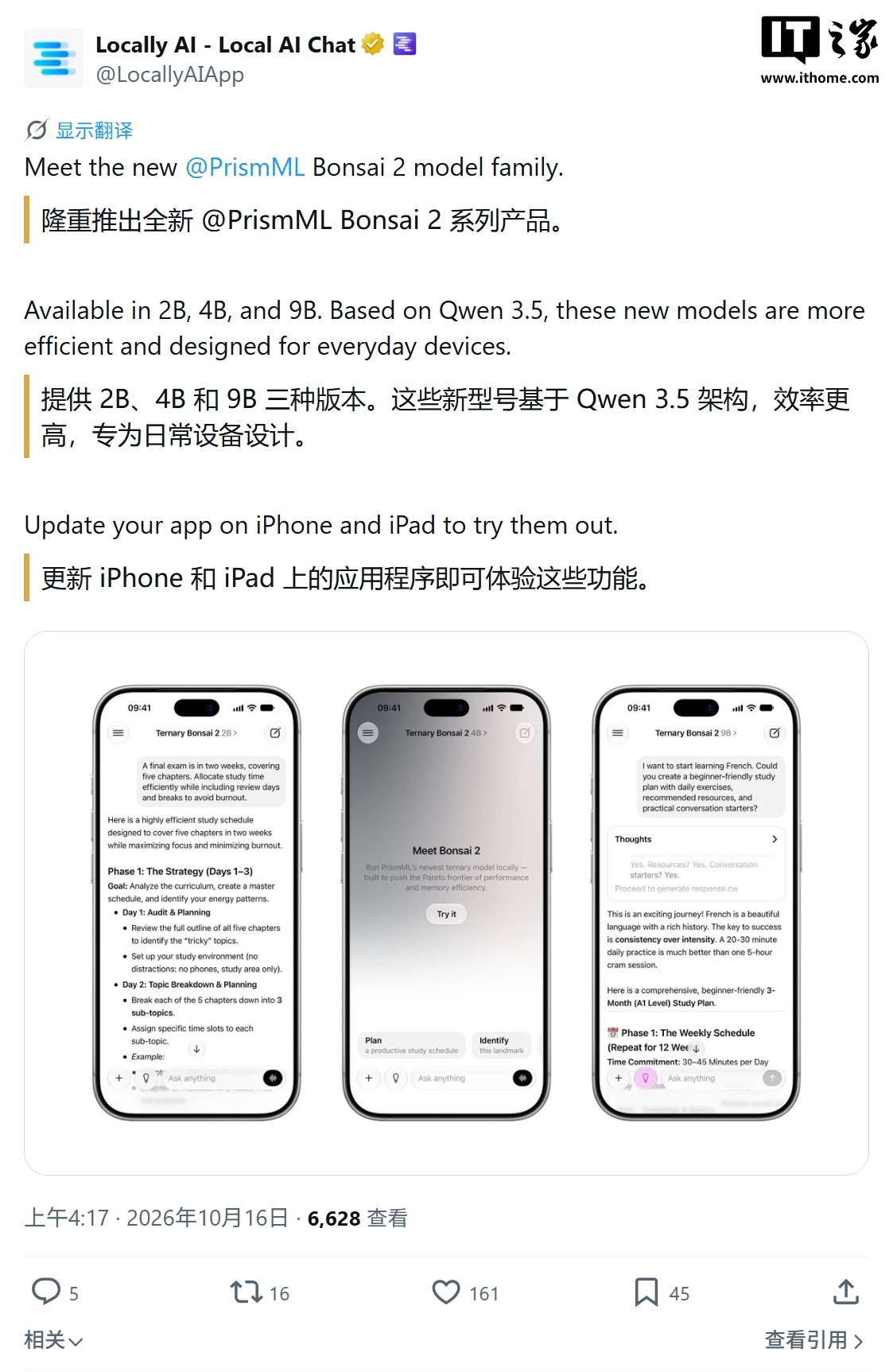
In terms of capabilities, the Bonsai 2 series emphasizes the practicality of local agents: following instructions, completing daily tasks, invoking tools on mobile devices, avoiding repetitive outputs, etc. The official tested six categories of capabilities including intelligent tool invocation, mathematics, instruction following, programming, knowledge and reasoning, and visual understanding across 19 benchmarks; among them, the token required for the 9B model in standard instruction execution and daily mathematical tasks was reduced by about 40%.
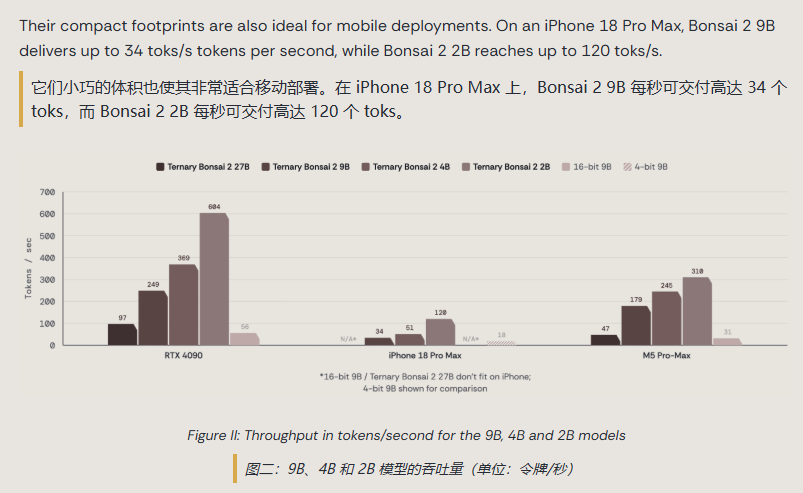
In terms of performance, PrismML indicates that on hardware such as RTX 4090 and M5 Pro, the new model can achieve up to 5 times higher throughput and 3 times better energy efficiency compared to the corresponding full-precision models; on iPhone 18 Pro Max, the 9B model can process up to 34 word elements per second, while the 2B model can process up to 120 word elements per second. IT attaches the relevant screenshots below:
This series can be combined with the existing Bonsai 2.27B to form a complete product line ranging from lightweight tasks to complex workflows. Developers can run on NVIDIA GPU using llama.cpp, and can also deploy on Mac, iPhone, and iPad through MLX; model weights are licensed under the Apache 2.0 license.