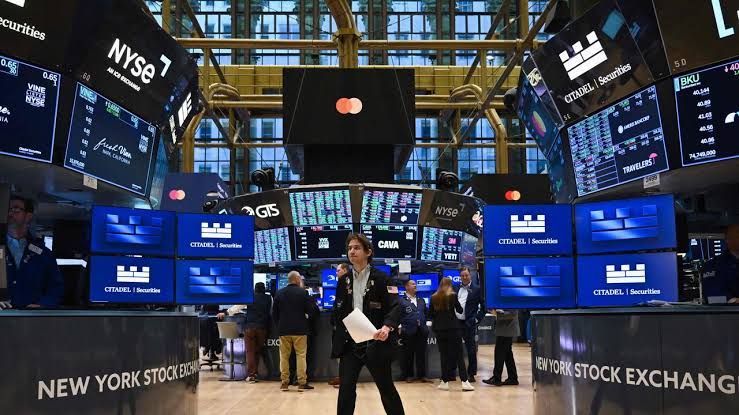
On Wednesday, global stock markets rose, but due to rising oil prices, markets remained cautious ahead of the Federal Reserve's interest rate decision and the financial reports of major artificial intelligence companies. As a result, U.S. stock index futures failed to follow the strong gains seen in Asian tech stocks. However, European stock markets were weaker, dragged down by declines in financial stocks, performing poorly on a day with a heavy release of corporate earnings reports.
Dow Jones futures fell 0.22%, S&P 500 index futures rose 0.12%, and Nasdaq futures rose 0.38%.
In terms of European stock markets, the Stoxx 600 index fell by 0.2%. Rising crude oil prices put pressure on stocks that are more sensitive to economic cycles. After chip equipment manufacturer ASM International raised its earnings outlook, its stock price once rose by 5%. On a trading day with a heavy release of corporate financial reports, European bank stocks performed differently.
MSCI Global stock indices rose by 0.2%. Storage chip giant SK Hynix reported earnings that far exceeded expectations, boosting stocks related to AI infrastructure construction. Asian stock markets generally saw gains, with South Korea's KOSPI index surging by 6%, leading the Asian market.
In the next 48 hours, the global financial markets will witness a series of events that could trigger significant fluctuations, including interest rate decisions by major central banks such as the Federal Reserve, the European Central Bank, and the Bank of Japan, as well as financial report releases from representative companies in the AI investment boom, including Microsoft and Alphabet.
The Reserve Bank of New Zealand took the lead in creating the first major surprise in the next two days. The bank decided to keep interest rates unchanged, contrary to market expectations which were for a rate hike, resulting in the New Zealand dollar experiencing its largest single-day decline in five months.
Two super-large tech giants release their financial reports
As the market begins to believe again that the massive investments in the AI sector will ultimately yield returns, traders are once again buying tech stocks. Microsoft and Alphabet will release their financial reports after the close of U.S. markets on Wednesday, becoming the focus of market attention.
XTB Director Kathleen Brooks stated: "Investors want to see how these two mega-tech companies actually convert their AI investments into actual revenue."
She pointed out, "These financial reports may determine whether the rebound of tech stocks and AI stocks can continue. If any of the following signs appear: first, if the AI investments fail to be effectively commercialized and monetized; second, if capital expenditure growth slows down, then the trading on AI on Wednesday evening and Thursday could be significantly impacted."
This week, Meta, SpaceX, and Broadcom have successively announced a series of financing plans related to AI, injecting new vitality into the investment boom in AI. In addition, Anthropic submitted an application for its initial public offering (IPO), which further boosted market sentiment.
SWBC Chief Investment Officer Chris Brigati stated: "When assessing future growth potential, we can no longer treat all large tech stocks equally. The era in the past where the market generally rose and drove all stocks to rise simultaneously has begun to change."
The Jai Malhi indicates that 'there are now sufficient signs suggesting that the process of concentrated liquidation of tech stock positions may have come to an end, which provides support for the latest round of tech stock rebound.' The strong performance of SK Hynix is undoubtedly an encouraging start, but the capital expenditure guidance of large-scale cloud computing service providers remains a key risk. Before these companies release their financial reports, this challenge may cause some investors to remain on the sidelines.'
The Fed's decision may send hawkish signals
In addition to corporate financial reports, investors are also awaiting the monetary policy decisions to be announced by the Bank of Canada and the Federal Reserve of the United States later on Wednesday. The market generally expects that the Federal Reserve will keep interest rates unchanged on Wednesday. Before the announcement of the decisions, U.S. Treasury yields rose slightly, while the dollar remained relatively stable.
JPMorgan analysts stated in their report that they expect at least two opposing votes among Federal Reserve policymakers, which could send a hawkish signal to the market.
If the Federal Reserve ultimately chooses to keep interest rates unchanged, Chairman Kevin Warsh ( Kevin Warsh ) may face external pressure and will need to explain why policymakers are not taking action at this time. After all, just last month, Federal Reserve officials unanimously voted in favor of raising interest rates to address the rising inflationary pressures.
XTB Research Supervisor Kathleen Brooks stated: "There are a large number of significant events on Wednesday that could potentially impact the market, to the extent that tonight's Federal Reserve meeting almost seems like a secondary concern." However, she warned, "This is a dangerous mindset for investors." This is because the market expects that U.S. interest rates could rise by as much as 75 basis points over the next year.
An unexpected incident involving the Reserve Bank of New Zealand
Earlier on Wednesday, the New Zealand Central Bank decided to maintain interest rates at 2.75% by a narrow margin of votes, catching investors off guard. As a result, the exchange rate of the New Zealand dollar against the US dollar fell by more than 1.2%, reaching a low of 0.5583 US dollars at one point during the session.
Australian Federal Bank foreign exchange strategist Carol Kong stated: "Today's decision indicates that the New Zealand Central Bank is willing to make decisions that surprise the market. This also serves as a reminder to investors that central banks do not follow the dictates of the market."
The market is awaiting the release of the first budget by British Chancellor of the Exchequer John Hilley ( John Healey ). It is expected to be a relatively cautious budget, focusing more on maintaining the stability of the bond market rather than implementing the large-scale fiscal spending measures mentioned when Prime Minister Andy Burnham ( Andy Burnham ) took office. The pound has underperformed among major currencies, and the price of UK government bonds has also fallen slightly, with the UK FTSE 100 index dropping by 0.3%.
In other markets, an oil refinery in Saudi Arabia, the world's largest crude oil exporter, was attacked, once again raising concerns about energy supply risks in the Middle East and driving up international oil prices. There have also been reports that the United States may resume military strikes against Iran after the mid-term elections next week.
At the same time, traders are also closely monitoring the highly competitive election situation in Israel. On the Israeli side, export polls indicate that the general elections held against the backdrop of war seem to have reached a stalemate, resulting in a 1% decline in the exchange rate of the Israeli shekel.
A financing gap of $4.1 trillion is looming, and the real highlight of the U.S. debt situation will occur next week.
JPMorgan is in line with market consensus. Jay Barry and others from JPMorgan's fixed-income strategy team indicate that they expect the Federal Reserve to remain inactive, but there may be more than one dissident vote from the hawks. However, Cleveland Fed Chair Loretta Harker and Dallas Fed Chair Robert Kaplan are expected to cast hawkish dissenting votes, and there is also a risk that Minneapolis Fed Chair Neel Kashkari may join them.
For the U.S. debt market, however, the Treasury Department's quarterly refinancing announcement next week is the real highlight. The Treasury Department will release its quarterly financing estimates on November 2nd and the full refinancing announcement on November 4th.
JPMorgan Chase expects the scale of interest-bearing bond auctions to remain unchanged. The fundamental figures are as follows: a deficit of $1.992 trillion for the fiscal year 2026, which is only $28 billion narrower than the bank's forecast; the deficit forecast for fiscal year 2027 remains at $1.960 trillion. According to the current auction arrangements, there is a funding gap of up to $4.1 trillion from 2027 to 2030. The report argues that reducing long-term auctions to lower yields lacks structural significance and will only shift the financing pressure to short-term bonds.
Pro-American countries saw a sharp 60% decline in US debt purchases in the first eight months; Japan saw a plunge of 99%, while South Korea recorded a record net sale.
According to data from the U.S. Treasury Department and the State Department, in the first eight months of 2026, countries and regions that align closely with the U.S. stance purchased a net amount of $174.3 billion in U.S. medium- and long-term government bonds, excluding short-term treasury bills, marking a new low since the same period in 2021, with a year-over-year decline of over 60%.
This shift is particularly notable in Asia, where economies that have maintained large trade surpluses for years are reducing their allocation of surplus funds to U.S. Treasury bonds.
Japan is the largest overseas holder of U.S. debt, but in the first eight months of this year, it only made a net purchase of $389 million, a sharp decrease of 99% compared to the same period last year; South Korea sold a net $23.8 billion, setting the highest level of reduction since statistics began in 1977; Taiwan Province of China is also in a state of net selling.
Bank of America sees interest rate hikes against the trend.
Bank of America stated that the Federal Reserve has sufficient reasons to raise interest rates in October. If no action is taken in October, the Fed will only have one option left; if interest rates are raised in October, it will retain the flexibility to continue raising rates in December, aligning the interest rate hike cycle more closely with the expectations for rate cuts in 2024 and 2025.
Given that inflation data is more threatening, the latter option holds greater strategic value.
Focus on Individual Stocks
EnerSys agreed to acquire Ultralife for $16 in cash per share. Driven by this news, the stock price of Ultralife soared by over 144%. The transaction is valued at approximately $320 million for Ultralife. The New York-based technology company announced the merger agreement after the market closed on Tuesday. The stock price of EnerSys rose by 2%.
Solar energy company Enphase Energy saw its stock price plummet by over 18%, and the company's revenue declined from $410.4 million in the same period last year to $293.3 million.
PPG Industrial stock price rises by 6%. The coating manufacturer announced an adjusted earnings per share of $2.25, a record high for the third quarter, and also raised the midpoint of its annual profit forecast.
Robinhood's stock price fell by 7%. Robinhood released its financial report for the third quarter of 2026: revenue increased by 12% to $1.42 billion, but cryptocurrency business revenue plummeted by 55% to just $120 million. The long-term downturn in the cryptocurrency market has suppressed trading activity and related business revenue.
Driven by the demand for AI storage chips, SK Hynix announced impressive financial results for the third quarter of 2026, with its stock price rising by 7%. The company also announced a special dividend linked to investment earnings from Kioxia ( Kioxia ).
Logitech's second-quarter performance was a mixed bag, with its stock price falling by over 11%. After adjustments, Logitech's earnings per share were $1.51, which is higher than the $1.30 consistently expected by FactSet analysts, but its revenue of $200.6 million fell short of market expectations.
Key digital infrastructure company Vertiv saw a 16% surge in its stock price. Vertiv's third-quarter financial report exceeded market expectations, and the company also provided better-than-expected guidance for this quarter and the full year; adjusted earnings per share were $2.21, higher than the $1.82 expected by analysts surveyed by FactSet; revenue amounted to $4.31 billion, exceeding the market consensus of $3.75 billion.
GE Vernova Stock Price Rises by Over 1%. This Energy Equipment Company Announces the Acquisition of High-Voltage Power Grid Equipment Manufacturer Trench Group for Approximately $9 Billion. In addition, the Company Upgraded Its Annual Revenue Guidance to $47 Billion.