Key Points
- OPEC + It is expected that the production target for December will remain unchanged.
- Despite renewed diplomatic efforts, Brent oil prices remain above $110.
- The shortage in production in the Gulf region makes it more complicated to restore global oil supply.
Despite the ongoing disruptions in supply from the Middle East and Brent crude oil prices remaining above $110 per barrel, OPEC + it is expected that the oil production targets for December will remain unchanged during a meeting of seven major oil-producing countries on November 1st (Sunday).
Three sources familiar with the discussions told Reuters that Saudi Arabia, Russia, Iraq, Kuwait, Algeria, Kazakhstan, and Oman are unlikely to adjust their production caps before 2027. However, a final decision has not yet been made.
At the time of this expectation, Brent crude oil was traded at around $113.77 per barrel on October 29th (Thursday), a decrease of 1.34%; US West Texas Intermediate crude oil ( WTI ) fell by 1.95% to $100.78 per barrel.
This apparent contradiction reflects an important issue faced by the global energy market: increasing production quotas does not necessarily guarantee a real increase in the available physical crude oil supply.
Despite previous increases, OPEC + production is still below target.
After gradually increasing production quotas for most of 2026, OPEC has completed the phased reversal of the previously agreed daily reduction of 1.65 million barrels in September.
However, disruptions related to conflicts with Iran have prevented several Gulf oil-producing countries from meeting their respective quotas.
The daily production of these seven major oil-producing countries in August was approximately 25 million barrels, an increase of 630,000 barrels from July, but it is still about 5 million barrels lower than the production level in February.
The organization also maintains another layer of production restrictions totaling about 2 million barrels per day, which will continue until the end of 2026.
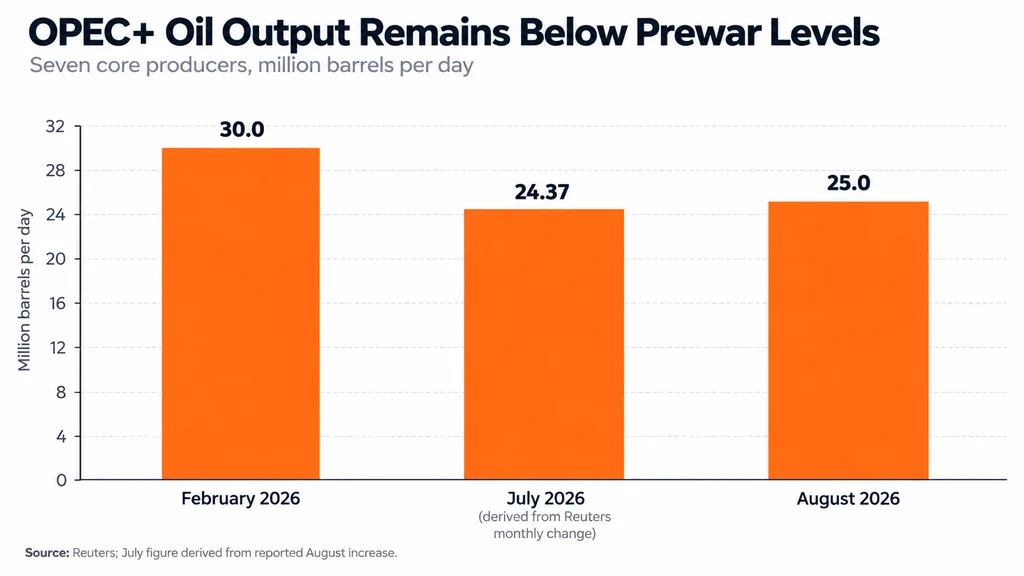
This also helps to explain why, despite weakening consumption expectations, crude oil prices remain high.
Earlier this month, OPEC lowered its outlook for oil demand, predicting that global oil consumption will only grow by 400,000 barrels per day in 2026, compared to the initial forecast of 1.4 million barrels per day.
Generally speaking, a decline in demand growth tends to ease price pressures, but ongoing disruptions in exports continue to limit the available supply.
As diplomatic progress in Iran alleviates supply concerns, Brent crude has fallen back to around $113.
Reports of renewed diplomatic contacts between Washington and Tehran have raised hopes that disruptions in supplies to the Middle East might be alleviated, and as a result, oil prices fell on Thursday.
However, the shipping risks around the Strait of Hormuz remain significant, and reports of oil tanker accidents also keep traders cautious.
The market's sensitivity to news was particularly evident on Wednesday: after the Houthi rebels in Yemen made an unverified claim of attacking the Ras Tanura refinery in Saudi Arabia, Brent oil prices soared to nearly $116 per barrel.
JPMorgan Chase previously estimated that the fundamental value of Brent crude oil was close to $94 per barrel, which means that when oil prices are above $110, there is a considerable geopolitical risk premium.
However, this estimate is based on a model and does not necessarily mean that crude oil prices will return to that level.
The meeting on November 1st may affect the oil supply arrangements for 2027.
For OPEC, the longer-term challenge lies in determining how much oil each member country can actually produce.
The organization must complete a capacity assessment before setting the baseline production for 2027, which will determine future quotas and how the remaining restrictions may be eased.
At the same time, additional fuel supplies from Russia may also affect the refined oil market. Following the relaxation of sanctions, a shipment of about 40,000 metric tons of diesel from Russia has recently been dispatched to the United States.
However, this shipment does not represent an equal increase in global crude oil production.
Washington has also tapped into emergency reserves to alleviate the shortage, including announcing the release of 40 million barrels of reserves in September.
However, the release of reserves provides temporary physical supply and does not permanently increase production capacity.
Author: Emir Abyazov
Coinpaper is the Chief Editor, responsible for driving data-driven editorial operations, content discovery oriented towards SEO, as well as prioritizing audience-oriented encryption, AI and fintech narratives.