


The Nasdaq Composite Index fell 2.86% on October 30, recording its largest single-day decline since June.
Rising infrastructure costs, financial reports falling short of expectations, and concerns about future returns are exacerbating the selling of tech stocks.
The index is approaching its 200-day moving average (EMA), making this key long-term support level a focal point of market attention.
The tech stock market, which drove Wall Street higher for most of 2026, is now facing a severe test. On Friday, the Nasdaq Composite Index fell 2.86%, continuing the downward trend since October, due to investors re-evaluating the costs and potential returns of the artificial intelligence boom. The pressure has spread from large technology companies to semiconductor stocks, with some of the biggest beneficiaries of this trend experiencing significant declines. Now, as the index trading levels approach its 200-day moving average, investors are faced with two questions: Is this just a brief pullback in the rise of tech stocks, or is it the beginning of a deeper market revaluation?
Why is the NASDAQ Composite Index falling? The key factors behind the sell-off
1. AI expenditures are becoming a concern for the market
Alphabet, Amazon, and Meta have all indicated that as they expand their data centers, enhance computing power, and expand their AI infrastructure, future expenditures are expected to increase further. However, these levels of investment are raising questions in the market regarding capital efficiency, cash flow, and the timeline for realizing returns.
During October, the Nasdaq 100 index, with a market value of over $2 trillion, faced the risk of having that value erased, as investors re-evaluated the economic viability of AI's operations. The increasing reliance on debt financing added another layer of concern.
2. The financial report failed to meet high expectations.
Amazon's continuously rising capital expenditures and cash outflows have exacerbated market concerns regarding the expansion costs of its AI. Intel has dealt another blow, with its earnings outlook disappointing investors, resulting in a 28.6% decline in its stock price on Friday.
The selling sentiment also spread to the semiconductor sector. NVIDIA fell by 4.2%, AMD fell by 10.9%, and the semiconductor index fell by 7.2%. These trends indicate how quickly the pressure from individual companies can spread to the broader technology sector.
3. Investors are re-evaluating tech valuations
After a long period of growth, market expectations for large technology companies have become very high. Even companies with strong revenue growth are facing scrutiny from the market regarding how much capital they need to invest in order to maintain that growth.
The market no longer rewards simply because of the exposure of AI. Investors increasingly hope to see that infrastructure spending can be transformed into stronger profitability and sustainable free cash flow.
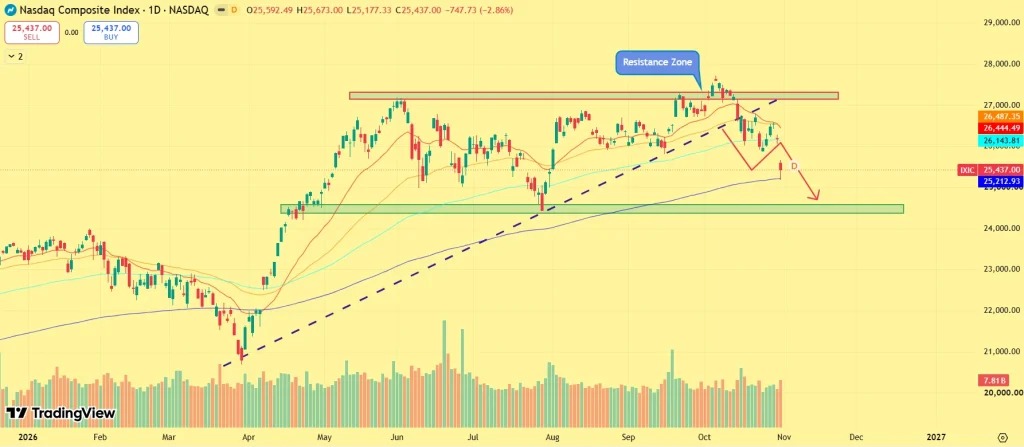
Nasdaq Composite Index Price Analysis: The 200-day EMA becomes a key test
The Nasdaq Composite Index has fallen from its recent highs and is approaching the upward-moving 200-day EMA. After several months of gains, this moving average has now become an important test. If the index can successfully hold above the 200-day EMA, it may attract buyers looking to enter the market after the October pullback. This would also help to maintain a broader upward trend, despite the recent deterioration in the performance of tech stocks.
However, if the index clearly falls below this moving average, the technical pattern will change. If large technology stocks and semiconductor stocks continue to be under pressure, the index may face a more significant pullback.
Therefore, the market's reaction around this level is more important than a brief rebound. Investors will be watching whether the buying pressure will return strongly, or whether the rebound will still attract new selling pressure.
What will happen to NASDAQ next? Three factors may determine the direction.
The next trend will depend on whether corporate performance can once again boost market confidence in the investment cycle of AI.
Financial reports to be announced soon:Apple's performance next week, as well as NVIDIA's financial report for November, will provide more insights into technology demand, AI spending, and profitability.
AI Investment Returns:Investors will be looking for evidence to prove that the increasing infrastructure spending is generating meaningful revenue and cash flow.
Technical Support:Whether NASDAQ can hold the 200-day EMA may determine whether the current decline is a correction or will evolve into a broader trend reversal.
Despite the significant decline on Friday, the weakness was mainly concentrated in the technology and communications services sectors, rather than spreading evenly across the entire market. This leaves room for a rebound driven by these sectors, but before investors return to the market, technology stocks may need more compelling earnings evidence.
Conclusion
Nasdaq's decline in October reflects a changing attitude of the market towards AI: growth expectations remain high, but investors are demanding clearer evidence of returns. The 200-day EMA is the next important technical test. If it can be held, it may stabilize this round of gains; if it breaks down, a deeper correction will become a formal consideration.