


Gold is experiencing a textbook example of a failure. All the macroeconomic factors that should have driven up gold prices have occurred simultaneously, yet gold prices have fallen in the opposite direction, breaking below the key psychological barrier of $4,000 last Friday. Goldman Sachs' latest analysis reveals the main forces behind this abnormal selling pressure and warns that the market structure has not yet cleared, and the downside risks remain uneliminated.
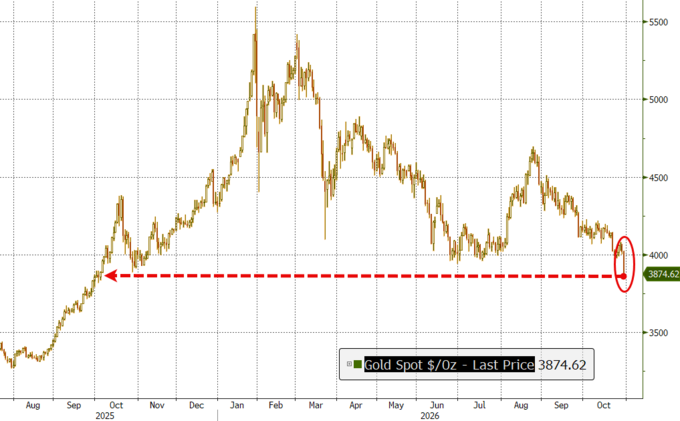
Last Friday, December gold futures closed at $3,898.90 per ounce, a daily decline of 3.3%; spot gold prices touched their lowest level since October 2025, falling approximately 30% from the historical high of nearly $5,600 in January. Goldman Sachs' commodities team noted in their weekly report that this drop below $4,000 occurred against a backdrop of geopolitical risks over the weekend and a broader contraction in risk appetite. On that day, the trading volume of CME surged by 80% compared to the previous day, with GLD ETF trading at around $4 billion in a single day, ranking seventh in the total trading volume of the entire market on that day.
Goldman Sachs analyst Robert Quinn pointed out in a report that since September 22, the market has sold off gold futures positions totaling $19.5 billion, and the pace of selling has continued to accelerate. Notably, the main force behind these sales is not hedge funds, which are usually blamed for such activities, but rather funds from the "other" and non-reportable categories, which together account for about 95% of the total sales volume. Meanwhile, bearish sentiment in the options market has risen to the 85th percentile of the past year, and the market is actively positioning itself for further declines.
The core contradiction of this sell-off lies in the following: the structural buying force that supports gold prices—central banks around the world—still exists and continues to enter the market, but their purchasing pace is much slower than the current selling speed. Buyers who are “insensitive to price” have encountered sellers who are also “insensitive to price”: central banks continue to buy regardless of price levels, while large holders such as sovereign nations may also sell gold, the most liquid reserve asset, without regard for price in order to meet their liquidity needs. In this battle between these two forces, the side with the faster pace currently holds the upper hand.
Selling scale and pace: For five consecutive weeks, $19.5 billion
According to Goldman Sachs' analysis of the CFTC position report, during the observation period from October 20th to 27th, speculative gold selling accelerated further. Managed funds, other categories, and unreportable categories collectively sold $8 billion, marking the fifth consecutive week of bearish capital outflows; the cumulative selling volume over five weeks reached $19.5 billion, including $5.2 billion in closing positions and $2.8 billion in new short positions.
Calculated at approximately $4,000 per ounce, $19.5 billion corresponds to about 4.9 million ounces, which is roughly 150 tons of gold. Goldman Sachs' own model for tracking central bank gold purchases shows that the current purchasing rate of official departments is about 85 tons per month. In other words, the amount of gold sold by speculative funds within five weeks is equivalent to the total amount purchased by central banks in nearly two months.
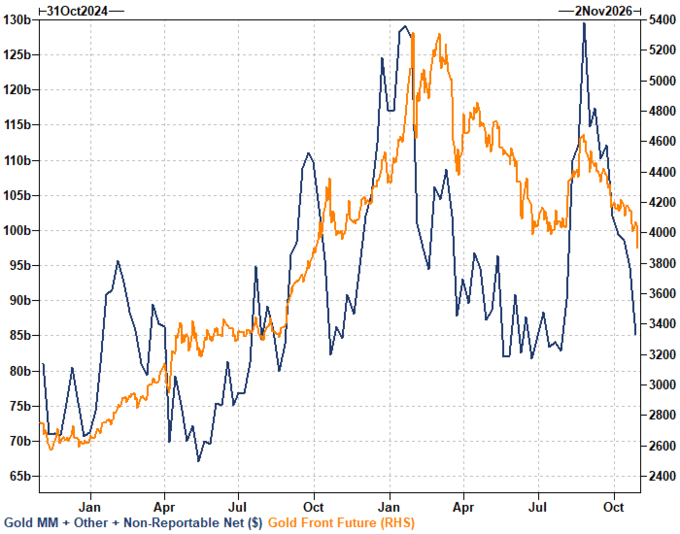
What is more noteworthy is the composition of the sellers. Hedge funds (managed funds) were almost absent from this round of selling. The "other" category and the non-reportable category together contributed about 95% of the total selling volume. Among them, the scale of short positions closed out by the "other" category reached $4 billion, making it the main source of selling. According to the definition of CFTC, the "other" category includes family offices, proprietary traders, and other large accounts that are not hedge funds in nature. These represent "slow money" with a lower turnover rate and more persistent positions.
All macro signals have failed: The shadow of sovereign liquidity management
What is unusual about this round of gold price declines is that all the traditional bullish factors are in place. Within the observed period, the U.S. 10-year real interest rate fell by 11 basis points, the stock market came under pressure, and the geopolitical situation in the Middle East remained tense—these three factors have always been the most reliable catalysts for gold prices to rise. However, gold prices still fell by 1.6% during this time.
Robert Quinn attributes some of the reasons to "concerns about sovereign liquidity management" as well as the strengthening of the US dollar. During the same period, Brent crude oil rose by 4.1%, and the US dollar index increased by 0.6%. Goldman Sachs pointed out that the six-month correlation between long positions in the "other" category and the US dollar and Brent crude oil is "moderately negative," meaning that when oil prices and the US dollar strengthen, these long positions tend to be closed and investors exit the market.
The term "sovereign liquidity management" points to a potential source of market concern: as Brent crude oil continues to rise and regional conflicts persist, some oil-importing countries, and even some oil-exporting sovereign entities, may have a greater need for dollars than they do for gold, which is actually the most liquid asset in their reserves. Goldman Sachs has also noted that recently a large amount of physical gold has flowed to London, and the gold bars that are entering London are precisely those that can be sold on the London market.
Position not yet closed: Downside risks remain.
Goldman Sachs made it clear that this round of selling has not yet ended. As of October 27, the long positions in the “other” category were still above the two-year median level in both nominal size and as a proportion of open contracts. The proportion of long positions in this category to open contracts once rose to around 20% in mid-October, which is the highest value on Goldman Sachs’ one-year chart; although it has fallen to around 18% after recent sales, it is still far higher than the low of around 11% to 12% in February.
The deadline for COT data is October 27th, after which the market further deteriorated. According to Goldman Sachs data, from October 27th to 30th, gold prices fell another 4.3%, while Brent crude oil rose by 3.7%, becoming a major restraining factor; the decline in the US dollar and real interest rates was no longer able to support gold prices.
At the ETF level, as of last Thursday, the position holding volume of GLD was still only about 1% away from its historical high. Goldman Sachs estimates that even if all the capital outflows on last Friday from ETF came from reducing positions, it would amount to only about 1 million ounces, while the total position holding of GLD exceeds 100 million ounces. This means that the potential selling pressure is still quite considerable.
Option Market: Bearish Sentiment Rises to a High of the Year
The signals released by the options market are also not optimistic. According to the report from Quinn, both the implied volatility of gold over 3 months and the standardized 25-day delta bear/bull skew have increased, with the latter reaching the 85th percentile of the one-year ranking.
Goldman Sachs data shows that the skewness has risen significantly from around -10 in September to around +6, and the implied volatility over three months has rebounded from around 19% near the low in 2026 to over 21%. Last Friday, the implied volatility jumped by 3.5 volatility points in a single day, and the two-week high-frequency implied volatility has now risen to 18.5. Six weeks ago in September, the market was still scrambling to buy call options; today, the premium on put options has risen to the 85th percentile.
In response to this, Goldman Sachs' commodities trading desk stated that currently, "the exposure to options and delta risks is limited," and they are waiting for signals to re-enter the market, having not yet deployed additional risk on the long side.
The next support level and the long-term logic of structural bullishness
Goldman Sachs' commodities trading desk regards $3,850 as the next key support level, but at the same time acknowledges that this is a "moving target," and admits that the previous expectation that $3,950 could be held has been proven incorrect. $3,850 is less than 1.5% away from the current futures price of $3,898.90, and it is also lower than the $4,070 short-term bottom set by Goldman Sachs' commodity research team last month in a scenario of a "tough Fed." At that time, the team believed that continuous central bank gold purchases would gradually raise this bottom.
The structural logic supporting gold prices has not changed: central banks around the world are still continuing to buy gold, and the trend of de-dollarization has not reversed. Goldman Sachs' research team maintains its target price of $5,400 for gold by the end of 2027 and believes that official gold purchases will be the main driving force behind achieving this goal.
However, the pace of structural buying is slow, while the current selling speed is faster. Against the backdrop of long positions in the “other” category still exceeding the two-year median, high option skewness, a cautious stance from traders, and the market pricing a 75% probability of a Fed interest rate hike in December, Goldman Sachs believes that the direction with the least resistance is still to first test support at $3,850, with a possibility of breaking below that level. Only thereafter would there be an opportunity for central banks to enter the market and buy on dips. This path will become even clearer if oil prices continue to rise within the “post-midterm elections escalation window” that the commodities team is monitoring.