

Beneath the apparent calm of U.S. stock market indices, there is a severe tearing apart that is rare since 2000. In a report released on November 1st, BTIG Research warned that this current intense sector rotation has not yet ended, and the market is far from reaching a true bottom.
In the past five trading days, five sectors have seen increases of over 2%, while two sectors have experienced declines of over 5%. However, VIX has not been able to close above 20 throughout this period. This seemingly contradictory combination actually reveals the issue: volatility has been absorbed by the rotation of different sectors, and the calmness at the index level has masked the fragility of the internal structure. BTIG believes that this state of low VIX does not constitute a safety cushion, and the day when correlations tend to align in a downward direction has not yet arrived.
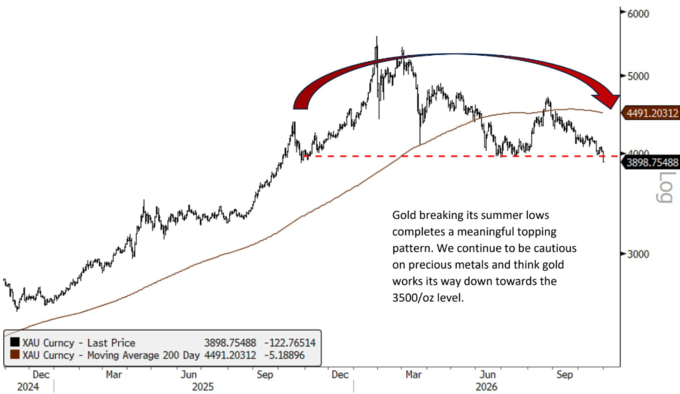
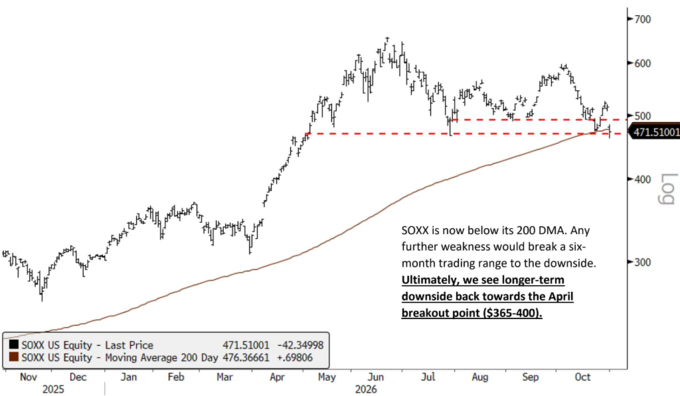
At key points, the downside target for the S&P 500 is around 7,300 points, near the 200-day moving average, while the long-term downside target for the Philadelphia Semiconductor Index ( SOXX ) is in the range of $365 to $400. Meanwhile, gold and silver have completed a topping pattern. The downside target for BTIG for gold is $3,500 per ounce, and for silver, it is $40 per ounce.
Surface volatility is suppressed, but the internal structure is already fragile.
The report states that VIX failed to close above 20, which in the eyes of many investors means that the market is still within a controllable range. However, the analysis of BTIG leads to a completely opposite conclusion.
Five sectors saw a single-week increase of over 2%, while two sectors experienced a decline of over 5%. This extreme cross-sectional differentiation indicates that the real fluctuations in the market are offsetting each other between different sectors, thereby reducing the volatility readings at the index level. In other words, the low levels of VIX are not a sign of market stability, but rather a byproduct of the intensity of sector rotation – volatility is being absorbed by these cross-sectional differences, making the index level even more vulnerable.
The technical pattern of the semiconductor sector further confirms this judgment. The equally weighted semiconductor index ETF ( XSD ) has fallen below the 200-day moving average for the second time and is approaching its third test of the July low. BTIG clearly states, "This is not what a bottom should look like." The Philadelphia Semiconductor Index ( SOXX ) also broke below its support level, and BTIG believes that its long-term downward target has returned to the breakout point from April, which is in the range of $365 to $400.
Historical patterns indicate: emotions are far from settled; the decline may not be over yet.
BTIG cites multiple historical data points to argue that current market sentiment and technical structures do not support the conclusion that a 'bottom has been reached.'
The Nasdaq 100 index has formed a negative外包 month pattern at a historical high for the eighth time since 1985. Based on historical experience, there has been positive returns in the six months following each of the previous seven occurrences, which is somewhat comforting for bulls. However, another aspect that cannot be ignored is that in all seven cases, there was a pullback of at least 8.5% within the following six months, with the pullbacks in 1990 and 2020 exceeding 20% in magnitude.
Emotional indicators also show that the washing process is far from complete. The NASDAQ Daily Sentiment Index ( DSI ) currently closes at 44, which is the lowest level since July. However, the lowest point in July was 30, and the lowest point in March was 12 – the current reading of 44 is still quite far from the true panic-level lows.
More importantly, in the past year, there has not been a single trading day on the New York Stock Exchange where the volume of daily declines exceeded 80%. BTIG describes this phenomenon as 'unprecedented.' In their view, the market does not yet have the conditions to make a comeback until there is at least one, or even several, such instances of a 'convergence of correlations' leading to significant declines.
The credit market is also issuing warnings. The average spread on high-yield bonds has risen to 340 basis points, reaching a new high for the year. Previously, market concerns were mainly focused on CCC rated bonds, but now the widening of the average spread indicates that the pressure has spread to a broader credit market.
Key milestone: S&P 500 targets 7,300; the risk-return ratio on the defensive side has changed.
At the specific risk points, BTIG has set the downside target for the S&P 500 around 7300 points, near the 200-day moving average, which is in the range of the summer lows. This position will be a key battleground for both bulls and bears.
The risk-return profile of defensive sectors is also quietly changing. The essential consumer goods sector just recorded its strongest single-month performance since October 2000, with a monthly increase of over 11%. The concentrated release of funds seeking safety has reduced the short-term cost-effectiveness of this sector. The same is true for the utilities sector – I was bullish on this sector in September when it was extremely oversold, but after a 11% rebound and reaching a key resistance level, its risk-return ratio has completely reversed, and it no longer possesses the previous attractiveness.
In terms of precious metals, BTIG believes that both gold and silver have completed their peak formation patterns, and maintains a cautious stance. The downward targets are set at $3,500 per ounce for gold and $40 per ounce for silver, respectively.
Midterm Election Variables: Kansas Turns Blue, AI Sector Faces Policy Headwinds
Uncertainty at the political level has added new variables to the market. BTIG points out that polls and betting market forecasts often prove incorrect, but current data indicates that the probability of the Democratic Party winning a Senate seat in Kansas has exceeded 50% – the last time Kansas swung in favor of the Democratic Party in a Senate election was in 1932.
If the Democrats achieve a "blue sweep," it will pose a setback for data center construction, thereby putting pressure on investments related to AI infrastructure. BTIG judged last week that the midterms were unlikely to be a "cleaning event" for the market and still maintains that assessment.
However, BTIG also leaves room for maneuver: if the sectors related to AI continue to decline before the election day (Tuesday, November 3rd), they are willing to cover their tactical short positions in order to capture any possible short-term rebound. BTIG also notes that SOXX has been declining for four consecutive weeks, and a counter-trend rebound could occur at any time, but this does not change their medium-term assessment that there is still substantial downward potential for the semiconductor sector.
BTIG has set clear verification conditions for the aforementioned judgment, with the verification period being two weeks from November 3, 2026, the date of the U.S. mid-term elections.
In terms of outcome indicators, the key observation point is whether the S&P 500 touches or falls below its 200-day moving average of around 7,300 points. Regarding mechanism indicators, it is necessary to pay attention to whether there are trading days on the New York Stock Exchange where the volume of single-day declines exceeds 80%, as well as whether VIX closes above 20.
The counter-evidence is equally clear: if semiconductors experience a strong rebound after four consecutive declines, the S&P 500 manages to stay above its 200-day moving average, and the yield spread on high-yield bonds falls below 300 basis points, then the judgment that 'there will be further declines' will be significantly weakened.