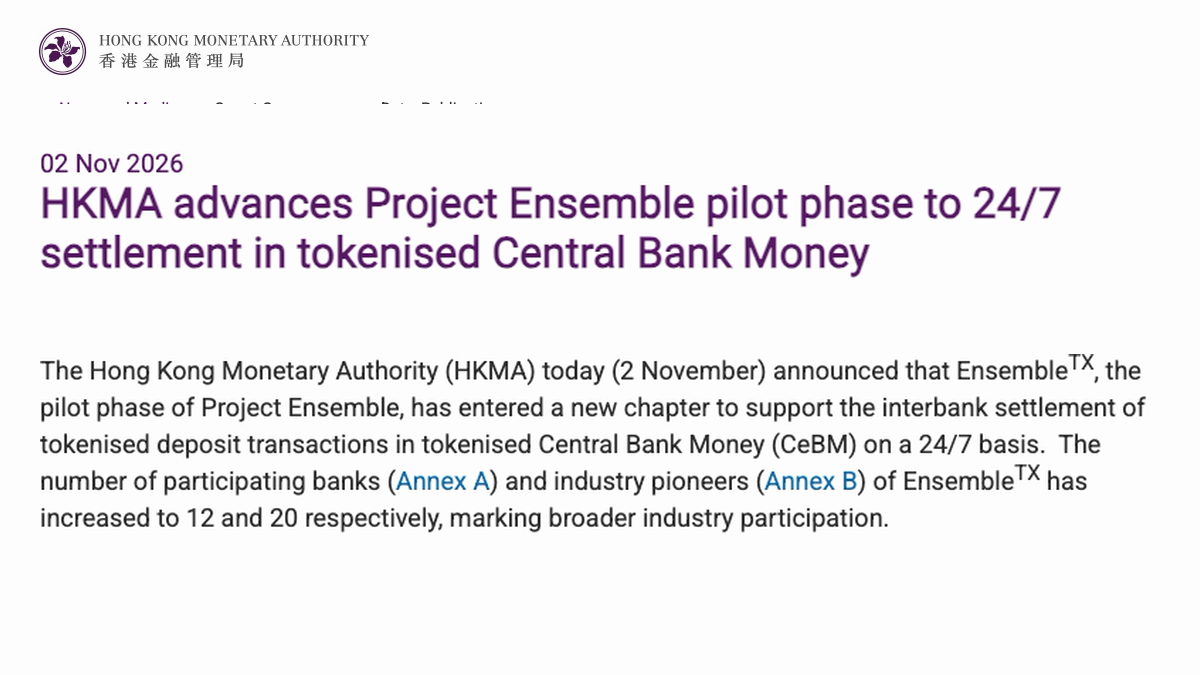


Tokenized assets can be traded throughout the day, but if interbank settlements are still restricted to traditional business hours, funds will come to a halt at the most critical stage. On November 2nd, the Hong Kong Monetary Authority announced that during the trial phase of Project Ensemble, Ensemble TX began to support the use of tokenized central bank money for 24/7 settlement of interbank tokenized deposit transactions. The number of participating banks has increased to 12, and the number of industry pioneers has risen to 20.
This upgrade affects the settlement layer. When customers and institutions holding tokenized deposits need to transfer value between different banks, the participating banks use tokenized central bank money to complete inter-bank settlements. In this process, central bank money serves as the final settlement asset, which is not equivalent to issuing retail digital Hong Kong dollars that can be freely used in wallets to the public.
When Ensemble TX launches in November 2025, it will primarily rely on the Hong Kong Dollar Real-Time Payment and Settlement System RTGS to process transactions involving the real value of tokenized deposits and digital assets in a controlled trial environment. Existing use cases include corporate financial management and transactions in tokenized money market funds. In the new phase, interbank settlements will be extended from traditional operating hours to 24 hours a day, seven days a week.
Assets are active throughout the day, and the settlement window must keep up as well.
Traditional securities and banking systems typically have settlement days, business hours, and cut-off times, whereas assets on a blockchain can be transferred continuously. If asset transactions occur on weekends or late at night, and the settlement funds are only available once banks are open again, both parties to the transaction still have to bear the time lag and counterparty risk. Central bank-backed real-time currency settlement aims to shorten this gap.
The Hong Kong Securities and Futures Commission mentioned in its announcement that tokenized deposits can support corporate financial management, as well as secondary market trading of tokenized funds on licensed platforms. The term "can support" refers to the infrastructure capabilities and application directions, and does not imply that all funds have been opened for 24-hour trading, nor does it mean that any platform has obtained the same permits.
The test scope for the expanded display of the participant list has widened, but 12 banks and 20 pioneers still serve as clear boundaries. The pioneers listed in the announcement include Ant International, BlackRock, and Huaxia Fund (Hong Kong). The participating banks include Bank of China (Hong Kong), CCB Asia, ICBC Asia, Standard Chartered (Hong Kong), and HSBC. The fact that certain institutions are on the list does not mean that all their customers or products have been integrated.
It's not about the full release of stablecoins.
In the materials for the Financial Technology Week on the same day, the HKMA stated that it had completed trials allowing recognized traders to participate in the secondary market and repurchase transactions of tokenized foreign exchange fund notes, and plans to include regulated stablecoins in these trials later on. This timing is crucial: the settlement of tokenized central bank money has entered a new phase, while regulated stablecoins are the targets of the upcoming expansion of these trials; therefore, it cannot be stated that both will be fully launched on the same day.
Tokenized central bank money, tokenized deposits, and stablecoins are not the same type of liability. The former involves the central banking system in undertaking the settlement role, tokenized deposits correspond to commercial bank deposits, while stablecoins depend on the reserves and regulations of licensed issuers. They can operate within the same market infrastructure, but they cannot be interchangeably referred to by the same name.
The HKMA stated that the project is moving from experimentation and trial implementation to promoting commercial applications. However, this direction does not yet equate to the announcement of transaction volumes, handling fees, or a timeline for products to be made available to the public. The announcement did not disclose how many transactions have been settled since this upgrade, nor the total amount involved, nor did it promise that all types of digital assets would be supported.
For institutional funding teams, the real change lies in the time boundaries: tokenized transactions no longer have to wait for traditional banking hours to complete interbank settlement. For ordinary users, the most important misunderstanding to avoid is to regard wholesale settlement facilities as a form of new retail currency. Ensemble TX has added infrastructure to support 24/7 markets, but who can use it, what assets can be involved, and what regulatory frameworks apply still need to be confirmed on a case-by-case basis.
24/7 settlement also pushes the operational requirements from "extended business hours" to true continuous operation. Banks need to handle issues related to permissions, liquidity, abnormal transactions, and technical failures at night and on weekends; the announcement does not clarify how these costs are allocated. The technical capability to settle transactions does not mean that every institution will immediately switch all their operations to a 24-hour mode.
For tokenized funds, extending the secondary trading time also involves valuation and redemption rules. If the underlying assets are still traded in traditional markets, the price to be used for the day-long trading of on-chain shares and when the net value is to be determined are still decided by the specific product documentation. Although the settlement layer has extended the time window, it has not canceled the market clock of the assets themselves.