

The 30-day average retail inflow for Binance has dropped to just 281 BTC, whereas during the bull market cycle from 2019 to 2021, this number was 2700 BTC. CryptoQuant believes that the ETF of spot Bitcoin in the United States may be one reason for the decline in funds entering exchanges. Meanwhile, Bitcoin is testing a support level around $77,300, with $78,000 and $76,460 still being key resistance and support levels, respectively.
Despite the valuation of BTC being much higher than in previous market cycles, retail activity around Bitcoin on Binance has dropped to a multi-year low. Analyst Darkfost from CryptoQuant stated that the inflow of small investors has decreased to just 281 BTC, which has raised questions among outsiders as to why retail investors are no longer as active as before.
Binance Retail deposits decline by nearly 90%
According to Darkfost, the average daily inflow of retail investors into Binance has dropped to just 281 BTC over the past 30 days. This indicator tracks deposits of less than 1 BTC, reflecting the situation of small investors transferring funds to the exchange.
During the bull market cycle from 2019 to 2021, the average inflow of retail investors was approximately 2,700 BTC, which is almost 10 times the current level. At that time, the trading price of Bitcoin was close to $15,700. At the beginning of 2023, after the collapse of FTX, market panic drove the average inflow up to about 1,900 BTC, and activity also picked up somewhat.
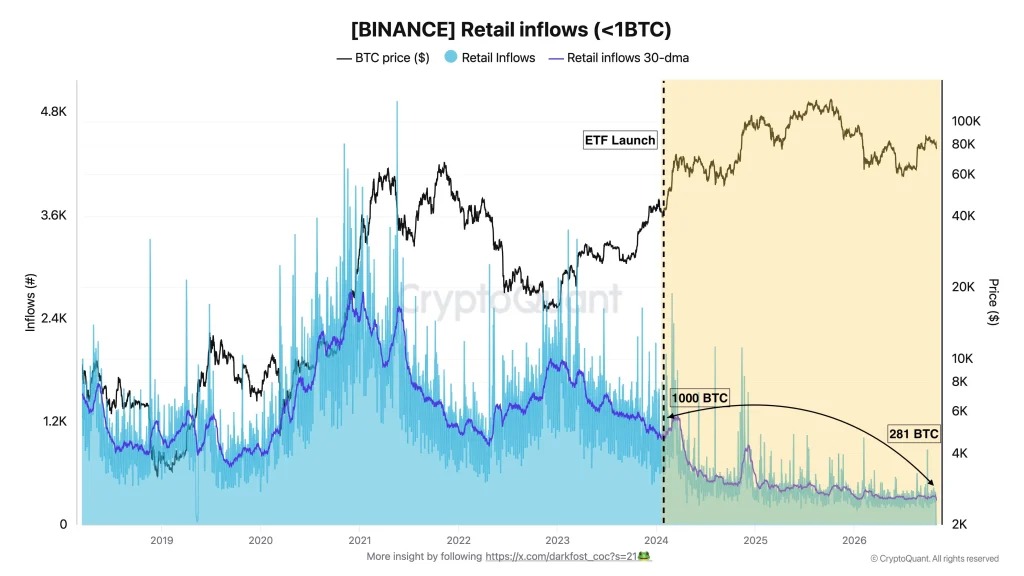
However, the increase brought about by the market highs in March and December 2024 was much smaller, with inflows reaching only 900 to 1200 BTC.
Why do retail investors deposit less Bitcoin?
Darkfost regards the launch of spot Bitcoin in the United States in January 2024 ETF as one of the main possible reasons. Before these products entered the market, investors who wished to directly obtain Bitcoin exposure usually had to purchase BTC through cryptocurrency exchanges.
ETF provides another option for investors to gain exposure through traditional investment accounts, without the need to manage private key wallets.
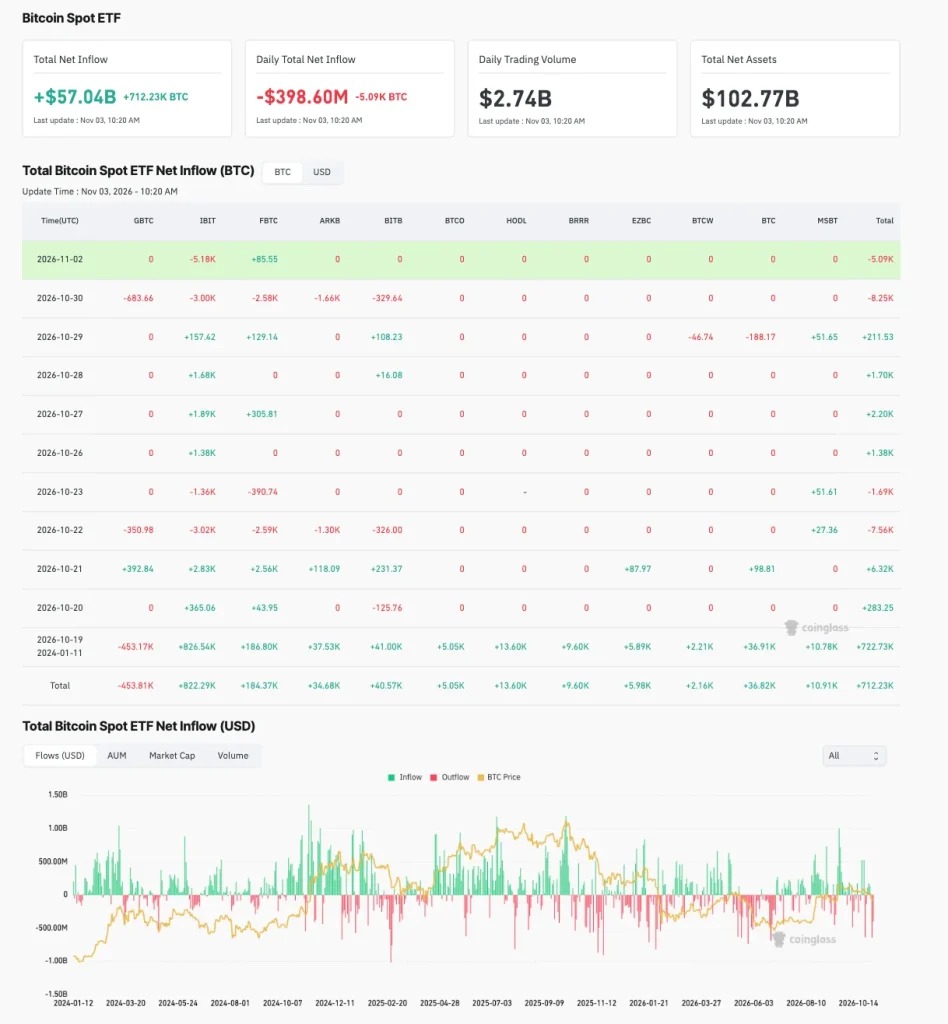
This market scale is already quite considerable. The cumulative net inflow of spot Bitcoin in the United States has reached $57.04 billion, and as of November 3, 2026, its total net assets have reached $102.77 billion.
Another possibility is that investor behavior has changed. Some holders may now be more inclined to hold Bitcoin in the long term, rather than making frequent deposits or transferring it between exchanges.
Bitcoin Price Outlook
As of now, Bitcoin has fallen by 1.09% in the past 24 hours to $76,915.34, while the broader crypto market has remained relatively stable overall. This decline has led to increased activity in the derivatives market, with the settlement amount for Bitcoin within 24 hours rising to $105 million.
Bitcoin is currently testing the support level around $77,300. If this level is held, prices could rebound to the resistance level of $78,000. However, if it clearly falls below $76,460, it could open the way for the next support level of $73,800.