Key Points
- The income obtained from predictive trading could be 175 times that of stock trading.
- The event contract generated $173 million in revenue in a single quarter.
- Predictive markets bring new opportunities, but also regulatory risks.
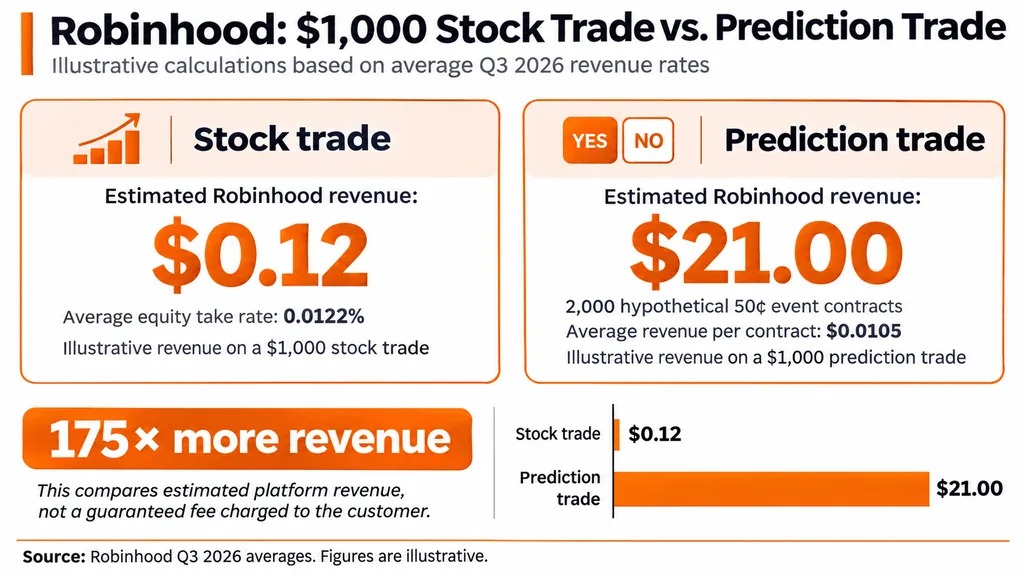
Robinhood has built a reputation on commission-free stock trading. However, nowadays, this brokerage firm can earn approximately $21 from a single market prediction trade worth $1,000, while buying stocks of the same size only generates $0.12 in revenue.
This astonishing difference helps to explain one of the most significant financial transformations on Wall Street. According to the Robinhood third-quarter results, event contracts generated $173 million in revenue, exceeding the $121 million brought in by traditional stock trading.
If we compare the same transaction amounts, this gap becomes even more apparent. The continuously expanding forecasting business of Robinhood not only attracts more customers; it is also able to realize certain transactions at significantly higher fees.
How can a $1,000 transaction generate 175 times the income?
The differences first stem from the different charging methods of the two markets.
When customers buy and sell stocks through Robinhood, the platform typically does not charge traditional transaction commissions; instead, it generates revenue by collecting fees from market makers through the order flow.
In the third quarter, the average revenue rate from Robinhood stock trading was approximately 0.0122%. This means that a purchase of $1,000 worth of stocks would only generate about $0.12 in income.
Predictive contracts use a different mechanism.
An event contract priced at 50 cents typically pays out $1 if the predicted outcome occurs; if it does not occur, no payment is made. Therefore, with an investment of $1000, one could theoretically buy 2000 contracts.
According to an analysis by The Wall Street Journal, Robinhood had an average revenue of about 1.05 cents per event contract in that quarter.
Multiplying this average value by 2,000 contracts results in an income of about $21, which is equivalent to 175 times the income from comparable stock transactions.
This does not mean that each customer paid a fee of 2.1%. The actual fee, the transaction price, and the income ultimately realized by Robinhood depend on the specific contract and transaction arrangements.
This difference reflects that, compared to the relatively newer event contract market, mature stock markets are much more efficient in terms of trading pricing.
Why predicting business has become bigger than the stock business
Robinhood entered the forecasting market in March 2025 through cooperation with Kalshi.
Its third-quarter event contract revenue increased from $27 million in 2025 to $173 million in 2026, while customers traded a total of approximately 16.4 billion contracts.
This growth helped to offset a 55% decline in crypto business revenue.
Robinhood is also further expanding beyond its distribution of third-party contracts.
Through the Rothera exchange jointly developed with Susquehanna, it has also provided another source of income from the underlying trading infrastructure.
At the same time, the company is also expanding into Bitcoin and gold forecasting, which brings more opportunities beyond traditional sports contracts.
Robinhood Can one still continue to earn so much?
As competitors enter the forecasting market and transaction costs decrease, this significant revenue disparity may become increasingly difficult to maintain.
Mature exchanges are already exploring binary stock contracts, which could introduce competition from traditional financial institutions.
Adrian Cole has been engaged in financial market reporting for over 6 years, with a focus on crypto assets, stocks, and macroeconomic trends. He tracks Bitcoin, major altcoins, the U.S. stock market, interest rates, commodities, as well as data that drives market fluctuations. Over the years, he has written hundreds of market updates and analysis articles, with an emphasis on price trends, investor sentiment, and the connections between traditional finance and digital assets.