There have always been many mysteries surrounding the financial situation of the large AI laboratory, and as Anthropic gradually approaches IPO, the outside world has begun to get some answers. In particular, the company has finally disclosed more data regarding the economics of computing power, as well as how much of its soaring revenue is consumed by the costs of computing power.
Data disclosed on Monday in a new document indicates that its profit margin related to computing power is actually deteriorating. This document is an update to the S-1 released last week – however, the financial disclosures in that document only covered up to June 30 of this year, while the new data extends the coverage period by one quarter to September 30. Overall, Anthropic performed well this quarter: revenue reached 17 billion US dollars, higher than the 11.5 billion US dollars of the previous quarter, showing continued growth. However, operating losses have also expanded at the same time, mainly due to rising computing power costs.
Looking at the profit margin of computing power, the situation is even worse. In the new quarter, computing power accounts for 58% of the company's revenue, up from 48% in the previous quarter. At a time when the company could have attracted IPO investors by showing an improvement in profit margins, the situation is actually deteriorating.
A chart in the document illustrates this point more clearly: it tracks the revenue generated for each dollar spent on computing power by the company. Since the beginning of 2025, this metric has been steadily rising, and in the just-passed quarter, it even exceeded 2 times; thereafter, it fell back to 1.72 times.
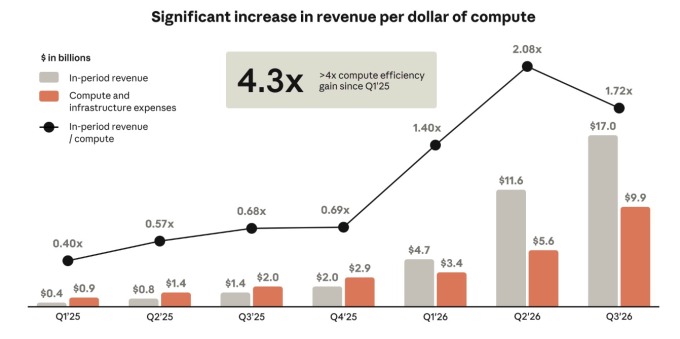
Many signs indicate that changes in the profitability of computing power are more like short-term fluctuations rather than long-term issues, but they still reveal important information about operating large-scale laboratory businesses. To meet the demand, Anthropic's computing power bill for this quarter soared to $10 billion, which includes the "5 billion dollars of short-term committed computing power mentioned in the document; the current cost of this type of computing power is significantly higher than that of comparable computing power we purchase through multi-year commitments." In simple terms, demand grew too fast, and Anthropic had to find computing power on a temporary basis, thus paying a higher price.
Some of these transactions have already become public. Anthropic has been paying SpaceX a monthly fee of $1.25 billion for computing power, and at the same time, it has also signed deals worth several billion dollars with Nscale, Akamai, and Volta. In industry terminology, these companies are classified as neocloud, rather than hyperscaler – which refers to smaller companies that can offer more flexible computing power agreements but at a higher cost.
Anthropic The profit margin in the third quarter deteriorated due to these types of transactions, and it does not seem that the company will be able to get rid of them in the short term. A new document states: "We expect that as we obtain more committed computing power through multi-year arrangements with CSP, and as we continue to invest in additional computing power, the costs of computing power and infrastructure will continue to rise in absolute dollar terms and will remain our largest operating expense for the foreseeable future."
Anthropic is still working hard to reduce computing power costs. In particular, the company has devoted considerable effort to discussing its efforts in building its own computing power infrastructure under a project called “Anthropic Direct”. However, with demand growing so rapidly, these efforts struggle to keep up. neocloud will still be their best option for now.
In a sense, these are all "champagne problems." As long as revenue grows at a rate of nearly 50% per quarter, few investors will worry about high computing power costs; however, once demand slows down, investors may feel reassured by the obvious improvement in computing power capabilities. But this also reminds us to what extent the AI laboratories still rely on infrastructure construction worth trillions of dollars, and how vulnerable they are to any fluctuations in this process. It's easy to imagine that if the bond market becomes more cautious or local resistance intensifies, data center construction could slow down in the coming year. Anthropic is almost powerless against both types of risks, and either scenario would make the already complex computing power situation even more troublesome.
At the same time, the future of Anthropic and other laboratories will still be constrained by the cost of computing power.