Key Points
- The CEO of Ripple stated that the competitors of RLUSD are other stablecoins.
- With the expansion of institutional business, the traffic of RLUSD has reached $2.63 billion.
- XRP remains a key component of the fees and liquidity for XRPL.
Ripple CEO Brad Garlinghouse refuted claims that the company's growing RLUSD stablecoin business is replacing XRP. He stated that although institutional adoption is accelerating, these two types of assets serve different purposes.
On November 3rd, Garlinghouse responded on X that RLUSD competes with other stablecoins, not XRP, and emphasized that it should be the customer's use case that determines which asset is more suitable. He also agreed with another interpretation in the community, that is, these two assets are complementary to each other.
Before his comments were published, there were again doubts from the outside world as to whether the business expansion of Ripple would directly translate into demand for XRP, especially at a time when more and more banks are adopting settlement methods denominated in US dollars.
Ripple CEO claims that XRP and RLUSD serve different markets
This statement by Garlinghouse followed closely on his speech at the Ripple Swell event in October. At that time, he denied rumors that the company had shifted its focus away from XRP.
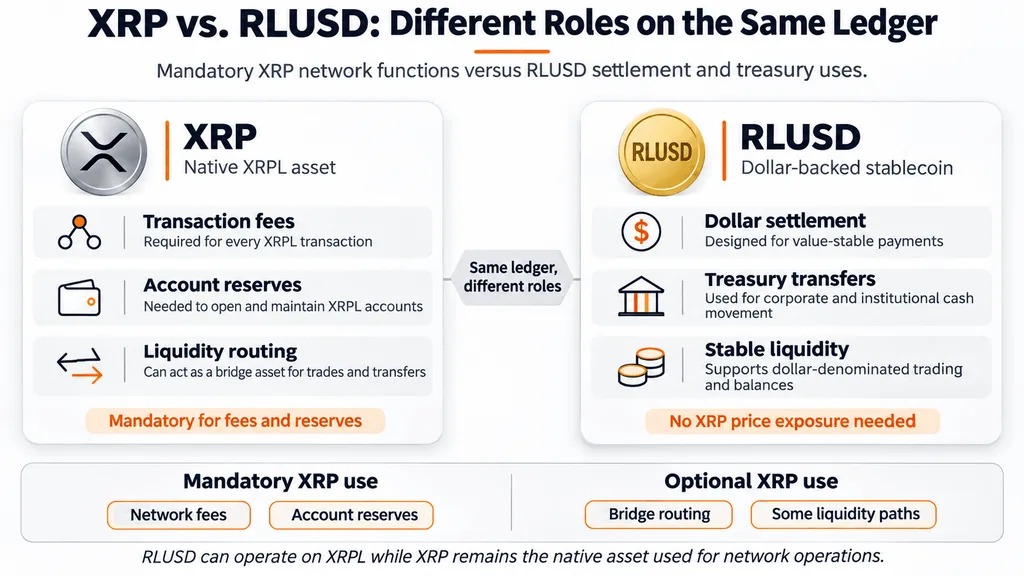
The difference between the two assets lies in their mode of operation.
RLUSD is designed to maintain a value of $1, allowing institutions to complete payments and settlements and manage their fund balances without bearing the risk of cryptocurrency price fluctuations.
In contrast, XRP is the native asset of XRP Ledger, and it is used to pay for transaction fees, account reserves, as well as for certain cross-currency liquidity pathways.
Each standard XRPL transaction consumes a small amount of XRP, while new accounts usually require at least 1 XRP as a minimum reserve.
However, to send RLUSD worth 1 million US dollars, there is no need to purchase XRP worth 1 million US dollars first.
This difference also echoes the previous statements of Ripple's Chief Technology Officer. The latter has explained why companies may prefer to use stablecoins in some transactions, while using XRP in others.
As the institution expands, the RLUSD circulation has risen to 2.627 billion US dollars.
Ripple official reserve disclosure shows that as of October 29th, the circulation of RLUSD was 2.627 billion US dollars, with corresponding reserve assets amounting to approximately 2.759 billion US dollars.
With the expanded support from major financial institutions, the growth of RLUSD is accelerating.
Bank of New York Mellon ( BNY ) has recently launched custody services for XRP and RLUSD simultaneously, and Coinbase has also incorporated this stablecoin into its retail and institutional trading infrastructure.
At the same time, Ripple expects that by the end of the year, the annualized revenue operating rate of its broader business will reach $900 million.
However, this growth does not necessarily translate into a proportional increase in purchases of XRP.
RLUSD is issued on both Ethereum and XRPL, which means that some of the stablecoin activities occur entirely outside of XRP Ledger.
RLUSD Is adopting growth really beneficial to XRP?
The strongest economic ties between the two come more from liquidity, rather than just the transaction fees themselves.
The decentralized exchange of XRPL can route transactions through XRP when there are more favorable exchange rates, which may create a demand for XRP as an intermediate asset.
Previous on-chain analysis found that within 6 months, the trading volume of RLUSD / XRP approached 900 million US dollars, indicating that this stablecoin may help to increase the liquidity of XRP.
However, trading volume does not indicate exactly how much XRP investors have held permanently.
In addition, the low transaction fees of this network also mean that even if the RLUSD transfer activity increases, it may boost the usage of XRP, but it is not necessarily going to create significant buying pressure.
Recently, data from the XRPL stablecoin shows that the quarterly transfer volume reached $14.09 billion, indicating that network activity is growing. However, this does not prove the existence of a corresponding demand for the XRP.
The author, Marcus Hale, introduces himself as someone who focuses on Bitcoin, Ethereum, digital assets, regulation, ETF, and the encryption and financial markets adopted by institutions. He primarily reports on developments that impact the market, investor trends, as well as the broader forces that shape the crypto economy.