Almost a year ago, Figure AI CEO Colby Adcock responded to some mild mockery from competing robotics company Agility on social media by saying, "You will go bankrupt within 12 months."
As a result, Agility is going public through a reverse merger and has raised $465 million in new capital from retail investors and a private placement. This transaction will be completed through a special purpose acquisition company, which is SPAC.
"You don't often see robots that dance like Agility or do backflips like those robots," said Agility, the CEO of Peggy Johnson, in an interview with TechCrunch before the company entered the market. "We stuck to our strategy, which is to focus on those manual tasks that are very repetitive and difficult to find people to do."
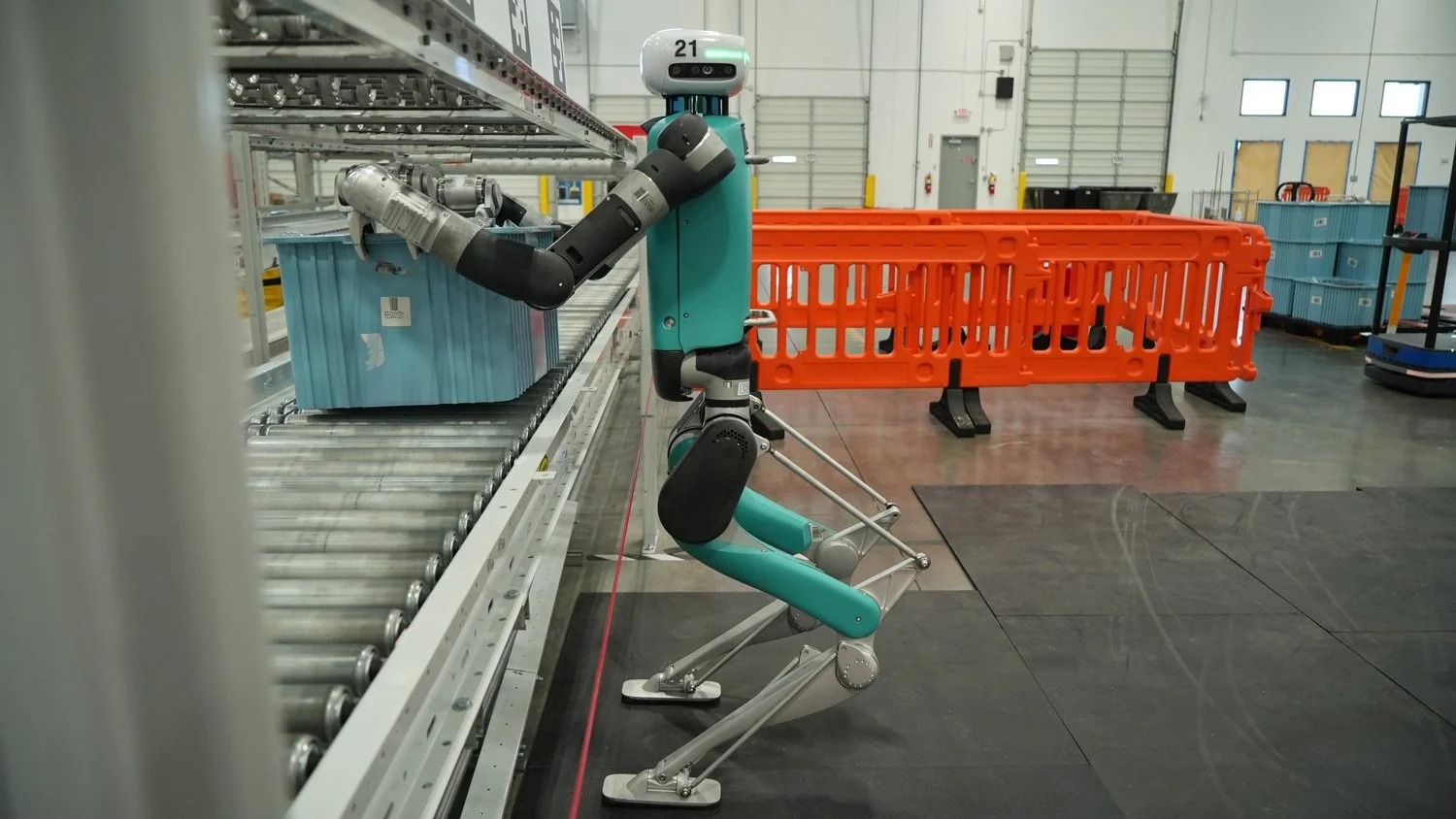
Agility predates the recent investment boom in AI. The company was spun off from Oregon State University in 2015 by a group of researchers who have made progress in enabling robots to walk safely on two legs. Since then, the company has focused on deploying a small number of Digit robots in industrial settings, with clients including Schaeffler, GXO, Toyota Motor Manufacturing Canada, and Mercado Libre among nine other customers. Digit is typically used for handling heavy turnover boxes, with over 100,000 of these being moved in one GXO logistics facility.
Compared to the humanoid robots created by Figure, Tesla, 1X, or Boston Dynamics, the Digit of Agility may appear to move more slowly, but this robot is indeed doing real work and is also generating revenue—although its income in the first six months of 2026 was only $174,000, and most of that came from related parties. The company incurred a loss of $362 million during the same period, which means it must successfully deploy this new capital as soon as possible.
The good news is that Agility has secured planned contracts totaling 300 million US dollars from 30 customers for the new generation of robots Digit. This new model can operate safely in human environments, unlike the previous generation which could only operate in isolated work units, which is actually the case for most humanoid robots as well. Johnson stated that this deal is "one of the driving factors" behind the company's decision to go public, but she cannot disclose who the customers are at this time, nor can she confirm whether they are also investors.
In order to finalize these transactions, Johnson stated that Digit must meet undisclosed targets across multiple indicators, including throughput, uptime, and placement accuracy. The company has not yet showcased a prototype of Digit, but Johnson said that they will be unveiled in CES 2027 and will be widely available by the end of that year.
The selling point of the company is that, under the robot as a service model, robots can save businesses $100,000 per year; if customers purchase the robots directly, the savings will be even greater. Whether this unit economics hold up in the end will depend on the capabilities of Digit, including the accuracy of tasks and how long it can work continuously without the need for charging or maintenance pauses.
Johnson gave an example: lifting a 50-pound object by one person – some workplaces use this informal threshold to avoid injuries. “Digit can do this over and over again,” she said, “you wouldn’t want to assign this task to humans. You would want to assign it to robots.”
Agility faces two key issues: how quickly it can find new customers for Digit, and how quickly it can enhance the capabilities of the robots. Potential customers need to spend $500,000 first to allow Agility to conduct on-site proof-of-concept tests before deployment can be fully scaled up; as of May 2026, 4 customers have signed contracts. Although Agility is capable of lifting heavy objects and placing them with 98% accuracy, it still – like most robots today – lacks the ability to perform complex operational tasks.
It is still unclear how quickly generative AI technology will unlock the kind of dexterity that would enable robots to handle a variety of objects. Systems trained on video and teleoperation data have not resulted in reliable general autonomous capabilities. However, physical AI researchers believe that adapting the Transformer architecture to different modalities seems promising.
"There is no internet of physical data for robot movements, so you will see many people trying to simulate this data using various methods. We have also utilized all these techniques," said Johnson. "Each has its advantages and disadvantages, but we also have... 65,000 hours of real operational data from actual customers and real facilities... This helps us accelerate the training of Digit."
Johnson indicates that the funds raised from the SPAC transaction will meet the company's current needs, but she cannot predict whether it will be sufficient for the company to achieve self-sustainability. She did not disclose the production target of Digit 5, but the company has stated that its production facilities can produce 10,000 robots per year.
"In the future, you will see us continuing to listen to our customers' voices and understand what they need in these facilities," she said. "We will be guided by them, because we are building a business."
Despite there still being many unsolved issues, Agility is already one step ahead of most humanoid robot manufacturers simply by actually putting their products into use in real scenarios.
“Start with boxes and turnover containers, then move on to sorting and matching,” co-founder and chief technology officer Johnathan Hurst told TechCrunch this summer when the company’s Fremont research and development center opened. “After that, we’ll tackle cardboard boxes, which is really challenging, as well as tasks like loading and unloading trailers. Well, now we’ve produced 100 million robots, do you know? That makes us a trillion-dollar company.”