After Democratic Senator Elizabeth Warren's victory in the midterms, she has become a frontrunner for the next chairperson of the Senate Banking Committee. This means that this individual, who has long criticized the crypto industry, may gain greater congressional oversight starting from January 2027.
It is reported that before the leadership makes a final decision, Warren is expected to take over the Senate Banking Committee. She has previously pushed for stricter ethical restrictions to be included in encryption legislation involving senior officials and their family businesses.
During the sell-off on November 5th, Bitcoin traded around $75,500, while Ethereum, XRP, and Solana all saw declines of over 6%.
The settlement amount for encrypted derivatives exceeded $1 billion during the decline on November 5th, mainly affecting long positions that used leverage.
The Wall Street Journal reported that as the new Congress convenes, Warren may lead the committee, but this appointment has not yet been finalized. This Democrat from Massachusetts currently serves as a senior member of the committee, while Republican Senator Tim Scott holds the position of chairman.
Her potential appointment as chairperson stems from the Democratic Party's victory in gaining control of both houses of Congress in the elections on November 3rd. This change will grant the party greater influence over congressional hearings, investigations, and legislation related to financial institutions.
Warren may take the lead in the Senate Banking Committee's supervision of the crypto industry
If Warren assumes a leadership position, he will have the authority to set the agenda for the bank committee meetings, preside over hearings, and promote investigations involving banks, financial regulatory agencies, and crypto companies.
The committee is responsible for overseeing matters related to the Federal Reserve, banking institutions, the securities market, and digital assets. Its responsibilities include reviewing the activities of crypto exchanges, stablecoin issuers, custodian institutions, and other financial intermediaries.
According to The Wall Street Journal, among the matters that Warren may prioritize are investigating alleged insider trading in the market, reviewing consumer protection for cryptocurrency users, and examining potential conflicts of interest involving U.S. President Donald Trump and his family.
She will also be granted the right to use the committee subpoena process, which allows members of parliament to request documents and testimony as part of the investigation. However, whether she will ultimately serve as the chairperson depends on the arrangements made by the leadership of the Senate in the next session of Congress.
Warren has previously questioned the regulatory practices of the financial industry and called for investigations into bank executives. Her earlier proposals covered private equity, consumer loans, and financial misconduct.
Warren has previously challenged crypto businesses associated with Trump.
Warren has repeatedly expressed concerns about Trump's financial relationships with crypto companies, especially those related to World Liberty Financial.
In January this year, she requested that banking regulators suspend the review of a bank's license application associated with a company linked to Trump until potential conflicts of interest could be further examined.
Her demands involve the relationship between the president's power over financial regulation and the commercial interests of members of the Trump family. These allegations remain controversial, and the related investigations do not constitute a determination of improper behavior.
During the negotiations surrounding the "CLARITY Act," Warren subsequently called for stricter restrictions on senior government officials holding crypto assets and participating in crypto-related businesses.
"That is corruption, plain and simple," Warren said in July when he issued a statement regarding proposed legislation and the financial interests of officials.
Trump has previously denied criticism of his encryption business and insisted that his activities did not violate the law.
After the election, Warren stated that the new Democratic majority should push for legislation to address issues of family costs and government ethics.
"If Donald Trump wants to be 'Mr. Veto', then let's give it a try," she wrote on X, referring to the president's power to veto bills passed by Congress.
Predictive markets and crypto legislation face scrutiny
In March this year, she co-signed a letter with more than 40 members of parliament, requesting responses from the Commodity Futures Trading Commission and the Government Ethics Office regarding the possible use of unpublicized government information for market forecasting and trading purposes.
"We request that CFTC and OGE issue guidance," these legislators wrote, seeking clarification on the existing restrictions regarding federal employees using confidential information for personal gain.
At the same time, this request comes after reports of bets placed at unusual times related to major political and geopolitical events. Members of parliament wish to understand the status of relevant investigations, as well as the measures taken by various agencies to detect prohibited trading activities.
The Democratic Party's victory in the elections has also sparked renewed discussions outside about legislation regarding the structure of the crypto market. crypto.news reported this week that Democrats in the House of Representatives are considering proposals for stronger investor protection and more supervision by the Securities and Exchange Commission.
These discussions include the terms previously proposed by Representative Maxine Waters, who is expected to seek the position of chairperson of the House Financial Services Committee.
As the scale of encrypted settlement increases, Bitcoin falls to $75,500
As investors assess the election results and U.S. tech stocks generally decline, cryptocurrency prices also fall in tandem.
According to the price data from crypto.news, as of November 6th, Bitcoin was trading at around $75,531, with a decrease of about 6.1% in the past 24 hours. Ethereum fell by 8.3% to $2,223, XRP dropped by 8.4% to around $1.20, and Solana also fell by about 7% to $89.18.
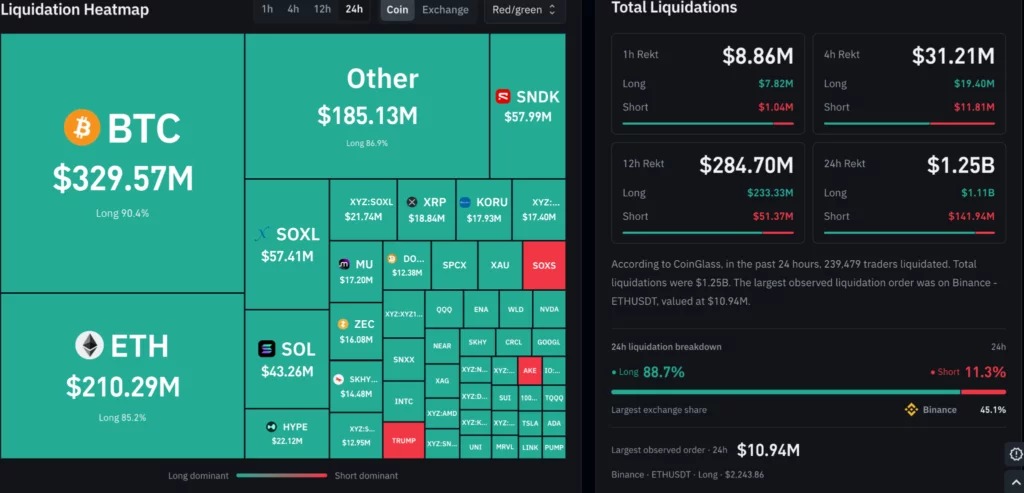
This sell-off occurred after a brief post-election rebound; on November 5th, Bitcoin briefly surpassed $80,000.
According to CoinGlass data, over 239,000 traders were liquidated in the past 24 hours, with the total settlement amount for crypto derivatives reaching 1.25 billion US dollars. As Bitcoin fell to $75,500, long positions bore most of the losses.
A previous review of the funding flow for ETF showed that after three consecutive days of net outflows, US spot Bitcoin funds experienced a net inflow of $74.6 million on November 4th.