Under the dual pressures of weak demand for mobile phone chips and rising semiconductor costs, Qualcomm delivered a mixed report, and its stock price immediately fell after the market closed.
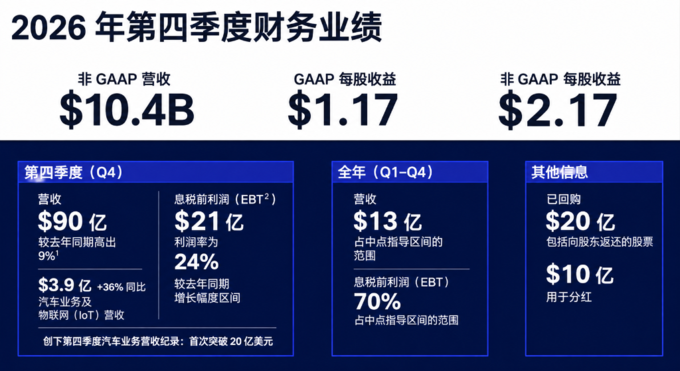
After the U.S. stock market closed on Wednesday, November 4th, Qualcomm announced its financial results for the fourth fiscal quarter ending September 27, 2026. Non-GAAP revenue amounted to $10.442 billion, and non-GAAP earnings per share were $2.17, both slightly exceeding Wall Street's expectations.
However, the company's guidance for the first fiscal quarter disappointed the market. The earnings per share range was set at $2.15 to $2.35, with a median lower than the analysts' average expectation of $2.32; the revenue guidance range was $10.4 billion to $11.2 billion, with the median roughly in line with analysts' expectations.
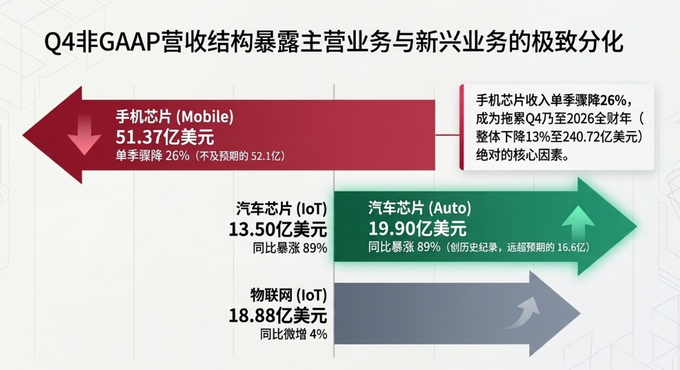
Mobile chip revenue plummeted by 26% to $5.137 billion in a single quarter, becoming the key factor dragging down overall performance. Meanwhile, automotive chip revenue soared by 89% year-on-year to $1.99 billion, setting a new record for a single quarter, and the data center business has also officially entered the commercialization phase.
CEO Cristiano Amon announced that Qualcomm has reached custom chip supply agreements with Amazon and another unnamed global hyperscale cloud provider, and data center revenue will begin to be recorded from this fiscal quarter onwards.
Mobile services under pressure, memory cost becomes the biggest variable
The weakness in the mobile chip business reflects the current difficulties faced by the entire smartphone supply chain.
The semiconductor industry is experiencing a round of comprehensive cost increases that cover wafer manufacturing, packaging and testing, advanced packaging, memory, and other materials. The rising prices of memory have pushed up the selling prices of consumer smartphones, which in turn has suppressed consumer demand, exacerbating the already strained smartphone market.
Qualcomm initiated a price increase for its products in September 2026 to cope with rising upstream input costs, but it is expected that the full benefits of this measure in terms of gross margin will not be fully realized until the second half of the fiscal year 2027.
In the fourth fiscal quarter, mobile chip revenue declined by 26% year-on-year to $5.137 billion, slightly below the market's expectation of $5.21 billion. After overall adjustments, revenue fell by 7% year-on-year to $10.442 billion, and non-GAAP earnings per share decreased by 28% year-on-year to $2.17.
Amon indicates that the company has seen signs of a bottoming out in Android phone shipments in the Chinese market, with preliminary signals of quarter-on-quarter growth in the mobile phone business. However, he also expects that the global mobile phone market as a whole will remain flat in 2027.
Analyst Stacy Rasgon previously pointed out that although Qualcomm's business diversification is progressing smoothly, mobile phone chips still account for the majority of its chip sales. However, current supply chain signals indicate that due to the impact of memory dynamics, the market environment is "clearly deteriorating."
He believes that before the driving force for growth in data centers becomes apparent, Qualcomm's performance "still needs to go through a reset."
In addition, Apple is gradually switching to self-developed modems, which will continue to dilute the revenue from mobile phone chips between Qualcomm and Apple, posing another long-term source of pressure. However, both parties have completed the renewal of their patent licensing agreement this fiscal quarter.
The company stated that the revenue scale of the QTL authorized business will remain stable in the 6G era. The next round of authorization renewals will commence in the fiscal year 2030 and continue until the fiscal year 2033.
Data center business officially launches, with Amazon cooperation opening up growth opportunities
The core narrative of Qualcomm's transformation is gradually becoming clear as the commercialization of its data center business takes shape.
The company's Chief Financial Officer, Akash Palkhiwala, stated during the financial report conference call that the guidance for the first fiscal quarter already includes the initial revenue from shipping custom chips to two large-scale cloud providers, marking a formal transition of Qualcomm's data center business from concept to monetization.
One of the customers has been clearly identified as Amazon. Qualcomm announced a multi-generation product cooperation agreement with Amazon, focusing on AI inference workloads, which includes custom silicon chips and optical interconnection solutions supporting up to 1.6T.
The agreement includes an option structure covering potential future purchases by Amazon from Qualcomm amounting to up to $60 billion over the next decade, of which 15% of the options are immediately vested based on the initial purchase commitment. The identity of the other customer has not been disclosed, and Qualcomm only refers to them as a "global hyperscale cloud provider."
Amon identified the supply-side bottlenecks in data center operations as the main constraints at present. He said:
"We don't have a problem with demand; rather, we have a supply issue. If I had more supply, our performance could be even better."
The company expects that data center revenue in the first fiscal quarter will exceed $650 million, with subsequent quarterly growth, and by the end of the 2027 fiscal year, it aims to reach an annualized revenue of $7 billion. The annual data center revenue target is set at $5 billion. Looking further ahead, Qualcomm maintains a goal of data center revenue exceeding $15 billion for the 2029 fiscal year.
Starting from the fiscal year 2027, Qualcomm will disclose data center operations as a separate revenue line under the QCT business segment, on par with mobile phones, automotive, and the Internet of Things. The company has also established a multi-generation chip cooperation framework with Amazon and announced during the previous investor day that Meta will adopt its Dragonfly C1000 server processors.
The automotive industry and the Internet of Things are growing rapidly, and the effects of diversified strategies are beginning to be seen.
The automotive chip business is becoming the most certain highlight in Qualcomm's performance.
In the fourth fiscal quarter, automotive chip revenue soared 89% year-on-year to $1.99 billion, setting a new record for a single quarter and far exceeding market expectations of $1.66 billion. For the entire fiscal year 2026, automotive chip revenue reached $6.004 billion, a 52% increase from the previous fiscal year. The company's previously set target for automotive chip revenue by the fiscal year 2029 is $10 billion.
The Internet of Things (IoT) business has performed relatively steadily. In the fourth fiscal quarter, IoT revenue increased by 4% year-over-year to $1.888 billion, slightly exceeding market expectations. The business scope covers low-power chips, smart glasses SoC, laptop chips, as well as solutions related to cellular infrastructure.
It is worth noting that Qualcomm announced this quarter a partnership with SpaceX, to supply them with Qualcomm Dragonwing cellular infrastructure solutions for their Starlink Mobile ground-based stations, in support of the nationwide 5G network construction in the United States. SpaceX plans to begin nationwide deployment in 2027, and the cooperation agreement covers tens of thousands of sites.
In the field of PC chips, Qualcomm Snapdragon X Elite has entered Google's Googlebook laptop platform. This product is manufactured by Dell and HP and is positioned as the first laptop in the category aimed at Gemini smart laptops.
The aforementioned diversified layout is being validated in terms of data. Amon indicates that non-mobile business revenue is expected to grow by more than 60% year-on-year in the fiscal year 2027.
Qualcomm raises its non-smartphone business revenue target for the fiscal year 2029 to $40 billion, with data centers accounting for over $15 billion, automotive at $10 billion, and the Internet of Things exceeding $14 billion.
Annual performance under pressure, rising costs test the pace of profit recovery
Overall, Qualcomm's financial performance for the full fiscal year 2026 is still in an adjustment period.
For the full fiscal year GAAP, revenue amounted to $43.12 billion, a year-on-year decline of 3%; non-GAAP earnings per share were $10.54, a year-on-year decrease of 12%. Revenue from mobile chips fell by 13% to $24.072 billion throughout the year, which was the main factor contributing to the overall decline in performance.
The annual free cash flow was 8.651 billion US dollars, and the company returned a total of 11.671 billion US dollars to shareholders, of which 7.817 billion US dollars were used for stock repurchases and 3.854 billion US dollars for cash dividends.
Looking ahead to the next fiscal quarter, the pressure of rising costs in the semiconductor industry will continue. Qualcomm explicitly mentioned in its guidance that increases in costs for wafer manufacturing, packaging and testing, advanced packaging, memory, and other materials will affect performance in the first fiscal quarter. The full benefits of price hikes are not expected to be fully reflected in the gross margin by QCT until the second half of the 2027 fiscal year.
Due to the addition of data center business, the first-quarter pre-tax profit margin guidance for the QCT division is 20% to 22%, lower than the 24% of the previous quarter. The company explained that this reflects the temporary dilution of profit margins caused by the increased investment in research and development for the AI accelerator and CPU platform before the revenue scale has fully expanded, and reiterated that the long-term pre-tax profit margin target of QCT remains at 30% unchanged.
For investors, Qualcomm is currently at a juncture where its mobile phone business is in a cyclical trough and its new business revenue curve is on the rise.
Whether the growth in the three sectors of data centers, automobiles, and the Internet of Things can make up for the temporary shortfall in mobile phone business at a fast enough pace, and whether the gross profit margin recovery from the price increase strategy can be achieved as scheduled, will be the most important variables to monitor in the fiscal year 2027.