

As the Democratic Party takes control of Congress, CLARITY Act faces new challenges, which also raises questions from the outside world regarding consumer protection, ethical issues, and what concessions the crypto industry may need to make.
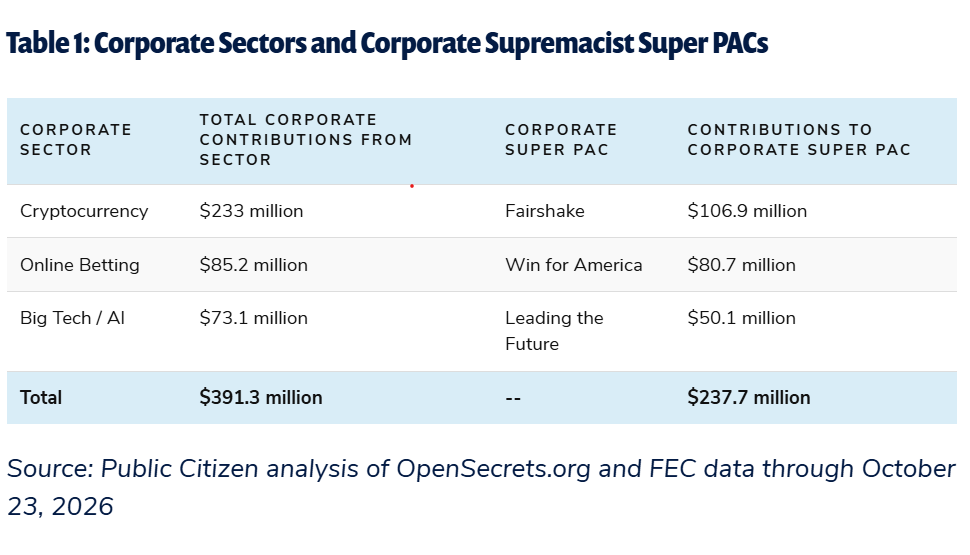
According to the analysis of the federal declaration documents by Public Citizen, encryption companies donated $233 million to political committees during the 2026 U.S. mid-term election cycle.
The Democratic Party has won both houses of Congress and will take control in January, which gives them the opportunity to reshape the stalled CLARITY Act. This bill is aimed at establishing federal regulations for the crypto market.
In Ohio, Sherrod Brown, a Democrat who has long been skeptical about cryptocurrencies, defeated Republican Senator Jon Husted, despite political action committees supported by the crypto industry spending 64 million dollars to try to prevent his election.
Senator Elizabeth Warren is one of Washington's most outspoken critics of cryptocurrencies and also the Democratic member with the longest tenure on the Senate Banking Committee. It is expected that he will serve as the chairman of that committee in the next Congress.
Stronger consumer protection, stricter scrutiny of political conflicts of interest, and the transfer of regulatory powers could all become topics for the next round of negotiations.
However, a majority in the Democratic Party does not mean that there is no hope at all for legislation regarding the structure of the crypto market.
Democratic Representative Shri Thanedar still hopes that CLARITY Act can pass, but he says that any legislation must include stronger ethical requirements. He stated regarding the Magazine:
President Trump's blatant corruption has slowed down the progress of encryption legislation. Therefore, Democrats need strong anti-corruption provisions that should apply not only to Congress but also to the president.
Can the political influence of the industry still be translated into legislation? What concessions must it make in order to achieve this?
The crypto industry needs a different type of transaction.
Due to disagreements on ethical provisions, the Senate was unable to advance CLARITY Act in September.
It is reported that Democrats are already discussing how to reshape the debate on market structure, and House Democrats are said to be considering expanding the proposal of Representative Maxine Waters into a broader market structure bill.
The bill may include stronger consumer protection, a greater role for the U.S. Securities and Exchange Commission (SEC), and new ethical restrictions on encryption activities by public officials.
This may ultimately mean that the demand for clearer regulations in the industry needs to be dealt with separately from the controversies arising from Trump's personal cryptocurrency business.
The Democratic Party has signaled its intention to investigate Trump family's business dealings and other corporate interests; Robert Garcia, who is about to take on the role of chairman of the House Oversight Committee, plans to push forward investigations into corporate corruption.
Silence Laboratories, the person in charge of the institution's business, Fidelity Digital Assets, the founder, and Hadley Stern said that Democrats have every reason to "investigate" the latter, and the industry should also hope they do so, because this is precisely "the root cause of undermining the bipartisan agreement."
He said about “Magazine”: “It’s a real governance issue when the family of the incumbent president launches memecoin and stablecoins. If I did the same thing in Fidelity, I would be asked to leave that very afternoon.”
He said that the digital assets industry in 2026 is vastly different from when Democrats last “held the gavel.” It has evolved from “FTX and a bunch of tokens” in 2022 to the current situation, where there are federal stablecoin laws, government bonds, credit funds on the blockchain, and tokenized stocks are on the horizon:
"You can't pretend it doesn't exist and then try to regulate it."
What concessions does the industry need to make?
If legislation is to remain in effect after a change of political power, the industry may also need to adopt stricter standards.
Nightfall Networks, founder and CEO, and former EY Global Blockchain Head, Paul Brody predicts that banks "will be the winners" because they will "push crypto companies" to adopt the same strict consumer protection and security standards.
He said that the industry has always opposed this, but told Magazine, considering that the blockchain native ecosystem is still “much more flexible, programmable, and efficient,” accepting such conditions is a “wise strategy.”
Blockchain Association Chief Policy Officer Lindsay Fraser also believes that consumer protection and innovation should not be seen as competing goals.
She said, "We can ensure that laws reflect the actual way this technology operates while protecting consumers." She added that the goal is to "develop sustainable policies that can win public trust, preserve a future for builders in the United States, and enhance America's financial leadership."
But this does not mean that the path to reaching a potential compromise will be smooth sailing.
Brody says that there is still a possibility of a presidential veto, and that encryption issues are likely to be considered of "lower priority" compared to "corruption investigations, budget disputes, and wars."
Binance How a Hacker Attack Affects Legislators
As the results of the mid-term elections are announced, legislators are already dealing with the consequences of the Binance hack attack. This is the largest hack incident in the history of cryptocurrency, with over $6.3 billion stolen on October 29th, which has once again raised concerns about the security of exchanges and customer protection.
Thanedar said that although this legislation "will not solve every potential problem," it will provide "much-needed certainty" and "safety barriers," and that this hacking incident provides a "clear example of the dangers of not enacting appropriate legislation."
Ma said that this hacking incident involved 'hot wallets of centralized exchanges and signature failures', but the current draft 'has no insurer, no loss beneficiaries, and no upper limit on hot wallets'. These measures could have mitigated the losses of Binance, or set security standards that could have prevented this hacking attack.
Better Markets Policy Director Amanda Fischer stated that this incident highlights "how unsuitable the crypto ecosystem is for mainstream finance." Crypto exchanges should not act as custodians, as this creates a 'honey pot risk.'

Ma said that this incident "is very likely to affect" the next vote of CLARITY, and may make legislators reluctant to pass the bills desired by the industry without stronger consumer protection.
The crypto industry spent years persuading Washington that it should sit at the negotiating table; now, it needs to agree to the obligations that come with that.
Magazine: Bitcoin is 18 years old: Has the original rebel grown up?