

Over the past week, the mid-term elections in the United States caused a huge shock to the market. After the Democrats unexpectedly swept both the Senate and the House of Representatives, investors bet that the Federal Reserve's monetary policy might shift towards a more moderate stance, which led to a rebound in the stock market and gold prices. However, this optimistic sentiment only lasted for a few days. Subsequently, tech stocks led the decline in the U.S. market, and markets re-evaluated the political landscape in the U.S., inflation trends, and the Federal Reserve's policies, resulting in another bout of sharp fluctuations in global asset prices.
Investors are concerned that the Democratic Party may strengthen regulation of AI and limit the construction of data centers, leading to a concentrated sell-off in AI infrastructure and semiconductor stocks. On Thursday, the Nasdaq tumbled 5.5%, recording its largest one-day decline in 19 months, falling more than 11% from its historical high on October 6th and officially entering a technical correction zone. On Friday, there was a technical rebound in chip stocks; the Philadelphia Semiconductor Index rose 4.2%, and the Nasdaq gained 1.09%, but the S&P 500 index only rose 0.31%, while the Dow Jones Industrial Average fell 0.46%. Market breadth remained weak, with the S&P 500 closing down about 2.7% for the week.
On Friday, non-farm employment in the United States increased by 165,000, far exceeding expectations, and the unemployment rate unexpectedly dropped to 4.1%, reigniting expectations for a Fed interest rate hike in December. The U.S. dollar index rose by 0.74%, marking the largest single-day increase since June, with a 0.4% rise for the week. The yield curve of U.S. Treasuries flattened, with the spread between 2-year and 10-year bonds narrowing to 33 basis points, and the yield on 10-year Treasuries rising to 4.85%.
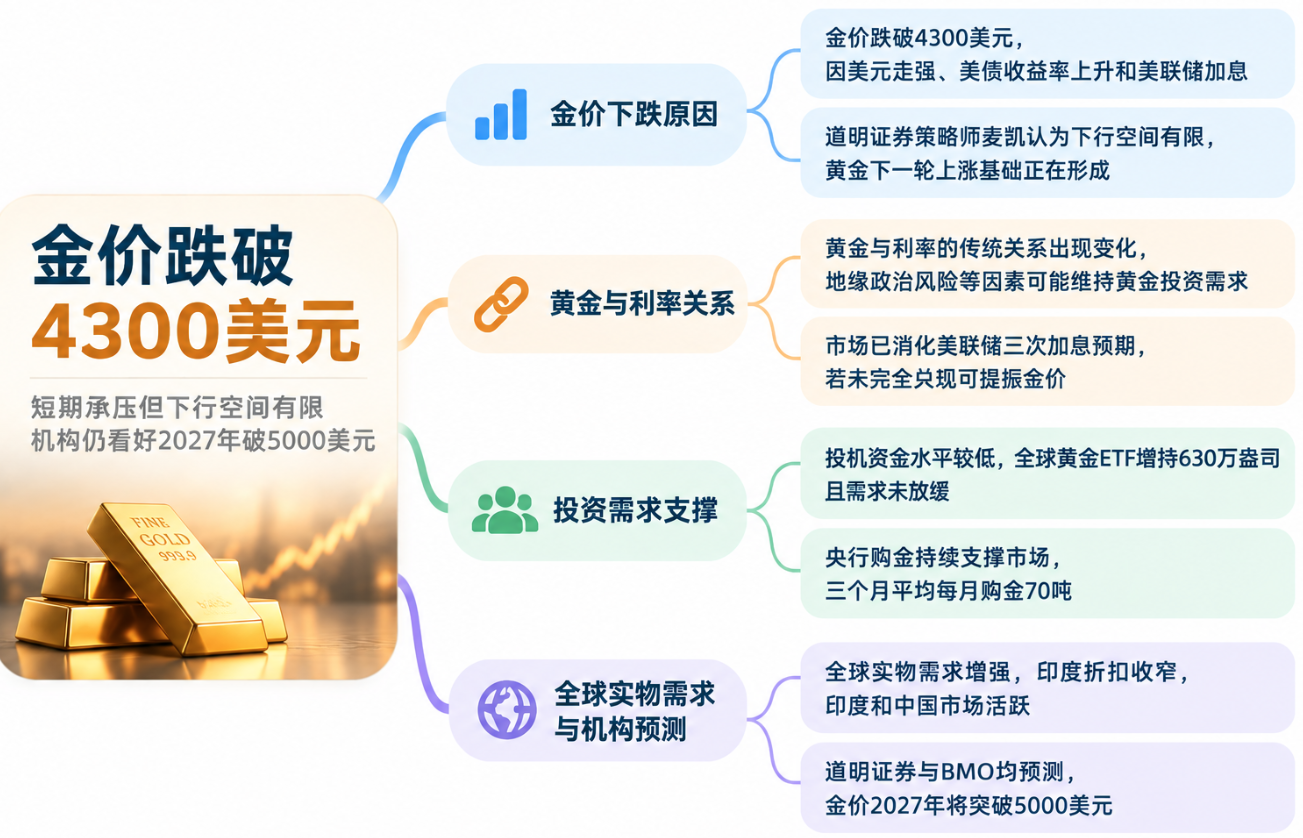
The Fed's hawkish interest rate expectations put pressure on precious metals, with spot gold falling 0.4% to around $4,070 per ounce. Nevertheless, gold still rose 5% this week, marking the largest weekly increase since August; spot silver managed to rise against the trend, gaining 5.73% for the week, and both gold and silver ended a three-week decline.
International oil prices were repeatedly affected by the situation in the Strait of Hormuz and news of U.S.-Iranian negotiations. Both U.S. and Brent crude prices closed lower on Friday, as there were reports during trading that U.S.-Iranian negotiations were close to making a breakthrough, with nuclear issues being reintroduced into the talks. WTI Crude oil fell by 12.06% for the week, while Brent crude fell by 13.39%, both recording the largest weekly declines since April.
The following are the key points that the market will focus on in the new week (all times are Beijing time):
Central Bank Dynamics: Probability of the Fed raising interest rates in December increases, AI Market Turbulence Could Become a Variable
Federal Reserve:
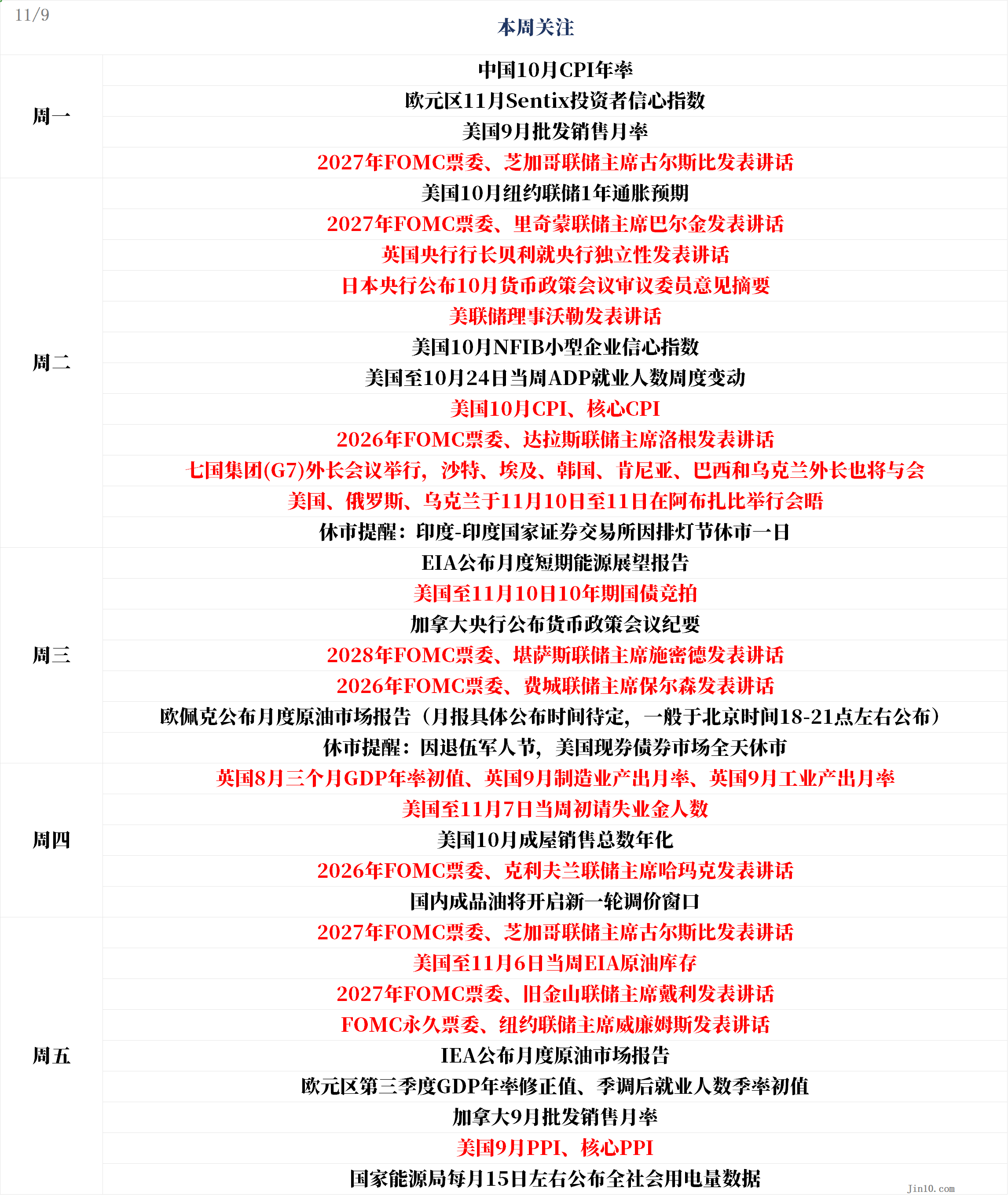
At 23:00 on Monday, 2027, FOMC Federal Reserve Board member and Chairman of the Chicago Federal Reserve, Charles Evans Guthlesby, delivered a speech; at 1:15 on Tuesday, 2027, FOMC Federal Reserve Board member and Chairman of the Richmond Federal Reserve, Robert Kaplan, gave a speech; at 17:00 on Tuesday, Federal Reserve Governor Lael Brainard Walser spoke; at 22:35 on Tuesday, FOMC Federal Reserve Board member and Chairman of the Dallas Federal Reserve, Robert Kaplan, delivered a speech; at 2:30 on Wednesday, 2028, FOMC Federal Reserve Board member and Chairman of the Kansas Federal Reserve, Esther L. Pritchard Smith, made a statement; at 7:30 on Wednesday, 2026, FOMC Federal Reserve Board member and Chairman of the Philadelphia Federal Reserve, Patrick Harker, addressed the audience; at 22:00 on Thursday, 2026, FOMC Federal Reserve Board member and Chairman of the Cleveland Federal Reserve, Loretta J. Shamak, spoke; at 0:30 on Friday, 2027, FOMC Federal Reserve Board member and Chairman of the Chicago Federal Reserve, Charles Evans Guthlesby, spoke again; at 2:10 on Friday, 2027, FOMC Federal Reserve Board member and Chairman of the San Francisco Federal Reserve, Mary Daly, delivered a speech; and at 7:30 on Friday, FOMC permanent Federal Reserve Board member and Chairman of the New York Federal Reserve, Jerome Powell, made a statement.
Other central banks:
At 1:25 on Tuesday, Bank of England Governor Andrew Bailey delivered a speech on the independence of the central bank; at 7:25 on Tuesday, the Bank of Japan released a summary of the opinions from members attending its October monetary policy meeting; on Wednesday at 2:30, the Bank of Canada published the minutes of its monetary policy meeting.
The U.S. labor market has shown resilience beyond expectations, once again making the possibility of further interest rate hikes by the Federal Reserve a focal point for the market. Previously, in order to avoid being seen as interfering in the election, most Federal Reserve officials reduced their public statements for a period of time; however, next week there will be a noticeable increase in the number of official speeches scheduled.
After the release of the latest employment report, San Francisco Federal Reserve Chair Janet Yellen clearly stated that she expects the Federal Reserve to need to raise interest rates further. In an interview with CNBC, Yellen pointed out that although many people are doing fairly well in terms of employment and income, they still find it difficult to keep up with inflation, so controlling prices must become a top priority. She believes that a strong labor market provides room for the Federal Reserve to continue to curb inflation.
Daley is not a voting member of the Federal Open Market Committee ( FOMC ) this year, but her policy views are generally in line with those of the majority of committee members. She also emphasized that there is significant uncertainty in the global environment, and policy adjustments need to be cautious and gradual. However, if the economic situation requires further tightening, she is prepared.
Federal Reserve Chairman of St. Louis, Muhammad El-Eslam, also stated on Friday that inflation remains the most concerning issue for businesses in his region. He believes that inflation is akin to a regressive tax, and that lowering inflation is the best way to promote economic growth and employment. Federal Reserve Chairman of New York, Jerome Powell, acknowledged that inflation has remained too high, but also agreed with the stance in the Fed's recent statements, which is to gather more information to assess inflation risks. Federal Reserve Chairmen of Cleveland, Loretta J. Harker, and Richmond, Robert H. Barkin, both publicly supported "gradual interest rate hikes" to combat inflation on Thursday.
Strong non-farm data has boosted market expectations for a Fed interest rate hike in December, but further hikes are still not a sure thing. Traders had previously reduced their bets on rate hikes due to the slump in tech stocks and the weakening demand prospects for AI, fearing that a slowdown in related investments would weaken economic growth and inflationary pressures.
If the adjustment in tech stocks continues, AI capital expenditures and related financing activities may be affected, which could lead to a cooling of corporate investment and demand for commodities. If oil prices continue to fall, it might also alleviate the contribution of energy prices to inflation. The adjustments within the financial market itself could thus play a role similar to monetary tightening.
Matthew Martin, a senior US economist at the Oxford Institute for Economics, believes that the latest employment data reflects a tightening labor market, which further supports the Federal Reserve's decision to raise interest rates in December amid inflation significantly exceeding targets. However, he also pointed out that the main portion of the expected core inflation exceeding targets is related to rising energy prices and AI related pressures. If tech stocks and oil prices continue to fall, the possibility of further interest rate hikes at the beginning of 2027 may disappear.
As pointed out by the "Fed mouthpiece" Nick Timiraos, the persistence of the AI selling spree may be more important than the employment report released on Friday. Federal Reserve Chairman Jerome Powell has indicated that he is more interested in the market's judgment of future economic trends and is skeptical about relying solely on lagging monthly data to set interest rates. Before taking office, Powell described "data dependence" as one of the most dangerous terms in monetary policy, noting that government data is often lagging and prone to revision.
Currently, data from LSEG shows that the probability of a Fed interest rate hike at its meeting on December 8-9, as implied by federal funds rate futures, has risen to around 80%. The market expects that this round of interest rate hikes may still see a total of about two additional hikes, each of 25 basis points.
Important event: U.S.-Russia-Ukraine talks resume after months of hiatus; will U.S.-Iran talks become even more difficult after Trump's midterms defeat?
The United States, Russia, and Ukraine have officially confirmed that they will hold a new round of working-level talks in Abu Dhabi, the United Arab Emirates, from November 10th to 11th. At present, all parties have completed the formation of their delegations and clarified the core issues for discussion. From January to February this year, the three parties held three rounds of talks in Abu Dhabi, UAE, and Geneva, Switzerland, respectively. However, after the United States launched a large-scale military strike against Iran in late February in conjunction with Israel, attention to the Russia-Ukraine conflict significantly diminished, leading to a stagnation in the negotiations.
Ukrainian President's Office Director Budanov clearly stated that he does not expect breakthrough results from these talks, but believes that the resumption of face-to-face negotiations between Russia and Ukraine after several months is in itself a form of progress. These negotiations are positioned as "work-level consultations to prepare for the end of hostilities."
Analysis generally suggests that there is a high likelihood of reaching phased consensus on less sensitive areas such as prisoner of war exchanges and humanitarian corridors during these talks. However, on core issues such as territorial division and a comprehensive ceasefire, it remains difficult for the three parties to reach a final agreement.
On the other hand, after President Donald Trump suffered a major setback in the midterms, the situation in Iran did not cool down as quickly as the market had expected. On Friday, the U.S. military launched another limited strike against Iran, with Trump describing the scale of the operation as "very small." This was the second time this week that the U.S. military has struck targets related to Iran.
Trump has been wavering repeatedly between military action and diplomatic negotiations. On one hand, he threatens to further destroy Iran; on the other hand, he indicates that U.S.-Iranian contacts have continued, and it is still possible to reach an agreement to end the war.
Meanwhile, according to CNN, Iran's hardliners see the Republican Party's electoral defeat as proof that their strategy against the United States is effective, and they are demanding that Tehran refuse to compromise in peace talks, forcing Washington to pay a greater price.
Hamidreza Azizi, a senior analyst on Iran issues at the International Crisis Group, believes that the Iranian leadership sees the results of the U.S. elections as a validation of their own strategy towards the United States. Therefore, Tehran's positions in negotiations are likely to become even more tough.
Azizi points out that if Trump wants to declare an end to the war, he must make substantial concessions on the Iranian nuclear program issue to offset domestic political pressure; another option would be to launch a larger-scale military operation to demonstrate that the United States is ending the war in a position of advantage. However, in Iran's view, Trump's electoral defeat precisely means there is no reason to make concessions on the nuclear issue, and Tehran may instead insist that the United States take the first step.
According to a report by the American AXIOS news website, US Vice President Pence has been directly involved in indirect talks with Iran over the past two weeks, seeking to reach a new ceasefire agreement and resume nuclear negotiations with Iran. Pence and the mediators have been discussing the possibility of holding working-level technical meetings between the US and Iran in the coming days, but this has not yet been confirmed.
Mediators stated that there has indeed been some progress in the US-Iran negotiations, but the pace is very slow. The Prime Minister of Qatar said on Friday evening local time that over the past few weeks, Qatar has been cooperating with officials within the US government who wish to control the situation and promote de-escalation, and has also received support from rational voices within Iran to prevent the conflict from getting out of control. He mentioned that communication with the Trump administration continues after the mid-term elections, although the negotiation activities are not as intensive as before the elections due to the US side needing to handle other matters. He emphasized that the US's willingness to seek a diplomatic solution still exists, and it is possible to reach an agreement.
Important data: The U.S. CPI for October will be announced next week, and the gold price at $4,000 is facing a test.
Monday at 9:30 AM, China's CPI annual rate for October; Monday at 5:30 PM, Eurozone's Sentix Investor Confidence Index for November; Monday at 11:00 PM, U.S. September Wholesale Sales Monthly Rate; Tuesday at 0:00 AM, U.S. October Federal Reserve 1-year Inflation Expectations; Tuesday at 7:00 PM, U.S. October NFIB Small Business Confidence Index; Tuesday at 9:15 PM, U.S. Weekly Change in Employment from October 24th to the Current Week ADP; Tuesday at 9:30 PM, U.S. October CPI, Core CPI; On Tuesday, a meeting of the G7 (G7) foreign ministers will be held, with participation from Saudi Arabia, Egypt, South Korea, Kenya, Brazil, and Ukraine; On Tuesday, the United States, Russia, and Ukraine will meet in Abu Dhabi from November 10th to 11th; Wednesday at 1:00 AM, EIA releases its monthly short-term energy outlook report; Wednesday at 2:00 PM, U.S. 10-year Treasury bond auction from November 10th; Wednesday schedule to be determined, OPEC releases its monthly crude oil market report (the exact release time is to be determined, usually around 6-9 PM Beijing time); Thursday at 3:00 PM, UK's August three-month GDP annual rate preliminary value, UK September manufacturing output monthly rate, UK September industrial output monthly rate; Thursday at 9:30 PM, U.S. Initial Jobless Claims for the week ending November 7th; Thursday at 11:00 PM, U.S. October Total Residences Sold Annualized; Thursday schedule to be determined, domestic refined oil prices will enter a new round of adjustment; Friday at 1:00 AM, U.S. EIA Crude Oil Inventories for the week ending November 6th; Friday at 5:00 PM, IEA releases its monthly crude oil market report; Friday at 6:00 PM, Eurozone Third Quarter GDP annual rate revised value, seasonally adjusted initial employment rate for the quarter; Friday at 9:30 PM, Canada September Wholesale Sales Monthly Rate; Friday at 9:30 PM, U.S. September PPI, Core PPI; On Friday, the National Energy Administration releases national electricity consumption data around the 15th of each month.
The U.S. data for October CPI will be released on Tuesday. This data, combined with the PPI data to be released on Friday, as well as the public speeches of several Federal Reserve policymakers, will be closely watched by investors in order to assess the likelihood of another interest rate hike in December. If there is more evidence indicating that inflation remains high, an interest rate hike on December 9th is very likely to occur, especially considering the strong employment data for October that was just released.
Monex Macroeconomic Research Director Nick Rees stated in a report: "Unless the October CPI data released on Tuesday falls significantly below expectations, or unless the November employment report released on December 4th shows a clear weakening, we expect that by the time of the Federal Reserve's next interest rate meeting next month, the market will have almost fully absorbed the expectation of a 25-basis-point interest rate hike."
Analysts at Rabobank stated that they expect the month-on-month increases in both the overall US CPI and the core CPI to reach 0.3%, a performance that is sufficient to support an interest rate hike in December as a high-probability event.
Although the mid-term elections brought a politically driven rebound for gold, whether the upward trend can continue will still depend on U.S. economic data and expectations regarding Federal Reserve policy. In the short term, the $4,000 mark and the CPI data next week will become important references for observing the trend of gold prices.
Blue Line Futures, the Chief Market Strategist, stated that the rise in inflation data next week will further reinforce market expectations of a Fed interest rate hike in December. He added that this environment will drive gold prices back below $4,000 per ounce.
However, Streible indicates that he expects this to be possibly the last adjustment for gold. He explains that the election results have weakened economic activities in the AI sector, affecting data center construction. This weakening trend should ultimately force the Federal Reserve to abandon its tightening stance, creating room for a rise in gold prices. Investors may wish to look for opportunities to buy gold when prices fall starting next week.
Shengbao Bank's head of commodities strategy, Ole Hansen, stated that despite the ongoing inflation risks, he expects the gold price to remain above $4,000 per ounce. However, he also pointed out that it is unlikely for this precious metal to see a significant increase in the short term.
Hansen indicates that 'trend-following funds ( CTA ) still seem to be the dominant force in the market. Last week, the weakening of silver led to a passive decline in gold prices below a certain level, followed by a rebound of gold prices above that level. Additionally, the sharp drop in oil prices after the general elections triggered short-covering. Now, this wave of buying has basically ended, and I can hardly see any subsequent buying momentum. I am long-term bullish on gold, but I remain cautious in the short term; we have not yet found a catalyst that would unify both short-term and long-term traders in their bullish views.'
FOREX.com Market analyst Fawad Razaqzada also regards $4,000 as a key level for gold next week. He said that although gold prices have shown resilience in the face of employment data that exceeded expectations, next week's inflation report will determine whether this rebound can continue. "Despite strong U.S. employment data, gold prices have temporarily held above the key level of $4,000. This level will decide whether the rebound can continue; if it falls below again, it could trigger a new wave of selling."
Walsh Trading John Weyer, co-head of commercial hedging at John Weyer, believes that the mid-term elections have not changed the Federal Reserve's policy path, and gold and silver will continue to be supported by the policy uncertainties under Trump over the next two years. He expects prices around $3,900 and $4,000 to attract buying interest, and believes that the upward trend is still the direction with the least short-term resistance for gold prices.
Company Financial Reports: How far is the U.S. stock market from truly hitting bottom?
Before the Democratic Party won both houses of Congress and before the prospects for data center construction in the United States faced more policy uncertainties, AI trading had already cooled down. Previously, retail investors continued to adopt a strategy of buying on dips, transferring funds between different sectors to avoid a complete withdrawal.
Recently, more funds have flowed into defensive sectors such as healthcare and daily consumer goods, which has even led to a congestion in some risk-averse trades. Despite experiencing several sharp fluctuations since autumn, the S&P 500 index ( SPX ) has generally returned to its levels from July of this year.
Vanda Research data shows that on Thursday, retail investors made net sales at their highest level since the outbreak of the pandemic, and retail investors began to withdraw from the market along with institutional investors. Although retail investors bought some stocks that had tumbled significantly at the opening on Friday, the net buying of NASDAQ 100 components was relatively weak and continued to decline thereafter. Some strategists believe that the current decline is not sufficient to confirm that the market has bottomed out.
Explosive Options Chief Options Analyst Bob Lang pointed out that to determine the bottom, it is necessary to observe consecutive days of selling. He pays special attention to the Chicago Board Options Exchange (CBOE) put/call option ratio: this indicator rose to 1.2 on Thursday, which is twice the average level of 0.6, meaning that for every call option bought, there were 1.2 put options bought. Such a high level of bearish sentiment can usually also serve as a signal for reverse buying, but Lang believes that more similar readings are needed to confirm that the market has completed a concentrated sell-off.
Freedom Capital Markets, the Chief Market Strategist, while Jay Woods regards the Chicago Board Options Exchange Volatility Index (VIX) as an important indicator. He believes that only when it breaks above 30 will he consider that the market has experienced a true panic sell-off. On Friday, the index was still around 24. He stated that the market is very close to a final clearout, but the panic has not yet truly occurred.
In the view of Wood, the peak for U.S. stocks this year may have already been reached. As the third-quarter earnings season comes to an end, there is a lack of new catalysts that could sustain further increases in stock prices. Woods is optimistic about Micron Technology ( MU.O ), NVIDIA ( NVDA.O ), and the broader semiconductor sector, which have recently suffered significant setbacks. However, he reminds investors not to enter the market in large volumes immediately but to buy gradually, as it is not easy to accurately determine the market bottom.
FactSet Data shows that as of now, the earnings of S&P 500 components are expected to grow by 31% in the third quarter. FactSet Analyst John Butters pointed out that corporate performance once again reflects the growth momentum brought about by AI, and this earnings growth is extending to 493 companies beyond the seven major tech giants.
Next, developments in Washington's policy and monetary policy will continue to affect the market. Investors need to assess how a divided government will handle expenditures related to the Iran war, and related disputes may lead to a government shutdown before the end of the year.

Market Close Notice:
- On Tuesday, the National Stock Exchange of India was closed for one day due to Diwali.
- On Wednesday, the U.S. cash bond market was closed throughout the day due to Veterans Day.
Recommended Reading More
- 13 minutes ago: Weekly Outlook: CPI Could Confirm the Fed's Interest Rate Hike in December? Gold May Face Another Battle to Defend 4000
- 19 minutes ago, costs for oil services in the Middle East soared. Why are contractors' profits being squeezed despite rising oil prices?
- 1 hour ago: Non-bank leverage magnifies risks in the European bond market, leaving the European Central Bank in a dilemma between fighting inflation and stabilizing the market
- 2 hours ago, a data center raised funds without signing any tenants? The Bank of England is investigating loan risks, and high-leverage projects have drawn attention.
- 3 hours ago: Is there hope for positive fiscal constraints for US debt? The risk of the US debt ceiling in 2027 emerges