


Ethereum transactions sometimes seem successful, but there may be underlying issues behind them.
Based on draft pull request #36084 on GitHub, a Geth developer proposed a fix for the estimation mechanism of that client Gas. This patch addresses an issue with the current estimator: internal calls from one smart contract to another are being ignored, which may lead to incorrect estimation of the upper limit on Gas.
Although the transaction itself may still be completed, there is no evidence to indicate that the operation the user intended to perform actually took place.
Gas What is the estimated issue?
The problem lies in such a mechanism: one smart contract calls another smart contract, and after capturing an error, it continues to execute the refund process, records the failure, or simply skips a certain item. Technically speaking, this transaction is successful, but for the users, the outcome is different.
This may result in the wallet suggesting an upper limit of Gas that is sufficient to complete the transaction, but not enough to carry out the actual work required within the transaction itself. The developer also pointed out that EIP-8037 could make this situation more common, as the Gas returned from failed internal executions might help to fund backup processes.
What changes were made to the pull request #36084 for Geth?
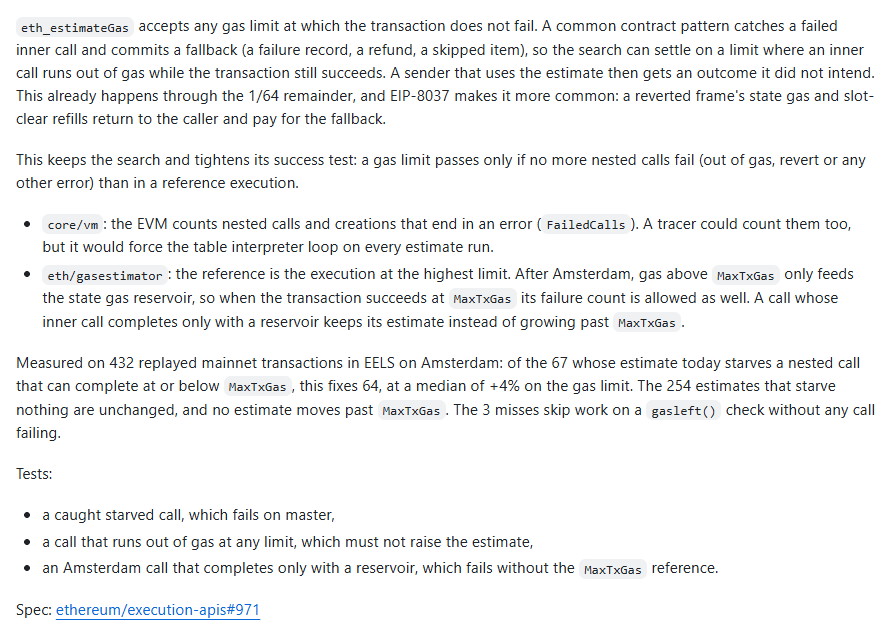
According to this pull request, this change provides a more stringent definition of "success" in the estimation of Gas. This version of Geth will improve its approach to handling internal failures: it will no longer only check whether the transaction is completed, but also take into account failed internal calls and contract creations.
Even if the transaction is completed, if it results in a higher number of internal failures than a single reference execution performed under a higher Gas limit, then this estimation will also be rejected.
However, this developer emphasizes that a constantly failing internal call should not cause the estimated value to rise indefinitely. The purpose of the reference execution is to allow the estimator to retain the failures that already exist, while not allowing new failures to occur due to insufficient Gas. This proposal also introduces a separate Amsterdam reference to prevent unnecessary increases just for the sake of accessing the Gas reserve.
Developers stated that they have replayed 432 Ethereum mainnet transactions in accordance with the new rules updated with Amsterdam. The proposed changes have fixed 64 out of 67 cases.
The upper limit has been increased by 4%. Additionally, 254 additional estimated results were not affected as these cases did not have the aforementioned issues; there were also 3 cases that were not detected.
For ordinary investors, this proposed change should be able to improve the reliability of wallet estimates and reduce situations where transactions are completed but do not achieve the expected results. However, in some cases, it may lead to higher Gas limits. Fortunately, there is currently no evidence indicating a proven link between higher Gas limits and higher transaction fees.