
















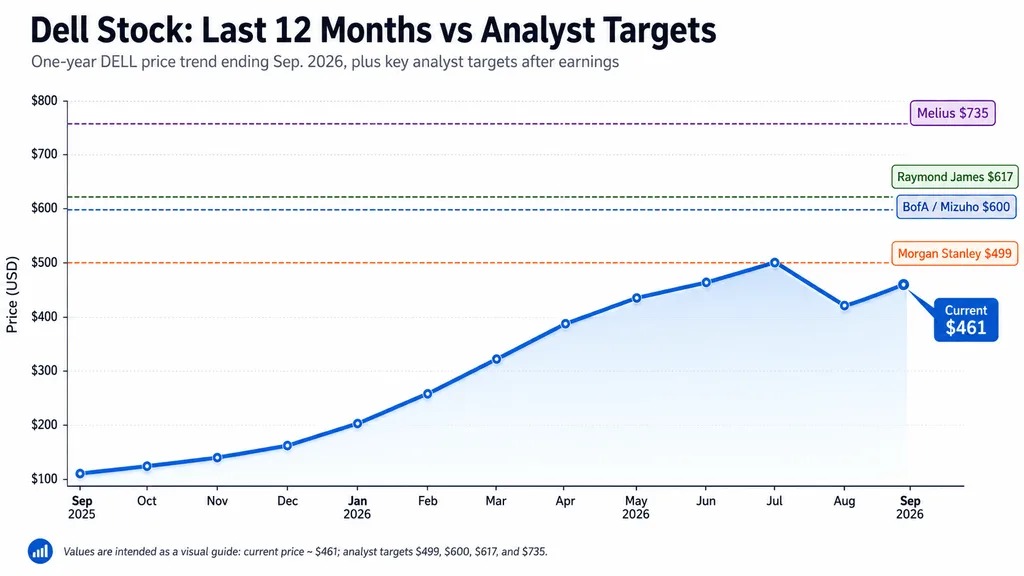
After Dell announced its latest quarter's earnings, Wall Street re-evaluated the story of this hardware manufacturer. Several institutions raised their target prices, driving the company's stock price up by 9% in a single day. The market's focus has shifted from whether there is demand for AI to whether Dell can continue to convert large orders into revenue and profit.
Target prices have been collectively raised.
Melius Research raised Dell's target price to $735, setting a new high on Wall Street. Bank of America and Mizuho also raised their target price to $600, Raymond James to $617, and Evercore ISI to $575. Even the relatively cautious Morgan Stanley increased its target price to $499.
Calculated at the stock price of $461.50 mentioned in the text, a target price of $735 implies there is still about 59% room for upside. This upward revision mainly comes from the market's re-evaluation of Dell's AI infrastructure business.
AI Server Orders Set a Record
The core data that drives the surge in sentiment comes from the AI server business. Dell recorded $60.9 billion in AI server orders this quarter, with related revenue amounting to $16.4 billion. By the end of July, the backlog of unsold orders rose to a record $95 billion. The company also raised its revenue forecast for AI servers for the fiscal year 2027 to $74 billion.
These figures are significantly higher than Wall Street's initial expectations and have also changed the market's assessment of Dell's growth quality. Previously, investors viewed Dell more as a traditional hardware company; nowadays, AI infrastructure has become the focus of valuation discussions.
Growth doesn't only come from the AI servers.
Another reason analysts are bullish on Dell is that the range of growth is expanding. Revenue from traditional servers and networking products increased by 122% year-on-year, while storage business grew by 26%. Among these, the storage business has been particularly favored by some institutions, as it generally has higher profit margins than certain hardware products and is also seen as a beneficiary of the AI construction cycle.
This also reflects that AI expenditures are spreading from GPU to a wider range of infrastructure components, including servers, networks, storage, memory, and power equipment. Dell's expansion is closely aligned with NVIDIA's, and its systems utilize NVIDIA accelerators. NVIDIA recently announced quarterly revenue of $96.2 billion and provided a revenue guidance of $10.8 billion for this quarter, further reinforcing the market's assessment of the demand for underlying AI.
Valuation and supply remain the challenges
However, after a significant increase in Dell's stock price in 2026, its valuation is no longer considered cheap. According to data cited by Reuters, Dell's current expected price-earnings ratio is around 18 times, which is higher than that of Hewlett-Packard and Supermicro Computers. This means that investors are paying not only for the valuation of traditional hardware but also a premium for the sustainability of high growth of AI.
At the same time, the pressure on the supply side has not subsided. Key components such as DRAM, NAND, and CPU remain in short supply, and the rising cost of memory has also pushed up the prices of some AI servers. What the market is more concerned about now is whether Dell will be able to successfully convert its $95 billion in backlogged orders into revenue and profits, and whether this will support the stock price to continue to rise after the significant increase.