
















The cost of calling artificial intelligence continues to decline. Indicators tracking the actual market prices of large models show that the LLM Token expenditure index dropped to 0.97 US dollars on Monday, hitting a new low and falling by more than half from its peak earlier this summer.
This downward trend has coincided with recent price competition in the AI industry. With cheaper open-source and open-weight models entering the market, companies now have more options beyond OpenAI, Anthropic, and Google. Models developed by Chinese developers are considered one of the key factors driving down prices, and the Kimi series from Moonshot AI is also among them.
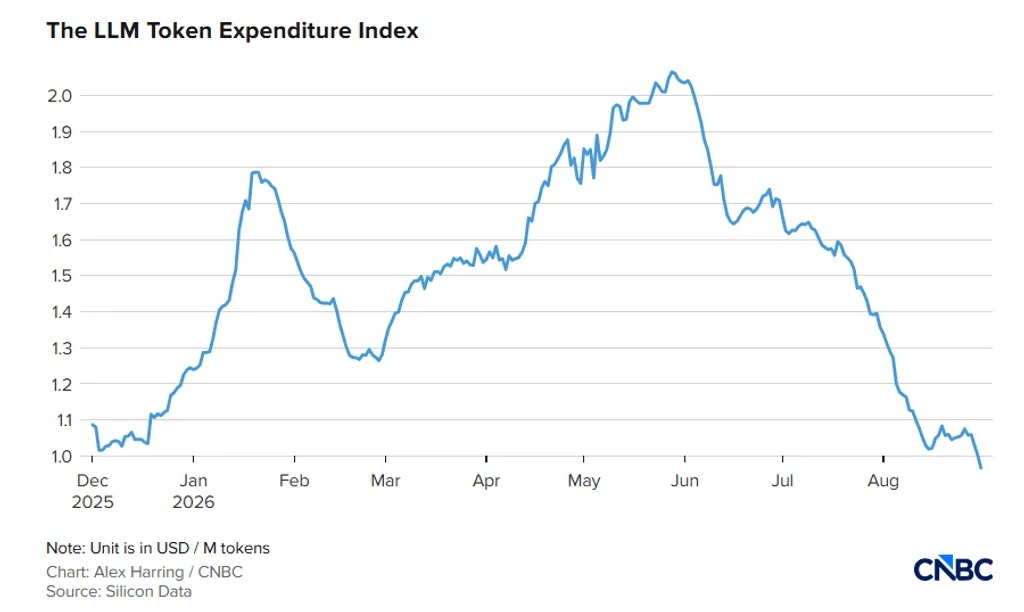
OpenAI has previously also lowered the prices of some product lines of GPT-5.6, further increasing downward pressure on the market. While model capabilities continue to improve, the unit call price is declining, which is changing the revenue structure of the AI industry.
Decreased enterprise deployment costs
For developers and enterprise users, lower prices bring more direct benefits. With reduced reasoning costs, the barriers to deploying AI proxies, programming assistants, customer service systems, and enterprise automation tools are also lowered, making large-scale use of AI more economically viable.
This means that more companies can embed the AI feature into their existing products without having to bear the high call costs that were previously required. For software companies and startup teams that rely on API, the reduced costs also help to expand the scope of trials and commercialization.
Frontier model manufacturers under profit pressure
But for companies that invest huge amounts of money in training cutting-edge models, the situation is not easy. Manufacturers such as OpenAI and Anthropic continue to increase their investment in computing power, data centers, and infrastructure construction, yet the per-Token fees they can charge to customers are declining.
If the increase in usage is not sufficient to offset the decline in unit price, the profit margin of model providers will be compressed. Anthropic has also recently been expanding its long-term computing power through large-scale infrastructure agreements in order to maintain competition with companies such as OpenAI and Google.
Competitive focus or shift to the ecosystem
The article indicates that if most models are capable of completing daily tasks, relying solely on 'stronger models' may no longer be sufficient to create a significant difference. At that time, the focus of competition between manufacturers could shift to distribution channels, enterprise integration, proprietary data, long-term memory, AI proxy capabilities, and a more comprehensive software ecosystem.
This change may also affect technology companies further upstream. Enterprises such as Nvidia and Microsoft have previously invested a large amount of capital in data centers, chips, and cloud infrastructure, betting on the continued long-term growth in demand for AI.
A core issue that the market is currently focusing on is whether the demand for AI can expand fast enough to offset the revenue pressures caused by the continuous decline in "smart prices."