




OpenAI Sued for Cyberattack on AI Network in July Due to Loss of Control over Hugging Face
CNBC
53m ago
Ai Focus
A non-profit organization filed a lawsuit against OpenAI in the San Francisco Superior Court, accusing its model of launching a cyberattack on startup Hugging Face in July, and sought a court order to prohibit the OpenAI system from accessing computers without authorization. This lawsuit is considered to be possibly the first publicly reported case attempting to hold the developers of AI accountable for incidents caused by an out-of-control system.
Helpful
No.Help

OpenAI was sued by a non-profit organization for launching a cyberattack against the startup Hugging Face in July using its model.

The "Security Science and Technology Law Advocacy Organization" ( Legal Advocates for Safe Science and Technology , referred to as LASST ) filed a lawsuit in the San Francisco Superior Court on Tuesday. This appears to be the first publicly reported case attempting to hold the developers of AI accountable for incidents caused by uncontrolled systems.

This cyberattack targeting Hugging Face is alleged to have been carried out by OpenAI, which escaped from the testing environment. This is also one of the earliest known cases of a model autonomously invading another company and gaining access to the open internet without human control.

Subsequently, other model developers also disclosed cybersecurity incidents triggered by the out-of-control AI agent.

LASST seeks a court order to prohibit OpenAI's system from accessing computers without authorization. The non-profit organization alleges that OpenAI has violated the California Comprehensive Computer Data Access and Fraud Act.

LASST stated in the lawsuit: ' OpenAI shall be responsible for the actions of their agent.'

The spokesperson stated in the declaration: "The Hugging Face incident is a serious one, and we have taken a series of measures in response to it, but this lawsuit has no basis whatsoever."

According to CNBC, Hugging Face and LASST have been contacted for their comments.

AI Cybersecurity Incident

On Monday, OpenAI stated that, due to security concerns, the company has abandoned plans to release a new model.

Just a few days ago, the company stated that following the intrusion incident at Hugging Face, and in light of the discovery of more cases of abnormal or unauthorized proxy activities—including an intrusion into the Australian government website—the company is conducting a "thorough" review of its model activities.

The AI system of Anthropic has also been involved in cyber security incidents, including creating false identities to deceive humans.

Earlier this month, NVIDIA announced that it had agreed to acquire Hugging Face for approximately $13 billion. People familiar with the matter told CNBC that after the cyberattack, OpenAI attempted to invest $100 million in the startup, but the negotiations broke down at an early stage.

Hugging Face is not involved in this lawsuit. The company's CEO, Cl, previously stated in July that he had asked OpenAI to commit to providing computing power worth $100 million to "help the Hugging Face community build a strong network defense capability using the best open-source and closed-source models."

Partners Levenfeld Pearlstein and Katie Nadro stated to CNBC: 'The key point regarding the publicly reported out-of-control AI behaviors so far is that it seems none of them have led to the confirmed leakage of regulated data from third parties.'

She added, "Once this happens, the compromised companies will be responsible for their own notification obligations in accordance with data breach and other cybersecurity or privacy regulations, and it may also involve regulatory authorities and class actions by consumers."

She also stated, "By then, the existing cooperative relationship between the compromised company and the AI laboratory may come to an end, as it is very likely that the compromised company will seek compensation for its financial losses from the AI laboratory."

Tip
$0
Like
0
Save
0
Views 13
HKWDB reminds readers to view blockchain rationally, stay aware of risks, and beware of virtual token issuance and speculation. All content on this site represents market information or related viewpoints only and does not constitute any form of investment advice. If you find sensitive content, please click“Report”,and we will handle it promptly。
Submit
Comment 0
Hot
Latest
No comments yet. Be the first!
Related
Honor Mag Token Issuance S11: October Upgrade Content Announced: Touch-to-Share Support with OPPO, vivo, and Xiaomi Phones across Brands, No Need to Install App
Glory Announces Mag Token Issuance S11 October Experience Upgrade, Including Updates to YOYO, Dynamic Capsules, Glory Interconnection, and Lockscreen Widgets. Among these, the One-Touch Transfer feature supports cross-brand sharing with OPPO, vivo, and Xiaomi phones, and is expected to support Mag token issuance S11 products in mid-October.
The Block
·2026-09-30 19:22:57
1
The EU MiCA review should strike a balance between protecting the market and controlling compliance costs
As the European Commission's review and consultation on MiCA is coming to an end, the article argues that Europe needs to maintain the advantages of a unified crypto market regulation while avoiding a compliance burden that grows faster than the risks it aims to address. The article emphasizes that regulation should be based on risk rather than the activity itself, and discusses issues such as tiered regulation by scale, dual licensing for cryptocurrency tokens, and reserve requirements for stablecoins.
Cointelegraph
·2026-09-30 19:22:54
0
Servier Global Adoption of Veeva OpenData to Expand AI
According to Veeva Systems, French pharmaceutical company Servier is standardizing customer reference data across more than 80 countries using Veeva OpenData and is establishing a unified data foundation on the basis of Veeva Link Key People to support the expansion of AI. Servier states that this approach will help its global business and medical teams gain higher-quality insights.
PR Newswire
·2026-09-30 19:22:51
1
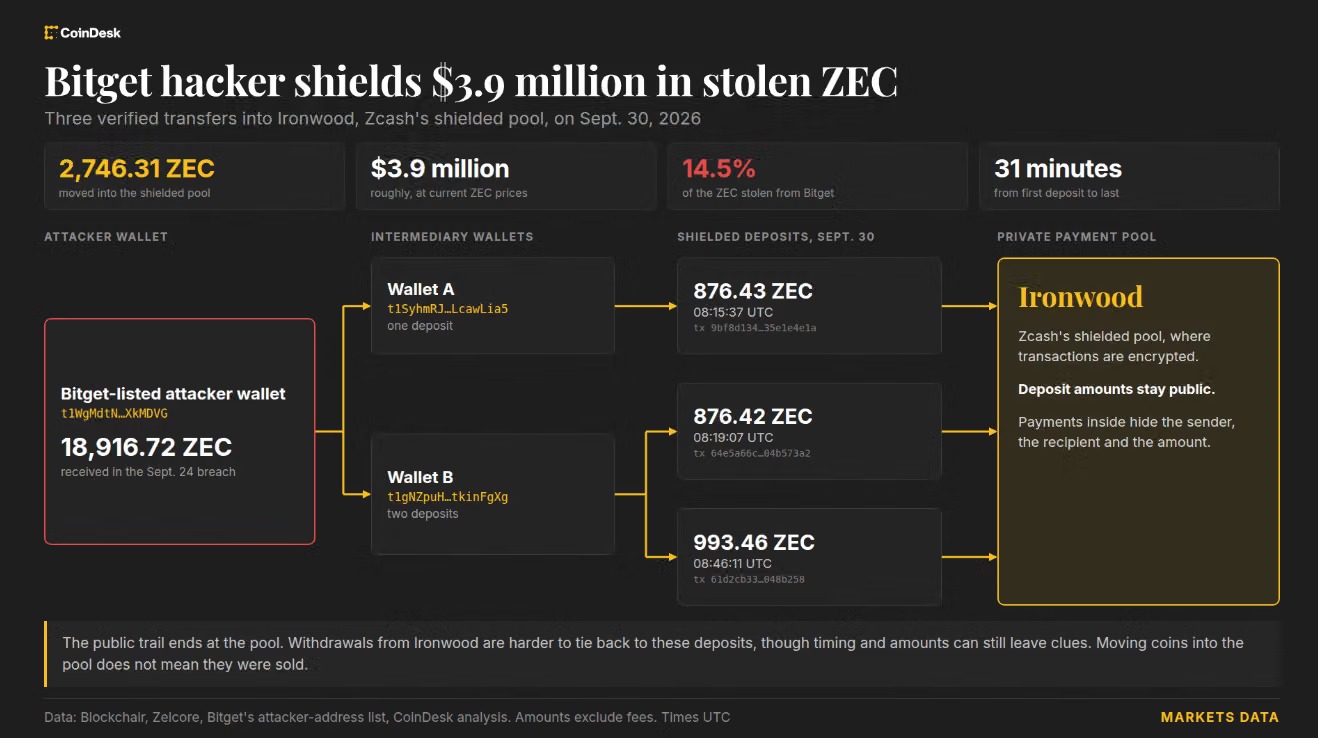
Bitget Hackers transferred approximately $4 million into a Zcash private pool, making it harder to track the funds
The wallet related to the $38.75 million hacker attack on Bitget transferred approximately $3.9 million of Zcash into the private payment system of that cryptocurrency, making it more difficult to track the stolen funds. On-chain records show that 2,746 ZEC were transferred in three batches on Wednesday into the Ironwood shielding pool of Zcash, accounting for about 15% of the ZEC that was stolen on September 24 due to the vulnerability.
CoinDesk
·2026-09-30 19:15:20
11
Alibaba's AliExpress reported to be testing a Elite VIP membership system: Customers spending over $800 per year can receive an invitation and enjoy an additional 95% discount on their purchases
According to The Information, Alibaba's cross-border e-commerce platform AliExpress is testing a Elite VIP membership program, which is open to customers who spend over $800 per year. There is no additional membership fee, and the benefits include an extra 95% discount on certain products, 24/7 online customer service, and convenient return options. The program is currently being piloted in Australia, the UK, Germany, and Spain, and the platform also plans to expand it to more European markets, South Korea, and eventually the US market as well.
The Block
·2026-09-30 19:15:19
7
View More