














The European crypto exchange market entered a new phase on July 1st, marking the end of the EU MiCA transition period on that same day.
Under this framework, encryption asset service providers that rely on transitional arrangements must obtain MiCA authorization; otherwise, they will be required to cease providing related services.
ESMA has also warned unauthorized service providers to gradually withdraw from their EU operations, and reminded users that the protection provided by MiCA does not apply to unauthorized CASP.
This transition has reduced the number of platforms that can serve European customers under the new framework. Gate Europe cites CASP Tracker data which shows that as of September 28th, 84 out of the world's 100 largest exchanges did not hold MiCA authorization.
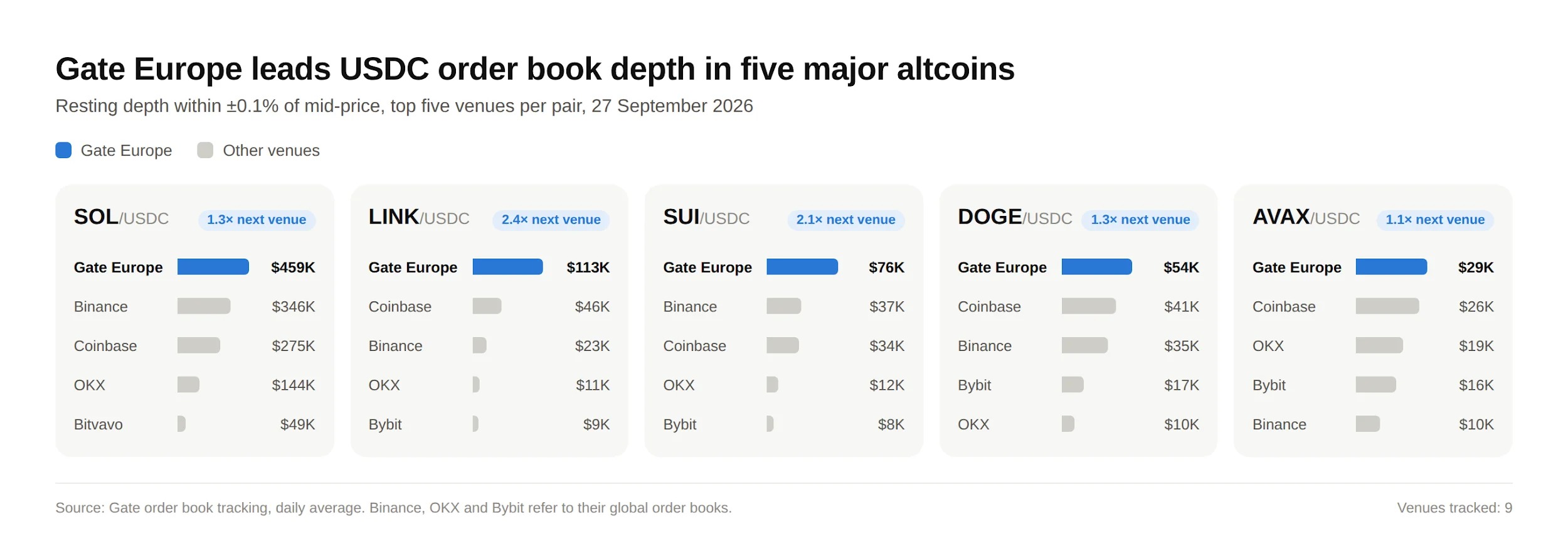
For exchanges that have already obtained authorization, regulatory barriers are increasingly becoming just another aspect of competition. Liquidity, transaction costs, tradable assets, and execution quality are becoming other factors that users consider when comparing licensed platforms.
Gate Europe is one of the platforms that obtained authorization before the deadline. The company stated that its European operations are carried out through Gate Technology Limited, which on September 29, 2025, received the MiCA authorization from the Malta Financial Services Authority. Subsequently, the services were extended to the European Economic Area.
As the European business of the global exchange Gate, which was established in 2013, Gate Europe entered the market at the end of the transition period already holding an existing MiCA authorization, rather than completing this process after the July deadline.
Gate Europe Expand the market and liquidity
Since the beginning of the final phase of the transition period, Gate Europe has expanded its asset coverage. The company stated that from June 16 to September 22, the platform added at least 68 new spot trading projects, bringing the total number of trading pairs to 382, covering approximately 190 different assets.
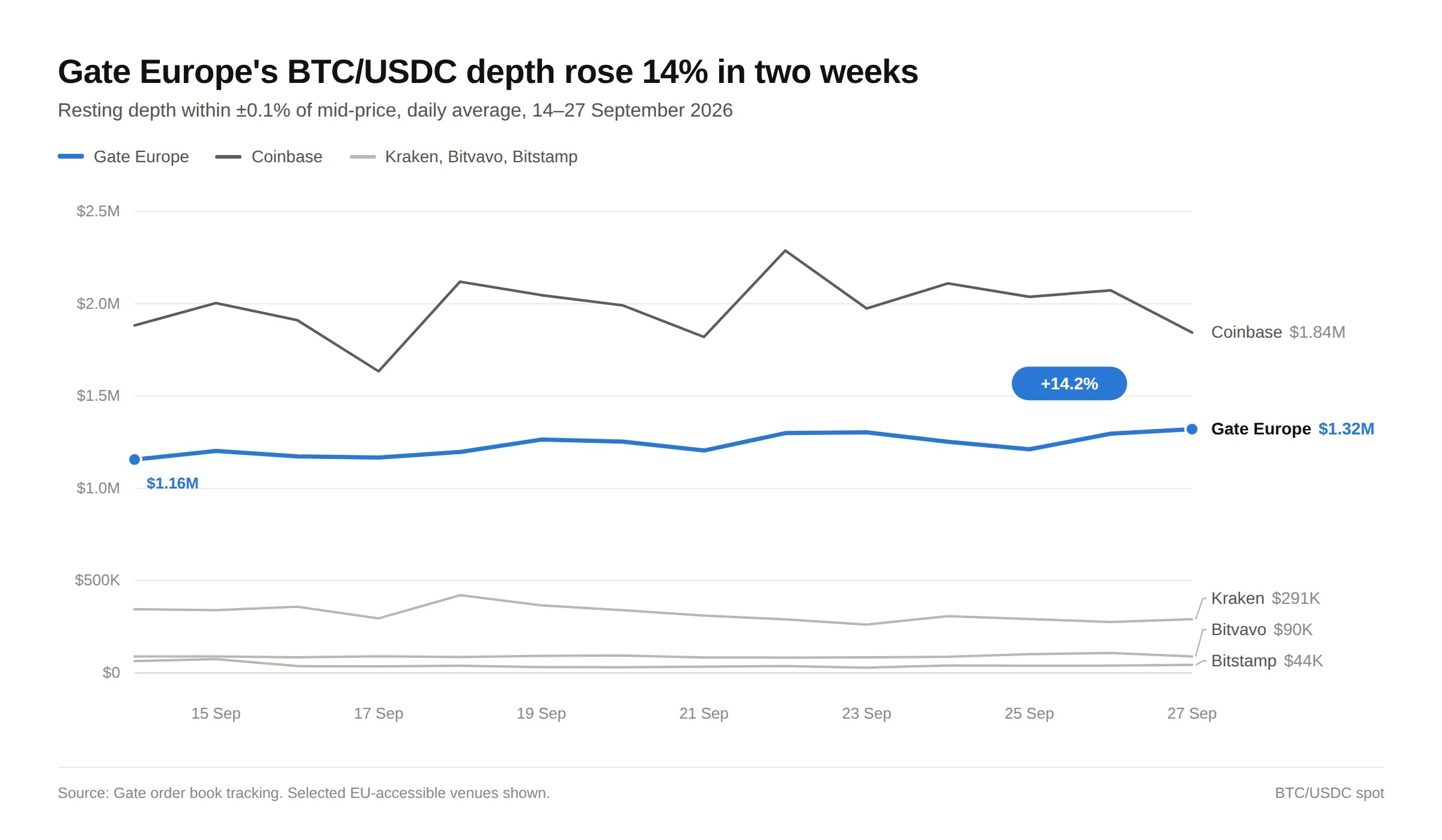
The exchange also reported that its USDC market has a deeper order book. According to the order book tracking data for Gate, from September 14 to September 27, the depth of BTC / USDC within a mid-price range of 0.1% increased by about 14%, to 1.32 million US dollars; the depth of ETH / USDC increased by about 12%, to 555,000 US dollars.
Independent market data cited by Gate shows that this platform is also one of the larger MiCA authorized trading venues, calculated based on spot liquidity. According to the DefiLlama MiCA exchange dashboard, at the referenced measurement point, the spot depth of Gate Europe within a 2% range of the mid-price was 15.9 million US dollars, while that of OKX EU was 13.6 million US dollars.
On September 15th, Gate Europe also completed the Level 1 assessment for PCI DSS and v4.0.1, covering services for Gate Connect and Gate Card. Level 1 is the highest assessment level in payment card security standards.
Gate Europe CEO Giovanni Cunti stated: "The deadline has not narrowed down the European market; instead, it has made it more concentrated. Users can now compare licensed platforms side by side based on independent data, and the platform that ultimately succeeds will be the one that performs better in execution."
Cunti says that in the environment following MiCA, liquidity, trading volume, market coverage, and fees will be among the factors that determine how exchanges compete.
However, not long after the deadline passed, it is still difficult to quantify the broader impacts of this transition. Nevertheless, this regulatory change has led to the formation of a more distinct group of authorized service providers competing for European users, and independent market data platforms have also provided increasingly direct comparisons of liquidity and trading conditions.
For those exchanges that were authorized earlier, the next stage is no longer primarily about entering the European market, but rather about retaining and expanding their user base through trading conditions, asset coverage, and infrastructure.