














Research institution Citrini Research believes that tokenization is opening up an important new market for the crypto industry, and companies and protocols that can charge fees from transactions, lending, and payments may benefit even more than Bitcoin or Ethereum.

The institution named Securitize, Coinbase, Robinhood, and Circle as those who may benefit from Wall Street's migration of financial assets to blockchain; in addition, Figure, SoFi, and Bullish have also been included in the list of potential beneficiaries.
Citrini is even more optimistic about the prospects of encrypted tokens, with a focus on projects such as Aerodrome, Maple, Ondo, Pendle, and Derive. At the same time, they warn that the growth in blockchain activities does not always translate into higher token prices.
According to this renowned research institution, Wall Street's shift towards blockchain technology could open up a vast new market for the crypto industry. However, investors who have bet on tokenization may find that there are better options beyond Bitcoin at $81,681.90 and Ethereum at $2,459.70.
In a 79-page report titled “Breaking the Wall”, the institution stated on Thursday that moving stocks, bonds, and other financial assets onto blockchain could create new businesses such as trading, lending, and payments.
Tokenization transforms traditional assets into digital tokens that can be transferred between financial platforms and may be traded around the clock. For example, a tokenized stock can be used directly as collateral for loans, borrowed from investors' digital wallets without going through traditional brokers.
The report suggests that this flexibility will open up new markets for trading platforms, lending institutions, stablecoin issuers, and companies responsible for recording securities ownership. It is stated that the biggest winners could be those companies and crypto projects that charge fees from these activities.
The report states: "We cannot assume that the major currencies, mainly BTC and ETH, will reach new highs as a result." The report refers to reaching historical highs. "Even if they do reach new highs, there are better ways to express that."
Bet on tokenized stock targets
In search of opportunities, Citrini proposed two sets of investment portfolios; one focuses on listed stocks, and the other on cryptocurrency tokens.
The report pays particular attention to those companies that are expected to earn fees as more Wall Street businesses move onto the blockchain.
The report mentioned the tokenization company Securitize ( SECZ ), which is responsible for maintaining the legal connection between blockchain tokens and the securities they represent.
Cryptocurrency exchanges Coinbase ( COIN ) and digital brokerage firms Robinhood ( HOOD ) can gain exposure through their trading platforms and blockchain infrastructure; reports indicate that stablecoin issuers Circle ( CRCL ) may benefit from increased demand for their USDC stablecoins, as USDC can be used for transaction settlement.
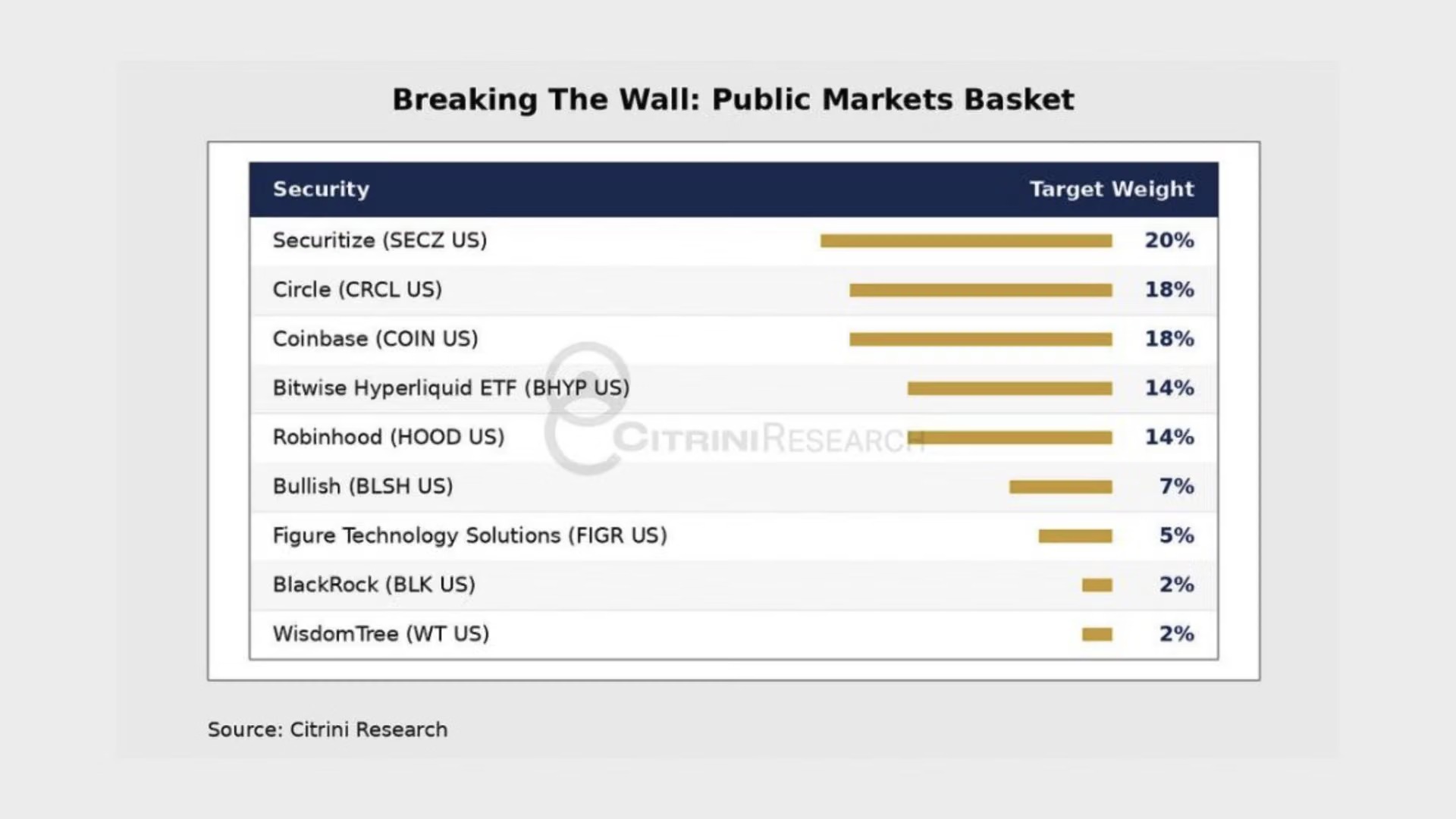
Citrini also mentioned Figure Technology Solutions ( FIGR ), believing that it could benefit from tokenized lending; SoFi ( SOFI ) might benefit from stablecoin payments; the institution-oriented digital asset exchange operator Bullish ( BLSH ) was also included in the list. Bullish is the parent company of CoinDesk and is acquiring the stock registration institution Equiniti.
Tokenized Cryptocurrencies Driven by Tokenization
Citrini indicates that it is 'actually more interested' in another set of encrypted token baskets, as this group of assets provides a broader exposure compared to a limited number of listed companies.
The report states: "If our judgment is correct, stocks, commodities, and other financial assets are being moved onto the blockchain, then all financial products built around these assets should ultimately follow suit."
The analysis highlighted Aerodrome ( AERO ), which is a trading platform that can charge fees from tokenized stock transactions; it also mentioned Maple ( SYRUP at $0.2335), a project that manages blockchain-based lending products for institutional investors.
The report also includes Pendle ( PENDLE ), which allows investors to trade the future earnings of interest-bearing assets; Ondo Finance ( ONDO at $0.4948) offers tokenized U.S. Treasury bonds and stock products, and has recently expanded to include perpetual contracts. Aave ( AAVE at $165.32) provides lending infrastructure, Uniswap ( UNI ) offers a decentralized trading market, while the cryptocurrency protocol Ethena ( ENA ) issues stablecoins and has recently expanded into digital finance, combining high-yield savings, card, and payment functions.
The encryption token basket of Citrini also includes ether.fi ( ETHFI ), which is used for encrypted native financial services; Chainlink ( LINK at $12.52), which is used for market data; and LayerZero ( ZRO at $2.0134), which is used to connect different blockchains. The report states that as tokenized assets spread across financial platforms and blockchain networks, all three of these could benefit.
The report also mentioned Derive ($0.3615 for DRV), which is a decentralized options trading protocol; it could benefit if tokenized stocks and other financial assets lead to more on-chain derivatives transactions.
The report also mentioned the emerging perpetual contract trading venues Lighter ( LIT ) and Variational ( VAR ). Perpetual contracts, also known as perps, are a type of contract that allows traders to bet on the rise or fall of prices without holding the underlying asset, and unlike traditional futures, they have no expiration date. Citrini indicates that Hyperliquid ( HYPE ) has become the dominant platform for trading perpetual contracts on the blockchain, and as the perpetual contract market expands further, these two challenger platforms may gain attention alongside Hyperliquid. The report also included exposure to Hyperliquid in stock baskets through Bitwise Hyperliquid ETF ( BHYP ).
However, the Citrini report also reminds us that an increase in trading volume and network activity does not always translate into higher token prices. Investors need to pay attention to how the protocol generates revenue, who collects the fees, and whether token holders can get a share of that revenue.
The report also points out that liquidity is dispersed across multiple competing blockchains, security risks may slow down the adoption rate, and synthetic tokenized stocks face legal obstacles – although such products allow investors to gain exposure to stock prices, they do not grant them the voting rights or direct ownership associated with traditional stocks.