












The annualized revenue of OpenAI is far lower than the figures previously circulated in the market, triggering a large-scale sell-off of AI concept stocks. The NASDAQ index closed down more than 1% on that day, and investors' judgment of the continued strong demand for AI is facing a severe test.
On October 8th, the British newspaper The Financial Times reported that OpenAI indicated in its latest investor document that its annualized revenue as of the end of September was “nearly $50 billion,” which is significantly lower than the $70 billion forecast widely cited by the market at the end of last month.
In response to the annualized revenue data disclosed by The Financial Times, CNBC also verified the information with relevant parties and confirmed the accuracy of that data.
The report indicates that the magnitude of this gap is so large that it “is very likely to dampen the market's optimism regarding the growing demand for AI.” Following the announcement of the news, U.S. tech stocks tumbled significantly on that day, with the Nasdaq index closing down 1.4%.
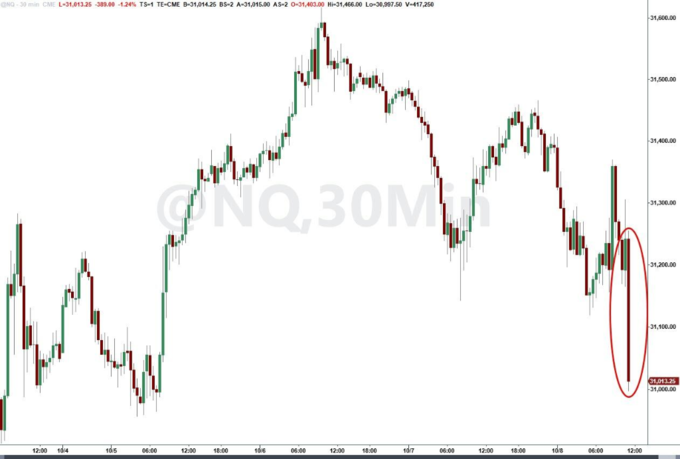
The AI sector experienced a significant decline. NVIDIA fell by about 3% on that day, Oracle dropped by more than 5.5%, while AMD, Broadcom, Intel, and Supermicro all saw declines ranging from 4% to 6%.
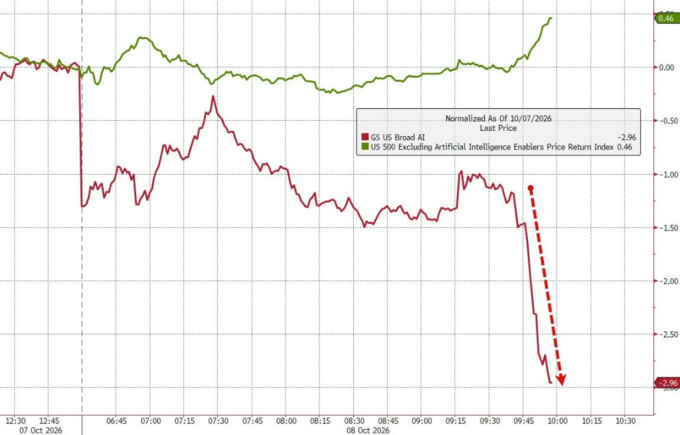
Data center stocks and optical interconnection stocks also tumbled significantly. Cloud service stocks Nebius and CoreWeave both fell by more than 7%, optical interconnection stocks related to optoelectronics plummeted by 13%, and Coherent fell by 7%.
The impact of this revenue shortfall on the market lies not only in the numbers themselves but also in the fact that it has shaken the core logic behind the narrative of AI's massive capital expenditures, namely whether the demand from AI end-users is truly so strong. More importantly, this expectation gap occurs against the backdrop of continuously declining Token costs.
The discrepancies in figures stem from differences in reporting methods.
On October 8th, media cited sources familiar with the matter as stating that the significant discrepancy in revenue figures is due to the fact that OpenAI and its competitor Anthropic used different methodologies when calculating annualized revenue.
Anthropic includes in its annual revenue statistics the income generated through cloud partner channels such as Amazon AWS and Google Cloud, which is referred to as the 'total revenue' figure; whereas OpenAI only counts its own directly generated revenue in its annual revenue figures, without including sales from partner channels.
It is reported that in order to make a horizontal comparison between the two companies, investors of OpenAI attempted to "restore the data to its original format" for OpenAI, which led to the figure of approximately $70 billion that was previously circulated.
However, it was only after the latest official investor briefing by OpenAI that market participants realized that the figures previously widely cited were significantly misleading.
Reports indicate that the latest documents from OpenAI show that at the end of July, the company's annualized revenue was approximately $30 billion, rather than the previously reported $40 billion; however, the company also demonstrated strong growth, with overall operating revenue in the third quarter increasing by 77% year-on-year, and corporate business growing by 107% year-on-year.
OpenAI refuses to comment. As a private company, it is not obligated to disclose financial data regularly to the public.
Valuation pressure surges, the prospects for IPO darken
This correction to the revenue data occurs during the most critical period for building market value for OpenAI, making the timing particularly sensitive.
OpenAI is currently in talks with investors for a new round of financing, which could set the company's valuation at around $1.4 trillion. There have also been reports previously that the company intends to raise about $30 billion, but the relevant terms have not yet been finalized.
Just in March of this year, OpenAI completed a historic round of financing amounting to $122 billion. Last week, the company's Chief Financial Officer, Sarah Friar, stated that the company is "well-capitalized."
However, OpenAI is expected to incur a cumulative loss of approximately $280 billion by 2030, while its valuation is as high as $852 billion. How to prove its growth trajectory to investors is a core issue that the company must face.
OpenAI secretly submitted an application to regulatory authorities for IPO in June of this year, and there is a general expectation in the outside world that it will be officially listed in 2027. CEO Sam Altman stated in September that "now is not a wise time to list," one of the reasons being the ongoing controversies regarding the security of AI.
The company has recently announced a suspension of the release plans for its GPT-6.1 and Astra models, as these models failed to meet internal security standards.
Anthropic is also under pressure, while the large model AI and IPO narrative as a whole have encountered a cooling trend.
In sharp contrast to OpenAI, Anthropic disclosed in August that its annualized revenue operating rate had reached $65 billion by the end of July. At that time, external valuations for it were as high as $2 trillion, and the company was actively engaging with potential investors in preparation for IPO.
However, on Tuesday this week, the independent financial research institution New Constructs released a report in which it directly referred to Anthropic's proposed listing as "the most absurd IPO of 2026," stating that the company's actual value is only about $150 billion.
According to the prospectus, Anthropic had revenue of $4.6 billion in 2025, with a net loss of up to $42 billion during the same period.
The revenue data of OpenAI and Anthropic has been closely examined, reflecting the market's deep-seated concerns about the commercialization process of the entire large model sector.
The UK's Financial Times pointed out that the annualized revenue figures of these two companies are regarded as the most important single indicator for measuring global demand for AI. They directly support a large number of infrastructure investment decisions related to AI and the valuation logic of the public stock market.
When there is such a significant gap in core data, the pressure for market re-pricing will inevitably be transmitted throughout the entire industrial chain.