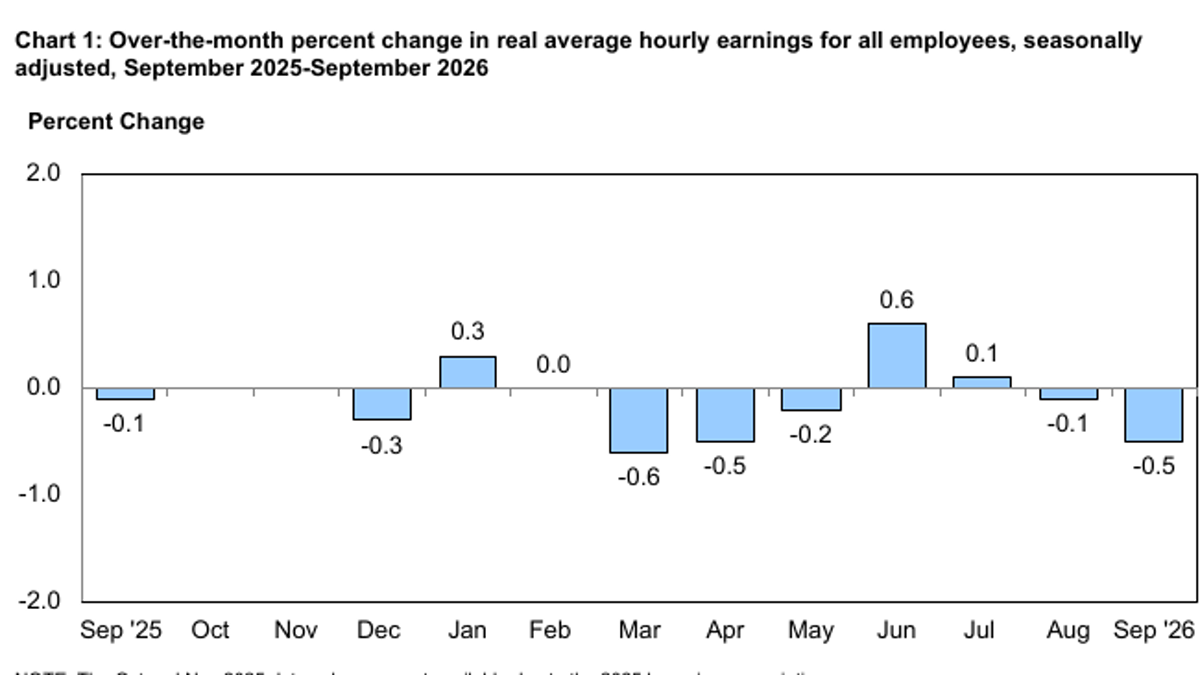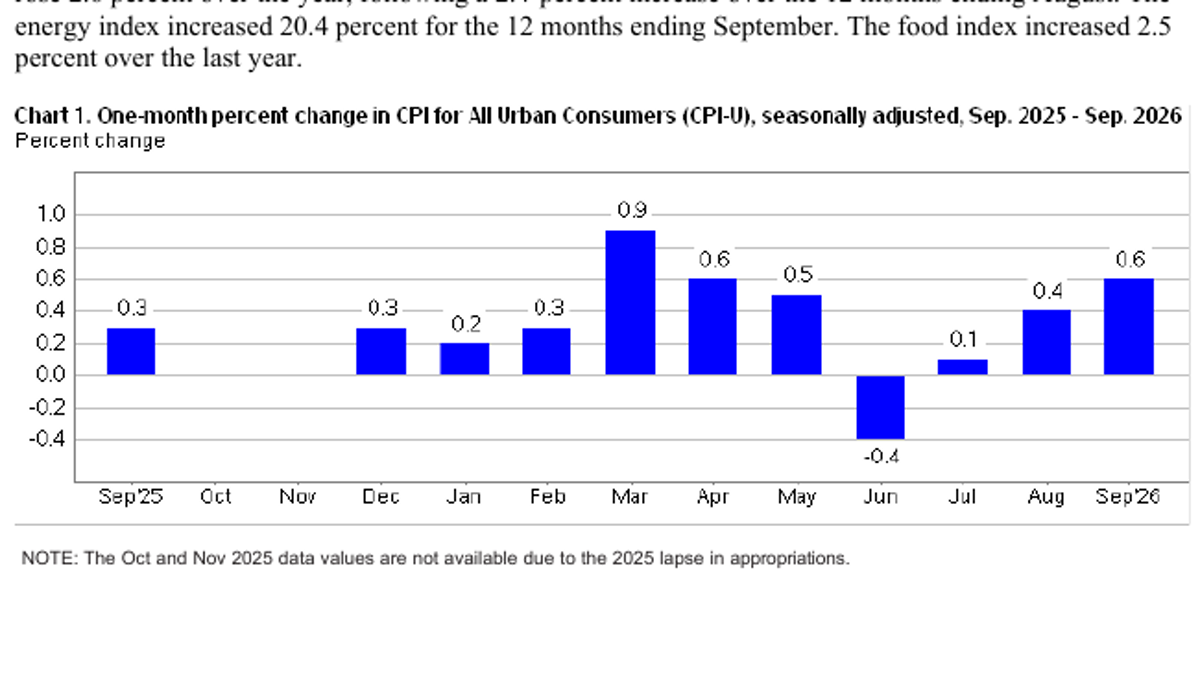


An increase in the numbers on a pay slip does not mean that one can buy more with that money. On October 14th, the U.S. Bureau of Labor Statistics released its report on actual income for September: after seasonal adjustment, the actual average hourly wage for all private non-farm employees decreased by 0.5% month-over-month. In the same month, the nominal average hourly wage rose by 0.1%, and the Consumer Price Index increased by 0.6%. Income has not disappeared from the books; rather, purchasing power has been eroded by faster-rising prices. This report is related to another release on the same day CPI, but it discusses a different topic: it is not another piece of “inflation news,” but rather the results of wage and working hours adjustments for inflation.
The actual average weekly salary also decreased by 0.5% on a month-over-month basis, due to a decline in the actual hourly wage while the average working week duration remained unchanged. It is important to present both the hourly wage and the weekly salary together: even if the purchasing power per hour decreases, an increase in working hours could still result in varying degrees of change to weekly income; however, this buffering effect was not observed in September. The year-over-year results of this report were also weak: from September 2025 to September 2026, the actual average hourly wage for all employees decreased by 0.7%, while the average working week duration increased by 0.6%, leading to a 0.1% decrease in the actual average weekly salary. If these figures are mixed together, it can easily lead to the misconception that the hourly wage and weekly salary must change by the same amount.
Wages increase by 0.1%, prices rise by 0.6%, how is the difference reflected in purchasing power?
Actual income can be understood as the purchasing power after removing the impact of prices from nominal income. If wage growth is slower than inflation, the same amount of money can buy fewer goods and services. In reports, a quick approximation is often made by subtracting inflation from the nominal wage increase; in this case, 0.1% minus 0.6% results in approximately -0.5%. Official statistics, however, are still calculated based on price indices and seasonal adjustments, and it is not appropriate to mechanically subtract these figures for all months. This does not mean that every worker’s wage has decreased by 0.5%, as the survey provides an average value, and factors such as industry, working hours, bonuses, and individual consumption baskets can vary.
Of particular note are the changes in the composition of "average" salaries. Increases or decreases in certain high-paying positions can alter the overall average salary, but they may not necessarily reflect changes in the wages of the original positions; moreover, fluctuations in the employment structure from month to month can also make the indicators appear better or worse. The income data from the Bureau of Labor Statistics comes from employer surveys, not from individual accounts that track the same employee on a monthly basis. Therefore, it is beyond the scope of this report to determine that every employee in a particular industry is experiencing the same level of pressure, or to infer what changes have occurred in family savings based on this data.
The report also provides separate figures for production and non-managerial employees. In this group, the nominal average hourly wage increased by 0.2% in September, but the corresponding CPI-W increased by 0.7%, while the actual average hourly wage decreased by 0.6% on a month-over-month basis. The actual average weekly wage also decreased by 0.5% on a month-over-month basis, again against the backdrop of unchanged average working hours. Year-over-year, the actual average hourly wage decreased by 0.6%, and with an increase of 0.3% in average working hours, the actual average weekly wage decreased by 0.3%. Separating the two sets of figures for “all employees” and “production and non-managerial employees” helps to reveal the sensitivity of different groups to price shocks; they cannot be considered completely substitutable sequences.
A one-month decline in purchasing power does not represent the annual income outlook.
Actual wage indicators are often used to determine whether consumption can be sustained, but they are not an immediate predictor of consumer spending. Families can draw on savings, change the timing of their purchases, or adjust their mix of goods; in addition to wages, there are also sources of income such as property gains, transfer payments, and changes in tax burdens. Conversely, some families may feel greater pressure even if their wages temporarily keep up with inflation due to concentrated increases in housing, insurance, or energy costs. The greater the difference between the average price basket and the actual expenses of individual families, the more the macro-level "real hourly wage" deviates from what individuals perceive.
The actual hourly wage in September declined, which is related to the significant increase in gasoline prices that month. However, this decline cannot be entirely attributed to a single impact from gas stations. The CPI-U overall index rose by 0.6% month-on-month, and this report uses it to adjust the nominal hourly wages of all employees; for production and non-managerial employees, the CPI-W index is used, which saw a 0.7% increase in September. Different price indices have different consumption weights and cover different populations, which is one of the statistical reasons for the slight differences in the actual income results between the two groups. If the denominator is ignored, readers might mistakenly assume that the changes in nominal wages for these two types of employees are in opposite directions.
A monthly report is most suitable for highlighting risks, rather than replacing trend analysis. In the coming months, if price increases slow down and nominal wage growth is maintained, real purchasing power may improve; however, if energy pressures continue to spread, it will be more difficult to restore purchasing power. These are all conditional statements, and the data from September cannot confirm these predictions in advance. It is important to pay attention to subsequent data on prices, employment, working hours, and consumption to avoid making assertions that the economy has entered a recession or that household demand will immediately collapse based on just one negative figure.
For businesses, this report also highlights the gap between “salary increases” and the actual benefits perceived by employees. If the nominal salary budget is fixed annually, short-term fluctuations in prices can change its actual value; however, business operating costs are also affected by energy, financing, and supply and demand, so it is not straightforward to determine how all employers should set salaries. For readers, a more important method of judgment is to keep track of salary, working hours, and major personal expenses separately. Official data from September confirms only one trend: average salaries have increased slightly nominally, but have actually decreased after adjusting for inflation. Understanding this difference is more useful than just focusing on the positive figure on the pay slip.
A decrease in actual income cannot be confused with 'wage arrears.' The former refers to a statistical change in the purchasing power of money, while the latter is a legal and contractual issue regarding whether employers pay as agreed. The report does not investigate whether individuals receive their wages on time, nor can it be used to evaluate the compensation practices of a particular company. Clearly defining the subject of the indicators is the first step in avoiding macro data from misleading micro-level judgments.