According to a senior wealth management executive at Goldman Sachs, the era in which wealthy families viewed purchasing a sports team as an "enthusiastic project" has come to an end.
Pullen Ross contributed to the creation of " Playing for Scale ". This is the second edition of a sports investment report released by their team, and it marks the first update since 2024's " Getting in the Game ". The report is aimed at Goldman Sachs' private wealth clients. The core argument of the report is that the way in which people acquire team ownership has changed. Nowadays, institutional investors have become a significant force in driving up valuations, while wealthy individuals are entering this market through smaller stakeholdings, loans, and various structures that banks can assist in arranging.
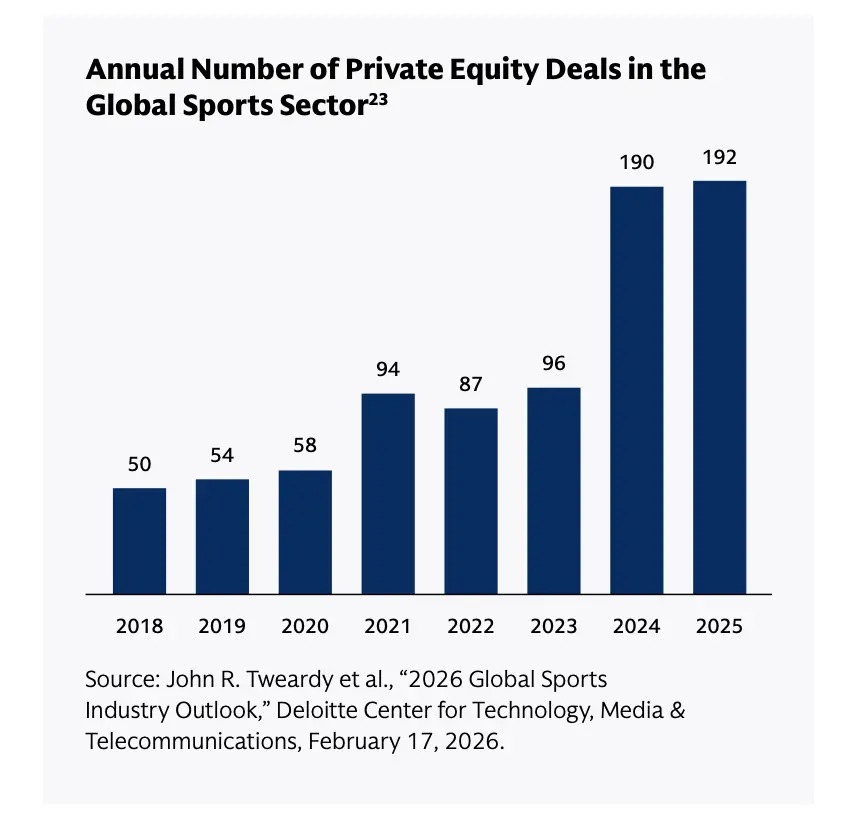
The report states that institutional funds have driven most of these changes. Private equity transactions in the sports sector have increased from 50 in 2018 to 192 in 2025. The report writes that institutional capital “has begun to squeeze high-net-worth individuals out of the controlling ownership market.” The NFL was the last major professional league in the United States to allow such funds to enter, and it opened up to them in 2024. The Pullen Ross indicates that currently, 74 teams in North America have private equity or institutional capital on their shareholder lists, and with team valuations reaching “quite astonishing levels,” institutional capital “is filling this gap in a meaningful way.”
Detailed Rules Restrictions
Funds enter the market under strict conditions. NFL requires them to purchase at least 3% of the shares in a team, with a holding period of 6 years, and the managed capital must reach $2 billion; at the same time, the capital contribution of any one team must not exceed 20% of the fund's total capital. The report states that after Arctos Partners purchased 8% of the shares in the Los Angeles Lightning team, the team's valuation rose from $5.8 billion to $8.6 billion the following year. Pullen Ross indicates that institutional funds "give some investors more confidence, believing that growth will be managed in a professional manner," and also make future exits more likely to be realized.
However, wealthy individuals are not completely excluded. The report states that the controlling shareholders of NFL are selling minority stakes to funds and “traditional high-net-worth individuals.” The Philadelphia Eagles recently sold 8% of their shares for a valuation of $8.3 billion. The report suggests that such transactions may reduce the discount on the rights of secondary limited partners in history, which typically range from 10% to 40%.
Pullen Ross indicates that most investors will need 'multiple methods to obtain exposure', including institutional capital as well as 'innovative financing' provided by Goldman Sachs' private banking division. The report describes two loans arranged by the team owner, and clearly notes that both are merely examples. The first loan is secured by current assets and equity in entities that hold real estate, and indirectly relies on the value of the team; the second loan is partly guaranteed by shares held by a private equity management company, while also including negative pledge clauses for the owner's equity in the team, meaning the owner agrees not to pledge that equity to anyone else.
These are all loans provided by Goldman Sachs, and the related reports are written for customers who may use these loans. Goldman Sachs also provides advisory services for sports transactions and sells wealth management services to the same group of customers. The reports state that its advisors do not refer customers to lenders that are not affiliated with Goldman Sachs. The same disclosures also mention that advisors may receive internal recognition for loan referrals, which could affect their compensation.
Even for institutions, the entry requirements are very strict. An institutional investor who was interviewed for the report stated that the demand for NFL is “far higher than the available supply.” The report suggests that the alliance is likely to expand the range of existing approved investors before admitting new institutions.
Under this round of valuation growth, a core question arises: will young fans continue to pay for sports? The report mentions a "fragmented media environment" and "an increasingly short attention span," stating that short-video social content has now become the main method to reach young audiences. Team owners' responses include athlete-centered documentaries, a 365-day content calendar, low-cost standing tickets, and subscription-based virtual reality services for watching live matches. When asked if young fans might drift away, Pullen Ross mentioned these strategies but did not provide data on engagement levels. When directly asked if young people are less interested in sports, she still described the same strategies. "Baseball has been working hard to solve this problem for quite some time now," she said.
"The Disney of the sports world"
Pullen Ross indicates that she really likes this idea and extends it to Disney, saying, "Part of it lies in the experience, in the personalized experience." She said that the team is trying to replicate that level of operational excellence to make fans feel "special, seen, and attracted." She called this analogy "a goal worth pursuing."
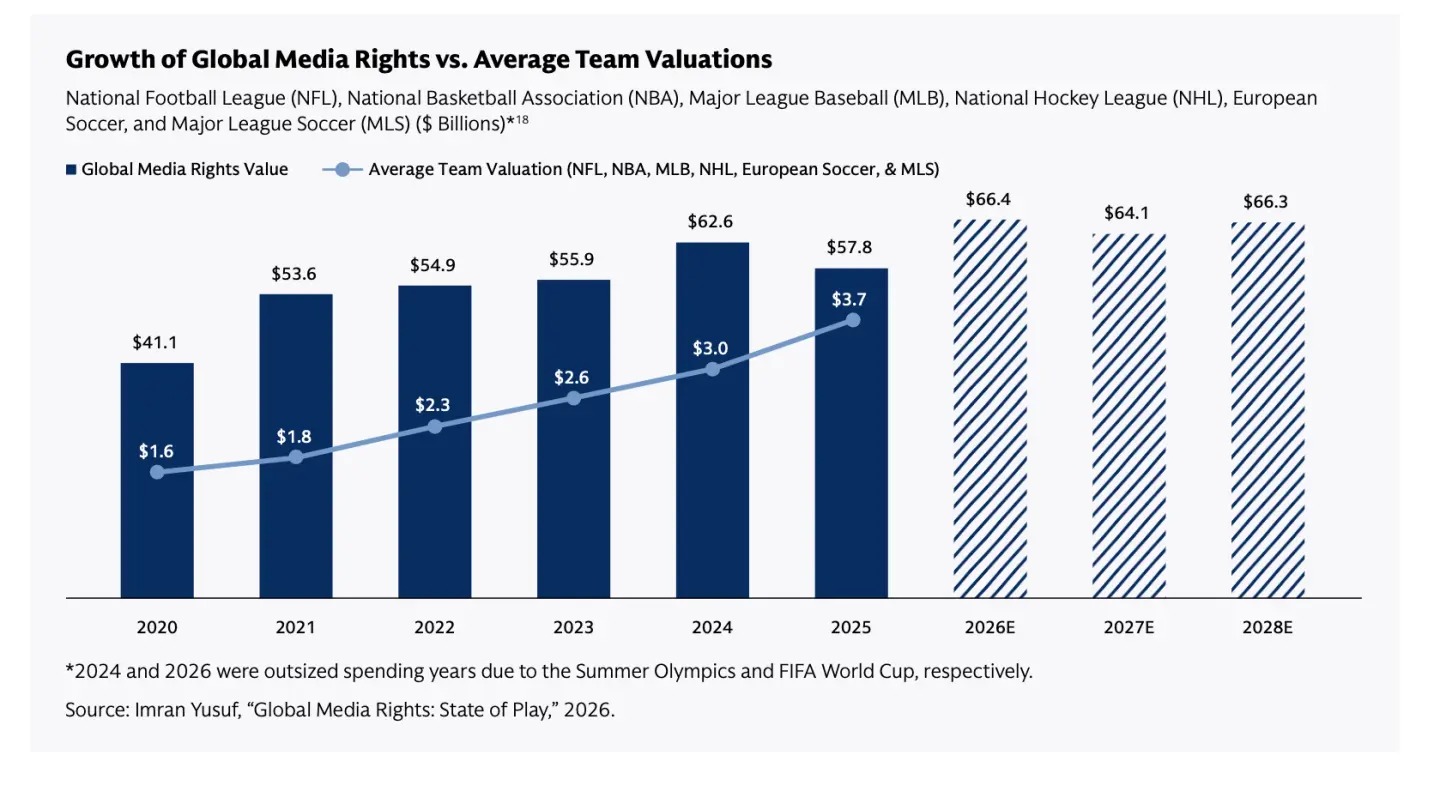
The valuation logic is based on media rights. The report estimates that the scale of media rights will reach $66.4 billion by 2026, and this figure is linked to the exceptional spending years brought about by the World Cup. Subsequently, media rights revenue is expected to drop to $64.1 billion in 2027. Pullen Ross states that this decline is “to some extent already predetermined by the contracts,” and describes 2028 as being roughly flat. Between 2020 and 2025, media rights grew by 41%; the report indicates that streaming platforms currently account for about 20% of the market, up from 8% in 2021. Therefore, these forecasts depend not only on the timing of contract signings but also on fan demand.
Women's Sports: The same pressure, at an earlier stage
Women's sports are also following the same path. The global women's sports market is expected to reach $3.04 billion by 2026, up from $690 million in 2022, with WNBA and NWSL contributing nearly two-thirds of that figure. The average valuation of WNBA teams is $414 million, an increase of 52% within one year; the average valuation of NWSL teams is $200 million, up 49%. New media rights agreements are worth an average of $200 million per year, which is four times that of the previous agreement. Golden State Valkyries generated over $78 million in revenue during its first season in 2025, exceeding the revenue of more than half of the teams in MLS.
Pullen Ross indicates that institutional funds are bringing the discipline that women's teams have lacked in the past to this market. She said that these businesses did not have 'the same level of professionalism' as men's sports in the past, and many projects were initially driven by family-level enthusiasm. The report states that active investors 'often give up opportunities with less well-structured operational plans.' A WNBA team owner described this change as 'disciplined capital allocation.' In women's sports, the proportion of commercial sponsorship revenue decreased from 64% in 2022 to 45% in 2026, while the proportion of revenue on matchdays increased from 11% to 30%.
Real estate is the next obstacle. None of the WNBA teams have their own home arenas for matchdays, and reports indicate that building such an arena is a project that can take up to 10 years or even longer, and it is likely to rely on public-private partnerships. In an interview, the Atlanta Dream team's plan to move from an arena with a capacity of 3,500 seats to the Hawks' arena, which has a capacity of about 17,000 seats, was cited as an example.
There is still a significant gap among the audiences. Pullen Ross indicates that more than 50 WNBA matches have attracted 1 million viewers, while some of the most watched men's matches have reached around 20 million viewers. “Over time, this becomes a rather large gap that needs to be bridged,” she said. She also added that, compared to mature markets, women's sports are “more like the early stages of competitions.”
Pullen Ross indicates that the next frontier area is college sports, which investors are closely monitoring. NCAA agreed to pay $2.8 billion in retroactive compensation to athletes as part of a settlement in 2025. Nowadays, college sports departments are also utilizing external capital: Otro Capital invested $500 million in a newly established business entity Crimson Brand Partners at the University of Utah. Reports suggest that such structures are expected to spread and may create opportunities for high-net-worth individuals to participate as limited partners.
Generative artificial intelligence was used in the research, assistance, and/or transcription process of this article. Reporters conducted independent interviews and verifications of the factual statements in this article, which were also reviewed by human editors before publication.