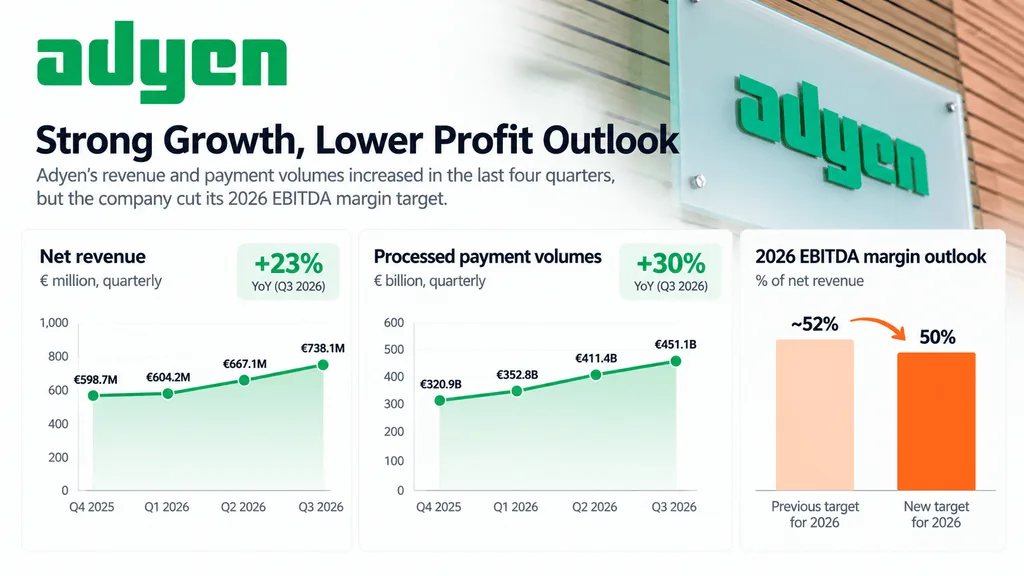
Adyen's stock price fell due to the company unexpectedly lowering its EBITDA profit margin target for 2026 from around 52% to 50%, and also withdrawing its longer-term profit targets.
According to the third-quarter business update officially released by Adyen, net revenue increased by 23% year-on-year to 738.1 million euros, exceeding the market forecast of 730.3 million euros. The volume of payment transactions processed also increased by 30% to 451.1 million euros, which also surpassed expectations.
Lower profit margin prospects drag down the stock price of Adyen
The revised outlook reflected in Adyen indicates that the company plans to accelerate its investment in employees, software, and the recently acquired businesses.
The company expects its EBITDA profit margin this year to be 50%, which is lower than the previous forecast of around 52%. The company has also abandoned its goal of raising the profit margin to over 55% by 2028.
Management stated that this adjustment will provide greater flexibility for expanding their payment, billing, loyalty, and financial product services.
However, investors reacted negatively to the loss of long-term profit visibility. Reuters reported that the stock's decline for the year has expanded to about 40%.
AI Billing and acquisitions drive up the costs of Adyen
The investment strategies of Adyen are increasingly surpassing traditional payment processing services.
The company recently acquired Talon.One and Orb, expanding its capabilities in customer loyalty management and billing software, including products that provide services to companies that charge customers based on the usage of the AI model.
Co-CEO Ingo Uytdehaage told Reuters that the growing demand for billing services is driving the company to hire more employees. Adyen expects to add around 1,000 to 1,100 new employees by 2026.
The company currently serves large enterprises such as Microsoft and LVMH, and is also expanding its cooperation with GetYourGuide, Toast, and other international merchants.
The revenue of its Platforms department increased by 46%, significantly outperforming the overall business. The revenue of Unified Commerce increased by 29%, and the revenue of Digital increased by 16%.
As fintech companies compete to offer more services that go beyond traditional transactions, this expansion is taking place.
For example, Stripe's interest in PayPal earlier this year indicates the pressure for integration around mature payment service providers.
Why Investors Question the Valuation of Fintech
Adyen maintains its revenue growth forecast for 2026 at a fixed exchange rate of 21% to 23%, and expects capital expenditures to remain at around 7% of net revenue.
However, the company will not provide its new financial targets for 2027 until February, which means that investors will not be able to see its previous interim profit benchmarks for the time being.
The broader payment industry is facing increasing competition from traditional fintech providers and blockchain-based settlement infrastructure.
The continuously expanding stablecoin strategy of Visa and the development of OpenUSD indicate that mature companies are exploring alternative payment networks.
Emir Abyazov
Editor-in-Chief Coinpaper, responsible for driving data-driven editorial operations, content discovery guided by SEO, and storytelling tailored to the audience, covering the fields of cryptocurrencies, AI, and fintech.