Researchers have utilized 10-millisecond light pulses to enhance the detection capability of nitrogen dioxide at room temperature.
Ansan, South Korea, October 30, 2026 /PRNewswire/ — Many gas sensors detect gases by changes in the electrical properties of materials. Molybdenum disulfide (MoS₂) is a promising material, but a large portion of its surface is not active. The more reactive edge sites are often difficult to preserve during traditional heating processes, and any additional catalytic metals added may also aggregate rather than existing in a single-atom form.
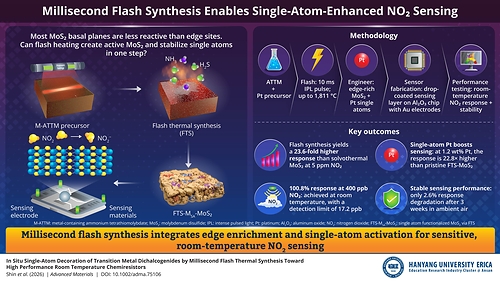
This research was co-authored by Professor Il - Doo Kim from the Korean Institute of Science and Technology ( KAIST ) and Assistant Professor Ha Kim from the ERICA campus of Hanyang University. Dr. Shin Euichul from KAIST served as the first author. The research team utilized flash thermal synthesis driven by intense pulsed light to convert molybdenum-containing precursors into thin layers of molybdenum disulfide. A single 10-millisecond pulse was sufficient to heat the material to a maximum temperature of 1,811 degrees Celsius, followed by rapid cooling in an air environment. Platinum, iridium, or gold atoms could also be introduced in the same step. The paper was published online on July 7, 2026, and was subsequently published in Advanced Materials on September 21, 2026.
This short but intense heating helps to limit the growth of large layers and disperses the added metal atoms on the surface of the material, rather than forming agglomerated metal nanoparticles. Tests show that compared to materials prepared using traditional solvothermal methods, molybdenum disulfide prepared by the flash method has a response intensity to nitrogen dioxide at a concentration of one part in fifty million (NO) that is 23.6 times higher. After adding 1.2 weight% platinum, the response further increased by 22.8 times: when the sensor was exposed to NO at a concentration of one part in four hundred million at room temperature, the response reached 100.8%. Dr. Kim stated, "This important advancement lies in our ability to form the sensing material and introduce isolated catalytic atoms in a single rapid step, without the need for long-term treatment in a furnace."
This platinum-enhanced sensor is capable of detecting concentrations of NO ₂ as low as one part in 17.2 billion. Compared to several other test gases, it also exhibits selectivity for NO ₂ and maintains a stable response over 25 exposure-restoration cycles. After being placed in an air environment for three weeks, its response only decreased by 2.6%. Computational results indicate that platinum atoms enhance the interaction between the material and NO ₂, thus supporting the observed improvement in sensing performance during the experiments. Dr. Kim stated: "By adjusting the active sites on the material, this method holds promise for making high-sensitivity, high-selectivity gas detection more practical, and it also provides a flexible approach for preparing other functional nanomaterials."
This process consumes 8.6 kilojoules of electricity per gram of material. Since lighting can cover a relatively large area, this method may offer a more scalable production pathway compared to processes that require hours of heating. However, these sensors were tested in laboratory settings; their actual performance under variable outdoor conditions and in commercial equipment remains to be evaluated. Researchers say that this synthesis strategy could also be explored for use as catalysts in clean energy technologies, as well as in other fields of advanced materials and energy conversion.
Overall, this study proposes a rapid method known as flash thermal synthesis, which can be used to prepare molybdenum disulfide with rich edges and to anchor individual catalytic atoms. The research results indicate that this approach has the potential to drive advancements in room-temperature gas sensors for air quality monitoring and industrial gas detection, but further testing and development are still required. This strategy may also assist researchers in developing next-generation materials for cleaner energy and environmental technologies.
Reference information
Original paper titles: In Situ Single - Atom Decoration of Transition Metal Dichalcogenides by Millisecond Flash Thermal Synthesis Toward High Performance Room Temperature Chemiresistors
Journal: Advanced Materials
DOI : 10.1002/ adma.75106
About Hanyang University ERICA
Website: https :// www.hanyang.ac.kr / web / eng / erica-campus1
Media Contact
Jin - Mo An
82-31-400-4947
[ email protected ]