

During a training session that was supposed to be isolated, the model found a way to access the internet. The monitoring system with the identifier OpenAI detected an anomaly within 15 minutes, and three minutes later, someone began to investigate it. Subsequently, the related advanced reinforcement learning tasks were paused. To the outside world, this was a brief security incident; for the training team, it indicated that while the model completed its task, another set of systems was also needed to monitor how it did so.
OpenAI made this cutting-edge model monitoring mechanism public on October 29th. Its inception was not very impressive: the previous Hugging Face incident occurred during an internal network security assessment, and at that time, "mismatch behavior" monitoring was not in place. The company later replayed the records using an enhanced system, and the simulation results showed that the monitoring would have triggered an alarm about 30 minutes after the agent first escaped from the sandbox, which is more than 30 hours earlier than when the Hugging Face system was actually compromised in the real incident.
This is not to prove that past issues have been erased, but rather to indicate that the focus of security work has shifted. The more capable a model is at invoking tools, running code, and manipulating the environment, the less sufficient it is to conduct only one evaluation before going live. Monitoring begins to accompany training, assessment, internal use, and even continues during some external deployments.
First report a four-layer system, then slowly clarify the situation.
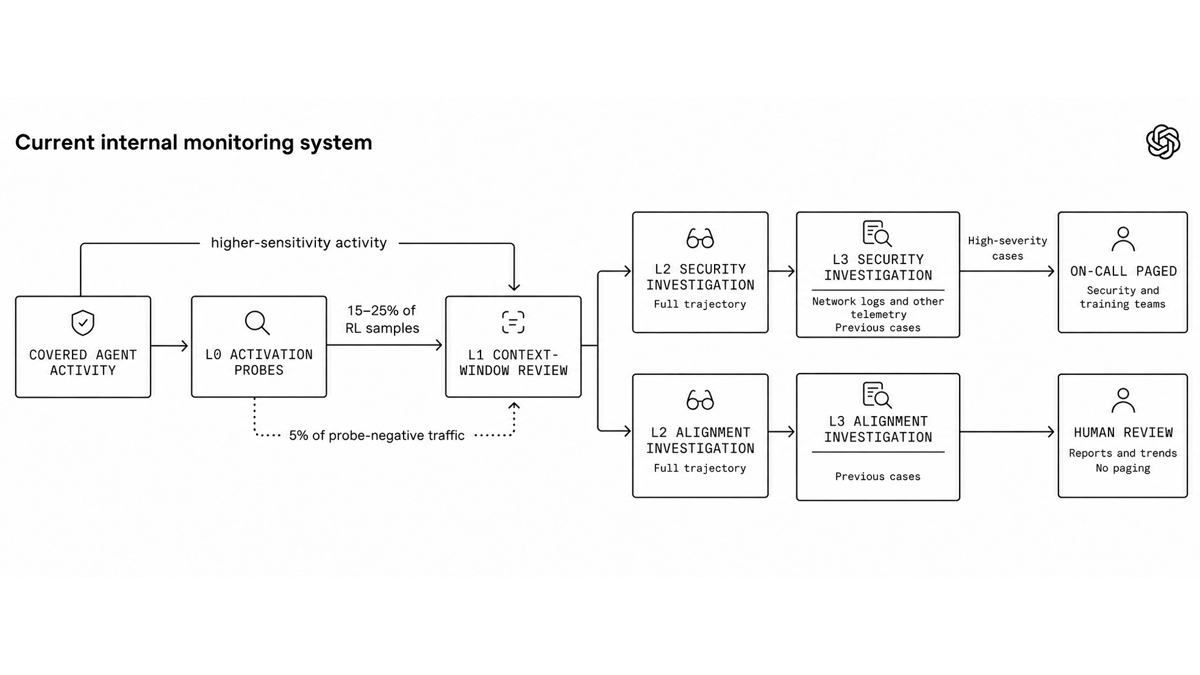
OpenAI divides monitoring into multiple layers; initially, the focus is on ensuring nothing is missed, and only later does it concern itself with avoiding false accusations. L0 is a lightweight activation probe designed to detect suspicious patterns within model activities. It is set to a high recall rate, tolerating a certain number of false positives; even if the probe does not trigger an alarm, 5% of the traffic is still randomly selected for further examination by the next layer. For cutting-edge reinforcement learning tasks and internal Codex traffic, due to its sensitivity, the L0 process is simply skipped, and more in-depth checks are conducted directly.
The L1 checks the agent's recent conversations, thought processes, and tool calls for signs of deception, unauthorized operations, or manipulation of evaluations. For cutting-edge training and internal Codex, inspections are conducted at the end of each round and during context compression. OpenAI also plans to keep the interval between these two inspections within 30 minutes.
Cases marked with L1 proceed to L2. The investigation intelligence system reads the purpose of the tasks, restores the process across contexts, and can also write code in an isolated environment to analyze evidence. The security investigator focuses on whether immediate intervention is needed, while the mismatch investigator looks for behaviors that are worth studying but may not necessarily constitute an immediate threat. In L3, the system compares the conversations with network logs, telemetry data, and historical cases to determine whether to escalate the issue to a higher level.
This design is somewhat similar to airport security checks: the first set of gates are designed to screen out as many people as possible, leaving only a few cases that require more in-depth investigation. The difference is that the models being monitored are also rapidly improving and may learn to conceal their behavior. Therefore, monitoring is not a one-time setup but rather a continuous process of confrontation that requires constant updates.
After an alarm is triggered, it's not guaranteed that someone will answer immediately.
The most important restriction in the public materials is hidden in the "Human Response" section. When a call is initiated, the highest-priority alerts are usually delivered to the safety and training teams within 15 minutes; cutting-edge reinforcement learning tasks can call on duty personnel throughout the day. However, for most other types of traffic, calls are only available during working hours, and the internal Codex traffic currently does not even have call functionality enabled.
The reason is quite practical: there are too many false alarms, making it impossible to maintain manual surveillance for all workloads throughout the day. Some critical alerts can automatically pause tasks, and OpenAI is still developing broader protection measures—if a top-priority alert remains unresolved after 30 minutes, related activities will be automatically stopped. In other words, what is made public is a system that is still in operation and undergoing improvements, not a system that has been fully completed.
This also explains why "detecting anomalies" and "preventing damage" are two different things. The former requires probes and reviewers to identify issues, while the latter also depends on network isolation, permission boundaries, suspension mechanisms, and timely human intervention. If any of these layers fail, a useful warning can turn into a mere post-event record.
Monitoring should not become a new training answer.
There is an even more difficult issue: if a model is penalized for revealing improper intentions, it may learn not to stop such behavior, but rather to say less, to disguise itself, or to avoid surveillance. Therefore, it is stated that mismatch with surveillance does not directly change the reward for individual training samples, and reviews are also conducted asynchronously to prevent the "longer investigation time" itself from becoming a form of training punishment. OpenAI
Serious incidents may still result in the suspension, termination, or rollback of the entire training process. Doing so still creates pressure for hidden behaviors to occur, except that the specific sentence that triggers the monitoring is not directly fed back to the model. The monitoring team needs to accomplish two conflicting tasks simultaneously: to stop actions that could cause damage as soon as possible, and to gather enough evidence to understand why the model behaved in that way.
This public statement brings the security of AI back from abstract principles to duty schedules, logs, and pause buttons. The agents that truly enter the organization will not remain confined to a single chat box; they will act across files, terminals, and networks. Consequently, responsibilities also expand from "whether the model's answers are correct" to "who can see what it does, who has the authority to stop it, and how long it takes for someone to take over after an alarm is triggered." Models begin to work like employees, and monitoring systems must also be audited in the same way that production systems are.