

Global stock markets continued to slump amid regulatory panic during AI. Affected by the victory of the Democratic Party in the U.S. elections and market concerns that the tech and artificial intelligence industries will face stricter regulation, Asia-Pacific stock markets saw an intensification of declines on Friday. Japan's benchmark index recorded its largest one-day drop in over a year, and South Korea's stock market temporarily triggered its circuit breaker mechanism.
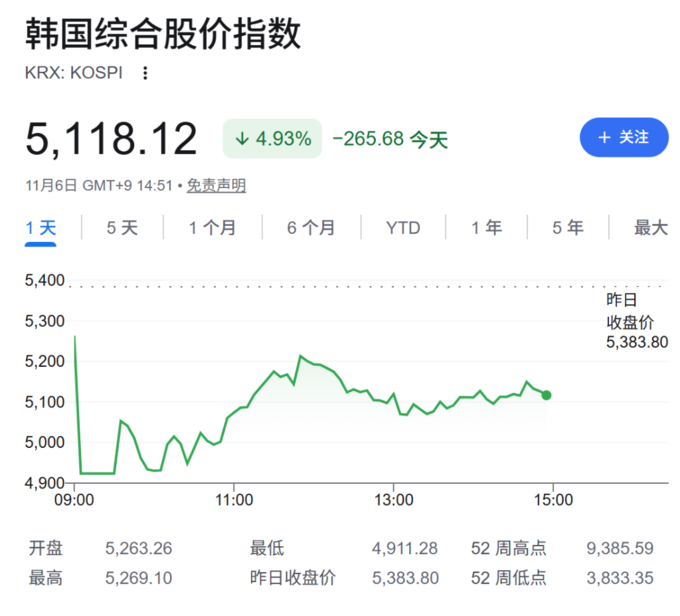
MSCI The Asia-Pacific index tumbled 3.8%, with the Nikkei 225 index closing down 5.96% at 57,434.77 points. South Korea's KOSPI index fell 6.02% to 5,059.65 points; China's Taiwan Weighted Index dropped 4.5%, retracing more than 20% from its October high and entering a technical bear market. Boosted by the recovery of U.S. stock futures and South Korean authorities' announcement of market rescue measures, the MSCI Asia-Pacific index later narrowed some of its losses, with NASDAQ 100 index futures rising 0.8%. European stocks opened lower collectively, with the Euro Stoxx 50 index falling 1.1%, Germany's DAX index dropping 1.3%, and the UK FTSE 100 index falling 1.2%.
This round of decline continues from the dismal performance of U.S. stocks on Thursday. The S&P 500 index tumbled 4.4% on Thursday, recording the largest single-day drop since the tariff shocks in April 2025; the Nasdaq 100 index plummeted 6.4%, with a single-day market value erosion of up to $2.3 trillion. The Philadelphia Semiconductor Index has fallen by nearly 16% this week, and is expected to record its worst weekly performance since April last year.
Before the U.S. stock market opened, most of the star tech stocks rebounded: NVIDIA rose nearly 3%, Micron Technology rose more than 5%, and Intel rose more than 3%, while Marvell Technology rose more than 6%.
The Nikkei 225 index closed down 5.96% at 57,434.77 points. South Korea's KOSPI index fell 6.02% to 5,059.65 points. The Taiwan Stock Exchange's weighted stock price index declined 4.5% to 39,701.64 points, marking a 20% drop from its October 6 high and entering a technical bear market.
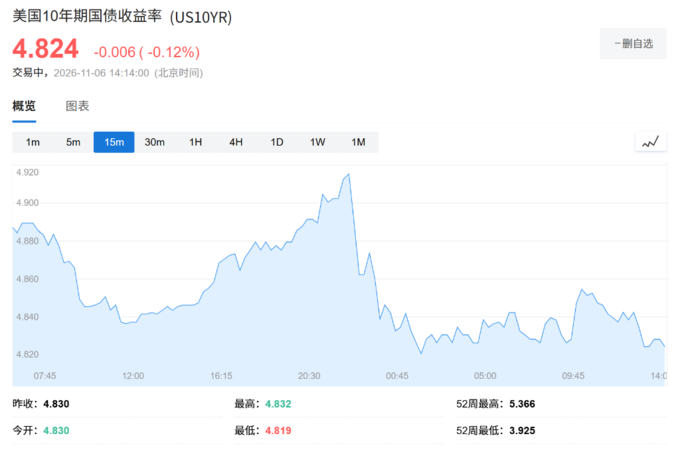
The U.S. dollar spot index rose by 0.1%. The yield on 10-year U.S. Treasury bonds remained relatively unchanged at 4.83%. The yield on 10-year Japanese Treasury bonds fell by 16 basis points to 2.610%. Spot gold declined by 1.1% to $4,043.02 per ounce. After a 3.9% increase on the previous trading day, Brent crude oil further rose by 1.4% on Friday to $99.70 per barrel. Bitcoin fell by 0.2% to $75,616.34.
The Democratic Party's victory in the general election reignites concerns about AI regulation
This week, global financial markets experienced severe turmoil, with the trigger being the Democratic Party's sweeping victory in the U.S. mid-term elections. Investors initially bet that a Democratic win would accelerate the end of the Iran war, but this optimistic sentiment was quickly overshadowed by concerns about tighter regulation of the data center industry.
At the state level, the newly elected Democratic Governor of Texas, Gina Hinojosa, has called for an immediate suspension of the state's data center project, putting local developers in a difficult situation. Combined with similar statements from newly elected Democratic governors in other states, the proposed AI data center expansion plan across the United States is facing stricter scrutiny and resistance.
According to data from market intelligence firm Cleanview, in states where approximately 40% of the planned data center capacity in the United States is intended to be built, the newly elected governors have all pledged to halt or postpone such construction.
NVIDIA, Qualcomm, and Arm Holdings were among the stocks with the largest declines in this round of a 12% slump in the Philadelphia Semiconductor Index. The MSCI Asia-Pacific Index tumbled 3.8%, and the Nikkei 225 Index fell 5.8%, recording the largest single-day decline since April 2025. South Korea's Composite Stock Price Index plummeted by 8.8% at one point, triggering a circuit breaker, with Samsung Electronics and SK Hynix both losing more than 5%.
South Korean authorities take urgent measures to stabilize the market
In response to the sharp decline in the stock market, Asian regulatory authorities took measures one after another on Friday.
According to a joint statement by the South Korean government, South Korea will temporarily exempt brokers from the requirement to maintain at least 140% collateral for margin loans, with the aim of preventing forced liquidations from further exacerbating market volatility.
Bloomberg strategist David Savage pointed out that the significant decline in Taiwan stocks on Friday echoed the heavy losses in South Korea. TSMC had previously provided relative support for China's Taiwan benchmark index due to its extensive presence in the AI supply chain, but as TSMC's intraday decline widened to around 5%, this key support is beginning to weaken.
Market Disagreement: Is the AI trend coming to an end, or is it just a short-term correction?
There are differing opinions among market participants regarding the nature of this round of decline.
"It's currently difficult to determine whether this marks the end of the AI market trend – the key is whether the decline is merely due to deteriorating investor sentiment or whether it truly leads to a decline in corporate profits," said Kazuki Sawamura, a strategist at a Tokyo Shinkin Asset Management. "Once the negative factors are fully released, there is a possibility of a short-term sharp rebound."
Lombard Odier Asia's Chief Investment Officer, John Woods, stated in an interview with Bloomberg TV that the AI narrative is not yet over. He also noted that some members of the Democratic Party have begun to moderate their statements regarding the suspension of the construction of the Texas data center. Woods believes that the significant correction in the prices of stocks related to this AI is more of a correction driven by position adjustments, rather than a sign of deteriorating market fundamentals.
Moomoo Market strategists, on the other hand, are more cautious about the rebound in U.S. stock futures, believing that it "seems more like a bottom-fishing and covering of short positions rather than a fundamental shift in sentiment." They point out that the more critical issue is whether the massive investment in AI infrastructure will ultimately translate into the profits and cash flows that investors expect.
Hedge fund losses exacerbate market unease
The recent market turmoil has dealt a heavy blow to many hedge funds, further deepening the sense of unease in the market.
It is reported that after experiencing its worst monthly performance since March 2020, Walleye Capital is returning some funds to investors. The macro fund Kirkoswald Asset Management under Greg Coffey recorded the largest single-month decline in its history. One of Europe's fastest-growing credit funds, Arini Capital Management, lost over 12% just last month. The quantitative hedge fund Engineers Gate also parted ways this week with the team responsible for managing its large portfolio of assets.
Non-farm data becomes the next focus, and the Fed's policy path is under close attention.
At a macro level, investors are turning their attention to the U.S. non-farm payroll report released on Friday evening in search of more clues regarding the Federal Reserve's interest rate path.
Bloomberg Economic Research expects non-farm employment to increase moderately by 26,000, with the unemployment rate expected to remain around 4.18%. Bloomberg economists such as Anna Wong pointed out in their research report that these figures are not sufficient to cause the Federal Reserve to deviate from its established path of raising interest rates in December.
In addition, U.S. Treasury bonds continued their upward trend from Thursday, with the dollar strengthening against all G10 currencies. After a 3.9% surge on the previous trading day, Brent crude oil rose another 1.4% on Friday to reach $99.70 per barrel.