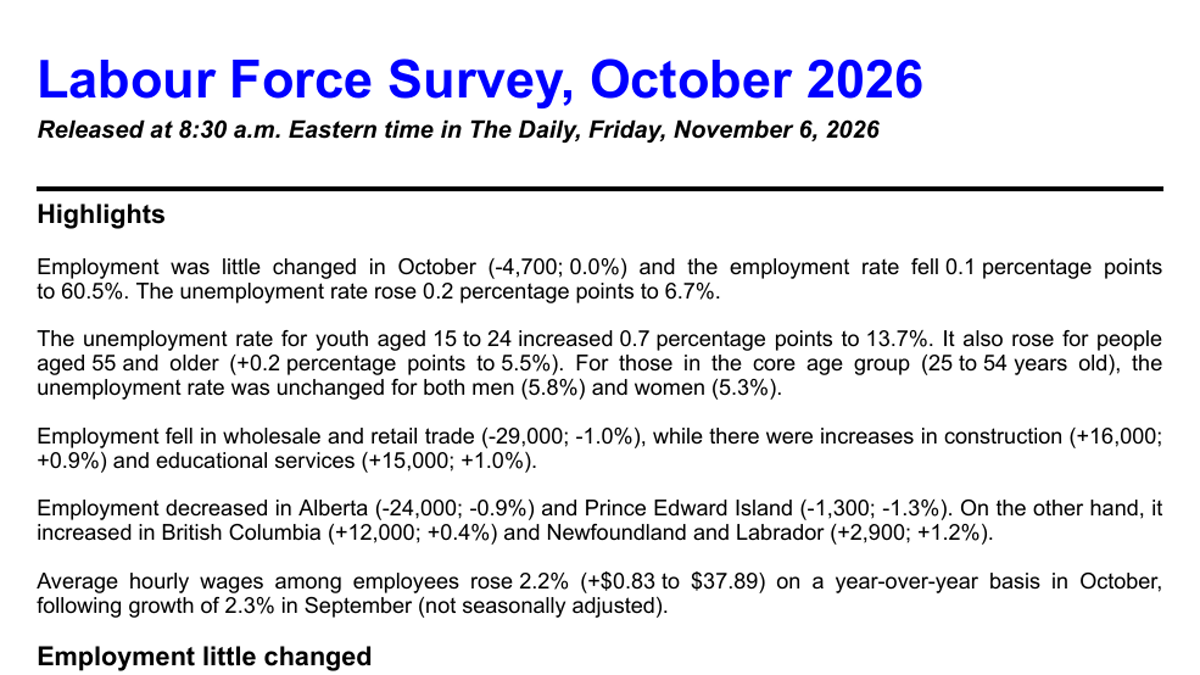


In October, the number of employed people in Canada decreased by 4,700, which is virtually insignificant in statistical terms, yet the unemployment rate rose by 0.2 percentage points to 6.7%. In the same report, the construction and education services sectors saw an increase in jobs, while wholesale and retail saw a noticeable decline; the public sector added 50,000 jobs, while the private sector lost 53,000. The labor force survey released by Statistics Canada on November 6 depicts not just a simple "deterioration in employment," but rather a rebalancing driven by a combination of population changes, job-seeking behavior, and job structure.
The rise in unemployment rates is due to more people starting to look for jobs.
The unemployment rate measures the proportion of people who are actively looking for work but do not have a job in the labor force. In October, the number of unemployed increased by 33,000, representing a 2.2% rise, partly due to more people joining the job-seeking ranks. Employment has not decreased significantly, but as the number of people looking for work has increased, both the denominator and numerator have changed, leading to an increase in the unemployment rate. This is not the same phenomenon as 'large-scale layoffs by companies in that month.'
The Bureau of Statistics also provides two additional indicators that better describe the difficulty of finding a job. Among the unemployed in September, only 18.9% found employment in October, which is lower than the average of 24.6% during the same period from 2017 to 2019; among approximately 1.5 million unemployed individuals, 23.7% have been looking for work for at least 27 weeks, up from 21.5% a year ago. These figures indicate that the pace of job transition is slowing down. The rise in unemployment rates is not merely due to changes in statistical methods but also reflects the reality that job seekers are staying in the unemployed category for longer periods.
The private and public sectors are moving in opposite directions.
In October, the number of employees in the private sector decreased by 53,000, marking the first decline since February; meanwhile, the public sector added 50,000 employees, ending a trend of a cumulative decrease of 148,000 over the previous four months. These changes almost canceled each other out, making the overall employment situation seem stable. However, if one only looks at the total numbers, they will miss the shift in employment risks from "whether there are jobs available" to "who provides those jobs."
The industry also shows differentiation. There is a decrease of 29,000 people in wholesale and retail, while construction has seen an increase of 16,000 people, and education services have seen an increase of 15,000 people. Retail is more closely related to household consumption, construction is affected by interest rates, housing, and project cycles, and education is often related to public budgets and semester arrangements. The opposite directions of these three sectors indicate that businesses have not reached a consensus on whether to expand or contract.
Young people face higher entry barriers.
The unemployment rate among youths aged 15 to 24 has risen by 0.7 percentage points to 13.7%, while the employment rate is at 54%. Young people typically have less work experience, and their jobs are concentrated in retail and service industries, making them more vulnerable to recruitment freezes. When overall employment is stable, companies can control costs by reducing entry-level positions, delaying recruitment, or raising requirements. These measures may not immediately result in large-scale layoffs, but they can first lead to a higher unemployment rate among young people.
Meanwhile, the unemployment rate for the core age group of 25 to 54 years old remains at 5.6%, while for those aged 55 and above, it is 5.5%. This age difference reminds policymakers that the same national unemployment rate may reflect very different situations. For recent graduates, finding their first job is the main concern; for middle-aged workers, salary and stable working hours are more crucial; for older workers, the cycle of job transitions and retirement options have a greater impact.
Wage growth has slowed down, but the pressure of living has not disappeared accordingly.
The average hourly wage increased by 2.2% year-on-year, reaching C$37.89, which is lower than the 2.3% increase in September. Wages are still rising, but not at a strong pace. What is more noteworthy is that 29.7% of Canadians over the age of 15 reported encountering difficulties with necessary expenses such as transportation, housing, food, and clothing in the past four weeks; this proportion is 2 percentage points higher than it was a year ago.
This means that the macro-level observation of "little change in employment" does not necessarily indicate stable family pressures. If wage growth slows down while housing and food expenses remain high, even if a person still has a job, they may feel a tightening of their budget. The labor force report, which puts family financial difficulties alongside employment data, serves as a reminder to the market that both the number of jobs, the quality of work, and disposable income need to be considered simultaneously.
Interest rate discussions will be even more contentious.
For the Bank of Canada, rising unemployment rates and modest wage growth support the view that demand is cooling down; however, the lack of a significant decline in employment, along with continued job creation in construction and education sectors, is not sufficient to indicate a rapid economic recession. Monetary policy is not faced with a single-directional signal, but rather a combination of weak growth, a differentiated labor force structure, and ongoing pressures on living costs.
The focus of the October data is not on the small figure of a 4,700 decrease in employment, but rather on the increase in job seekers, the decline in the probability of finding work, and the offset between private and public sector jobs. The rise in unemployment to 6.7% is not due to a sudden wave of layoffs, but rather to a narrowing of entry points into the labor market and an extended duration of staying in that market. What truly needs to be observed is whether these people waiting for employment will be absorbed by new job openings in the coming months.