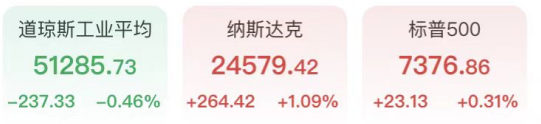
On Friday, tech stocks saw a rebound, with investors buying at lower levels after the Nasdaq index entered a correction zone due to selling pressure. By the close of trading, the Dow Jones Industrial Average fell by 237.33 points, or 0.46%, to 51,285.73; the Nasdaq index rebounded by 1.09% to 24,579.42; and the S&P 500 index rose by 0.31% to 7,376.86.
All three major stock indices fell this week: the Nasdaq index dropped by 3.4%, the S&P 500 index fell by 2.7%, while the Dow Jones index fared better, with a decline of 0.9%.
Popular Stocks Performance
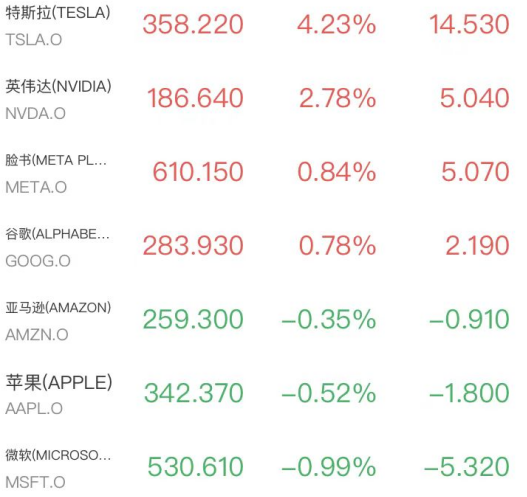
Star tech stocks showed mixed movements, with Tesla rising 4.23%, NVIDIA up 2.78%, while Amazon, Apple, and Microsoft closed lower.
The Philadelphia Semiconductor Index rose by 4.21%, AMD rose by 11.04%, and TSMC and Intel both gained more than 6%.
Storage chip market differentiation: Micron Technology rose by over 5%, SK SK Hynix and Sandisk rose by over 2%, while Seagate Technology and Western Digital fell by over 1%.
The optical communication sector strengthened, with Coherent surging by 13.58%, Lumentum rising by 5.67%, and Corning increasing by 2.61%.
The NASDAQ China Golden Dragon Index rose by 0.67%. Baidu increased by 3.01%, NetEase by 2.28%, JD.com and Alibaba by over 1%, while Pinduoduo fell by 1.10%.
Market Overview
In terms of economic data, the U.S. Bureau of Labor Statistics ( Bureau of Labor Statistics ) stated on Friday that non-farm employment increased by 165,000 in October, far exceeding the market's expectation of an increase of 70,000. The data for September was revised upward by 31,000 to 60,000, and the data for August was revised upward by 53,000 to 186,000. The unemployment rate fell by 0.1 percentage points month-on-month to 4.1%.
Thomas Feltemat, a senior economist at Dow Jones Economics ( TD Economics ), stated: "The report this morning indicates that the fundamentals of the labor market are slightly stronger than previously anticipated, which gives the Federal Reserve no reason to continue to wait and see."
Medium- and long-term U.S. Treasury yields have risen, with the two-year Treasury note, which is closely correlated with interest rate expectations, increasing by 3.7 basis points to 4.51%. The yield on the benchmark 10-year Treasury note soared by 3.2 basis points to 4.86%. According to data from the CME FedWatch tool, the market currently expects a 78% probability that the Federal Open Market Committee will raise the benchmark lending rate by 25 basis points in December, up from 67% on Thursday.
The Nasdaq Composite Index recorded its largest one-day decline in 19 months on Thursday, pushing the index into a correction zone and marking its fourth consecutive week of declines. On Thursday alone, the total market value of the "Big Seven" stocks decreased by $1 trillion. The selling pressure came after the Democratic Party's victory in the midterms, including in some key states for data centers, which sparked concerns that the construction of artificial intelligence data centers might slow down. Optimism about the rapid growth of this industry had driven the stock market to new highs this year.
Quilter Portfolio Manager Stuart Clark stated in an email comment: "The decline in some of the largest stocks in the market is quite astonishing. However, it also highlights the concentration risks that have accumulated in the U.S. stock market. Given that a relatively small number of tech and semiconductor stocks currently account for such a large weight, the weakness of these stocks will soon translate into a significant drop in the NASDAQ and S&P 500 markets."
Keith Lerner, the Chief Investment Officer of Truist Consulting Services, stated: "We still believe that artificial intelligence is the dominant theme of this bull market. We still assume that technology is innocent." He believes that the sell-off this week may provide many investors with a longer-term buying opportunity.
Regarding the situation in the Middle East, according to CCTV News, on November 6th local time, U.S. President Donald Trump stated that he was in communication with Iran. Additionally, Qatar's Prime Minister and Minister of Foreign Affairs, Mohammed bin Abdulrahman Al Thani, said during an event in Oxford, UK on the same day that the United States and Iran had not reached a "comprehensive agreement." He emphasized that both sides should accept a "good agreement" rather than pursuing a "perfect agreement."
Large-cap performance
Affected by market expectations regarding the prospects of the US-Iran war, the near-month contract of NYMEX crude oil for December delivery rose by 0.34% to $90.83 per barrel, and fell by 12.76% this week. The near-month contract of ICE Brent crude oil for January delivery rose by 0.03% to $98.32 per barrel, but fell by 13.32% this week, recording the largest decline since 2020.
The precious metals market weakened, with the November delivery of COMEX gold futures on the New York Mercantile Exchange falling by 0.93% to $4064.50 per ounce.