



















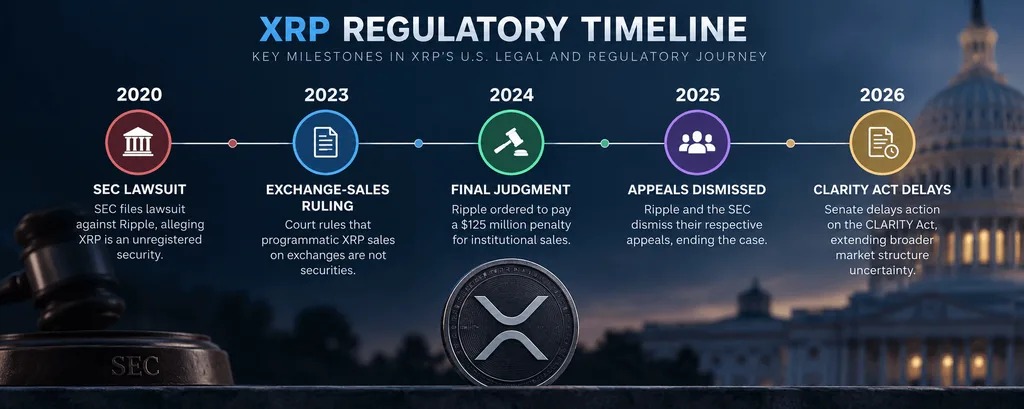
The advancement of the CLARITY bill in the U.S. Senate has been delayed again, but the market reaction to XRP has remained relatively calm. Foreign media believes that this is related to the fact that XRP has already gone through a round of key regulatory lawsuits. Compared to most tokens that are still waiting for a clear regulatory framework, XRP already has clearer judicial boundaries in the U.S. market.
Ripple The lawsuit has basically been settled.
The article states that the CLARITY legislation was originally intended to clarify the regulatory division of responsibilities between the U.S. Securities and Exchange Commission (SEC) and the Commodity Futures Trading Commission (CFTC) regarding digital assets, but the status of XRP is different from that of most crypto assets.
Ripple and the U.S. Securities and Exchange Commission withdrew their respective appeals in August 2025, marking the virtual conclusion of this case that began in 2020. The final judgment required Ripple to pay a fine of $125 million for its institutional XRP sales. An earlier court ruling determined that the programmed XRP sales within the exchange did not constitute the issuance of unregistered securities.
The article argues that this does not mean that XRP can be exempt from subsequent regulation, but it does indeed already have legal references that most other tokens do not yet possess. At least in the US market, some of the core disputes surrounding the sales methods of XRP have already had their boundaries defined by courts.
The progress of the Senate still affects the entire industry.
Nevertheless, the progress of the CLARITY legislation is still important, as it affects not only Ripple, but also the broader structure of the digital asset market.
A procedural vote originally scheduled for September 15 was considered an important milestone for the next phase. However, after several delays, the timeline for the bill has become even more uncertain. The article points out that if the Senate makes changes to the House version, the House will need to vote again before the bill can be sent to the President for signature.
With the November elections approaching, the legislative window is narrowing. This means that even though the market expects a more comprehensive federal regulatory framework, the related process may still continue to drag on.
Short-term fluctuations, or perhaps more, come from derivatives.
The article argues that for traders, the more immediate risk at present may not come from Washington, but rather from the leveraged positions themselves.
Data shows that the open interest of XRP futures contracts remains at around $3.15 billion, indicating that there are still large-scale speculative positions in the market. If these positions continue to concentrate on one side, price fluctuations may be further amplified.
In this context, the situation that XRP is currently facing is different from that in 2024 or early 2025. Back then, any new developments related to SEC could significantly change market expectations. In contrast, this delay in the CLARITY legislation does not have such a strong direct impact on XRP.